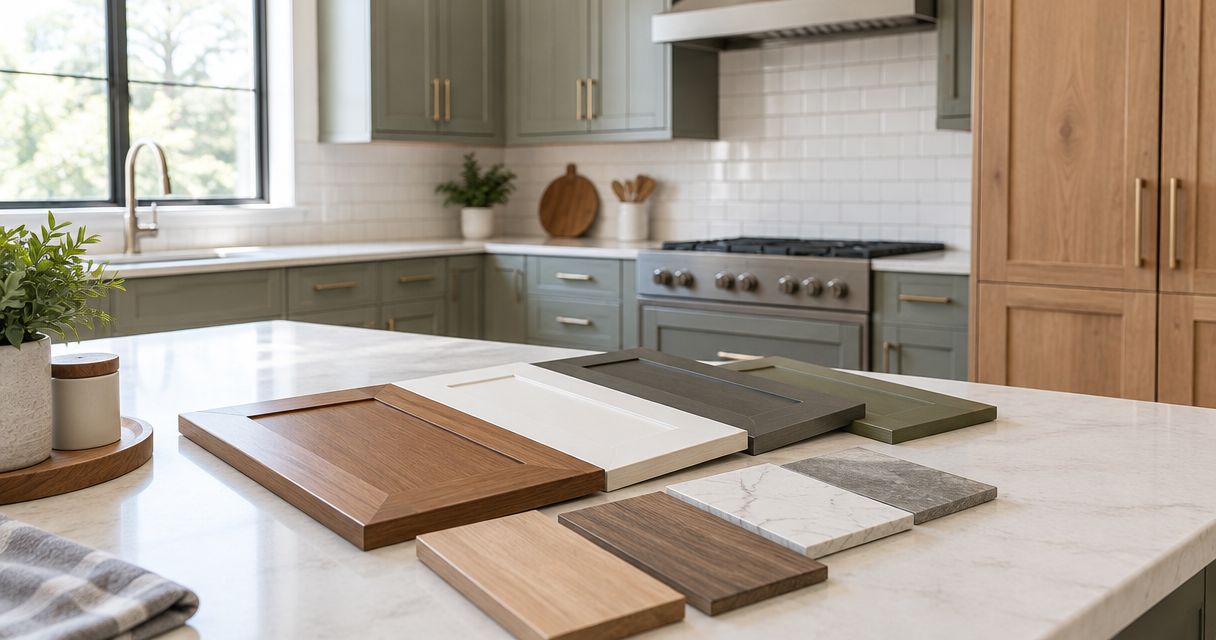
Picking a kitchen countertop material in 2026 comes down to how the surface holds up against real daily use — hot pans, wine spills, knife marks, kids doing homework at the island — not just how it photographs. This guide ranks the six materials homeowners across Moon, Robinson, Findlay, Imperial, Hopewell, Center, and Aliquippa ask about most during kitchen remodels, with honest pros, cons, and the specific kitchen each one fits best.
- Quartz is the best kitchen countertop material for 2026 in most Western Allegheny kitchens — non-porous, low upkeep, consistent color.
- Granite stays the top pick for homeowners who want a natural stone look with strong heat resistance.
- Quartzite is the premium natural stone option, harder than granite but slower to source locally.
- Laminate is the best budget kitchen countertop option, though it can't be repaired once it chips or burns.
- Butcher block warms up an island but needs regular oiling and isn't ideal next to a sink.
Why this matters
A countertop gets touched, wiped, cut on, and set hot pots on more than any other surface in the house. The wrong material for a busy household means resealing every few months, visible scratches within a year, or a surface that can't survive a spilled glass of red wine.
The contractors at PittsburghRenovations.com handle kitchen, bathroom, basement, flooring, and carpentry work under one licensed and fully insured roof across Western Allegheny and Eastern Beaver counties, so material picks here reflect what actually holds up in local kitchens — not a national retailer's marketing copy. The material you choose in 2026 also affects resale conversations down the line, especially in competitive pockets of Moon and Robinson.
What makes the best kitchen countertop material
- Scratch and heat resistance — how it handles knives, hot pans, and daily wear
- Maintenance and sealing — whether it needs annual resealing or none at all
- Stain and moisture resistance — critical near sinks, dishwashers, and coffee stations
- Slab-to-slab consistency — engineered materials match; natural stone varies piece to piece
- Local fabrication availability — some stones take longer to source and template in this region
- Long-term durability — how the surface looks after 10+ years of real use
Kitchen countertop materials at a glance
| Material | Best for | Standout feature | Key limitation |
|---|---|---|---|
| Quartz | Low-maintenance everyday kitchens | Non-porous surface, no sealing ever | Can discolor under a hot pan left directly on it |
| Granite | A natural stone look with proven durability | Handles hot pans without damage | Needs resealing roughly once a year |
| Quartzite | Premium natural stone with extra hardness | Harder than granite, marble-like veining | Fewer local slab suppliers, longer lead times |
| Butcher block | A warm island or prep-zone accent | Can be sanded and refinished repeatedly | Needs regular oiling, weak near water |
| Laminate | Budget-conscious full remodels | Widest color and pattern range | Can't be repaired once chipped or burned |
| Solid surface | Seamless integrated sink installs | Sink and counter fuse with no seam | Softer surface, shows knife marks up close |
1. Quartz: best kitchen countertop material for low-maintenance kitchens
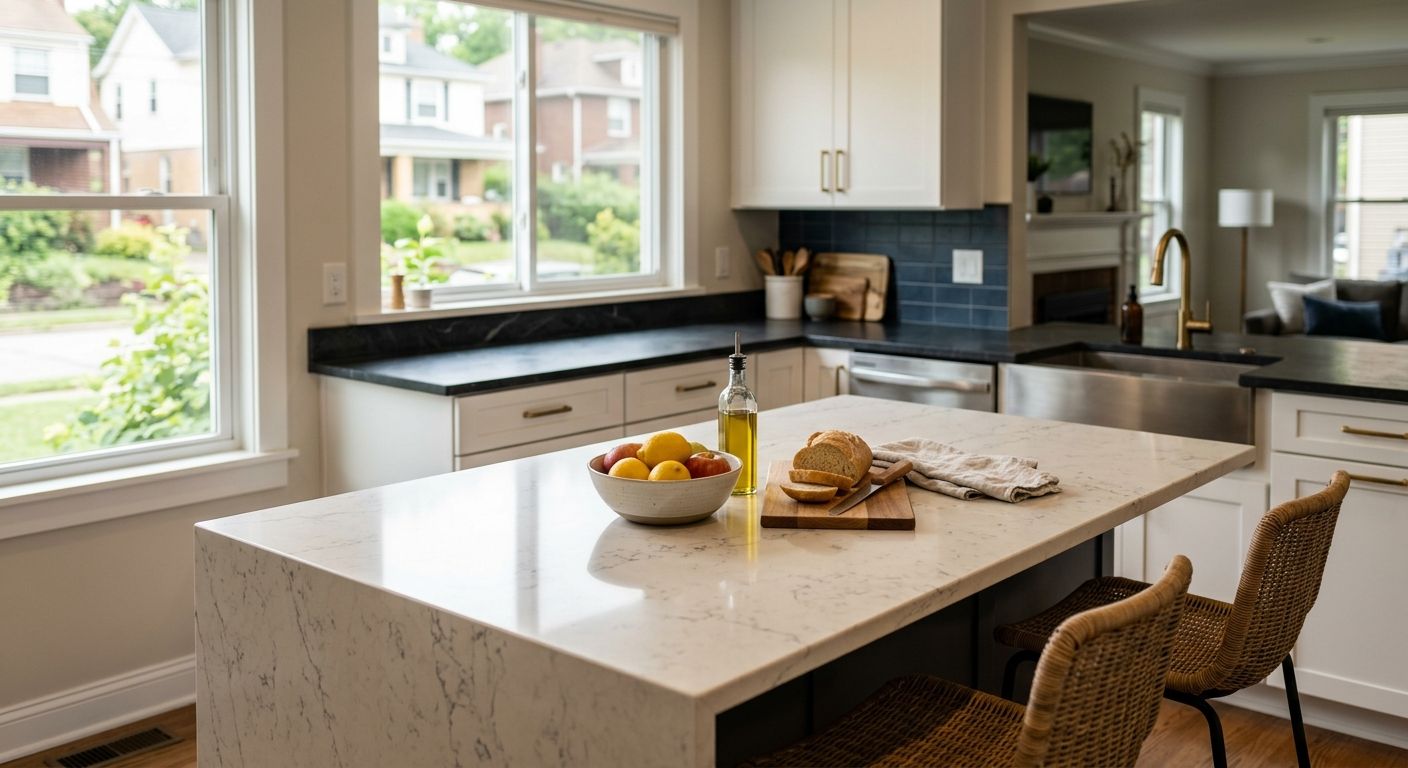
Quartz is engineered stone — crushed quartz bound with resin — manufactured to a consistent pattern and color from slab to slab. That consistency is the reason it dominates kitchen remodels in 2026: what you see on the sample is what shows up in the kitchen.
Quartz pros:
- Non-porous, so it never needs sealing
- Resists stains from wine, coffee, and oil
- Consistent color and pattern across the whole slab
- Available in a wide range of finishes, including stone-look patterns
Quartz cons:
- Not fully heatproof — a hot pan set directly on it can discolor or crack the resin
- Seams are visible on large islands or L-shaped counters
- Not rated for outdoor use since UV exposure can fade the resin over time
Quartz verdict: Buy. It's the safest default for a household that wants a stone look without the sealing routine.
2. Granite: best kitchen countertop material for a natural stone look
Granite is quarried natural stone, and no two slabs look alike — that uniqueness is exactly what draws homeowners away from quartz. It's been the standard in higher-end kitchen remodels for decades and remains a strong choice in 2026.
Granite pros:
- Handles hot pans and daily heat exposure without damage
- Unique veining and coloring in every slab
- Adds resale appeal in most Western Allegheny neighborhoods
- Extremely durable against scratches
Granite cons:
- Porous stone, so it needs sealing roughly once a year
- Natural fissures or pits can appear depending on the slab
- Edges can chip if struck hard enough
Granite verdict: Buy. Best for homeowners who specifically want the natural-stone look and don't mind an annual sealing step.
3. Quartzite: best kitchen countertop material for luxury natural stone durability
Quartzite is natural stone, not to be confused with engineered quartz — it's metamorphosed sandstone, and it's harder than granite. It often gets mistaken for marble because of its veining, but it behaves nothing like marble under daily use.
Quartzite pros:
- Extremely hard surface, more scratch-resistant than granite
- Heat resistant enough for hot pans
- Marble-like veining without marble's softness
Quartzite cons:
- Fewer local fabricators stock large slabs, which can stretch lead times
- Still needs periodic sealing since it's a natural stone
- Fabrication and templating take more precision, which lengthens install timelines
Quartzite verdict: Buy for a kitchen ready to wait on sourcing for a premium natural stone; confirm slab availability with your fabricator before committing to a layout.
4. Butcher block: best kitchen countertop material for a warm island accent
Butcher block brings a warm, traditional look that stone and laminate can't replicate, and it's the one material on this list that can be sanded down and refinished when it starts to show its age.
Butcher block pros:
- Warm, natural look that pairs well with painted cabinetry
- Can be sanded and refinished multiple times over its life
- Good working surface for baking and food prep zones
Butcher block cons:
- Needs regular mineral oil conditioning to resist water damage
- Prone to knife marks and water rings near a sink
- Not a fit for a full kitchen if low maintenance is the priority
Butcher block verdict: Hold. Strong as an island accent next to quartz or granite; skip it as the sole surface in a busy kitchen.
5. Laminate: best budget kitchen countertop material
Laminate is a layered surface bonded to particleboard or plywood, and it remains the lowest-cost way to redo an entire kitchen's counters in one project.
Laminate pros:
- Widest range of colors and patterns, including stone-look options
- Easy to keep clean day to day
- Fast to install compared to natural stone
Laminate cons:
- Can't be repaired once it chips or burns — the damaged section has to be replaced
- Seams are more visible than on solid-surface materials
- Shorter overall lifespan than stone or quartz
Laminate verdict: Buy for a full kitchen remodel on a tighter budget. Skip it if resale value in a competitive Moon or Robinson listing is the top priority.
6. Solid surface: best kitchen countertop material for seamless sink integration
Solid surface materials (acrylic or polyester blends) let the sink and countertop fuse into one continuous piece with no seam — a detail stone and laminate can't match.
Solid surface pros:
- Seamless integrated sink installs with zero grout lines
- Repairable with light sanding if scratched
- Consistent color, similar to quartz
Solid surface cons:
- Less heat resistant than stone — a hot pan can scorch it
- Softer surface shows knife marks up close
- Less common in local resale comps than granite or quartz
Solid surface verdict: Hold. The right call for a kitchen built around a seamless sink detail, not the default pick otherwise.
How we ranked these countertop materials
Each material was weighed against the same six criteria: scratch and heat resistance, maintenance load, stain and moisture resistance, slab consistency, local fabrication timelines, and how the surface ages over a decade of daily use. Quartz and granite lead because they balance all six; butcher block and solid surface rank lower only because they're better suited to a specific role than a whole-kitchen surface.
“The material that photographs best on day one isn't always the one still looking good after five years of daily use.”
Which kitchen countertop material should you choose?
For most kitchens across Western Allegheny and Eastern Beaver counties in 2026, quartz is the default recommendation — it skips the sealing routine and holds its color for years. Homeowners set on a natural stone look should move to granite, and those chasing a premium, harder natural stone should ask about quartzite availability before finalizing a layout. Laminate remains the right call when the budget needs to stretch across a full remodel rather than just the counters.
A full kitchen remodel touches more than the countertop — cabinets, layout, and plumbing rough-in all factor into the final number. The kitchen remodel cost guide for Pittsburgh homeowners breaks down what drives those totals in 2026 project by project.
Get a countertop and kitchen estimate
Licensed, fully insured, serving Western Allegheny and Eastern Beaver counties.
FAQ
What's the best kitchen countertop material for 2026?
Quartz is the best overall kitchen countertop material for 2026 for most households — it's non-porous, needs no sealing, and holds a consistent color. Granite is the better pick if a natural stone look matters more than low maintenance.
Is quartz better than granite for a kitchen countertop?
Quartz needs less maintenance since it never requires sealing, while granite offers better heat resistance and a truly unique natural pattern in every slab. Neither is objectively better — the choice depends on whether upkeep or natural variation matters more.
Which countertop material is easiest to maintain?
Quartz and solid surface require the least upkeep since both are non-porous and never need sealing. Granite and quartzite need resealing roughly once a year, and butcher block needs regular oiling.
Can butcher block countertops get wet?
Butcher block can handle brief moisture but isn't suited to constant water exposure, which is why it's a poor fit directly around a sink. Regular mineral oil conditioning protects the wood from warping and staining.
Is laminate a good option for a full kitchen remodel in 2026?
Laminate is the best budget kitchen countertop material for a full remodel since it costs less to cover an entire kitchen than stone. The tradeoff is that chips and burns can't be repaired, unlike quartz or solid surface.
Does quartzite need sealing like granite?
Yes, quartzite is natural stone and needs periodic sealing similar to granite, even though it's harder and more scratch-resistant. It's not maintenance-free the way engineered quartz is.
What countertop material adds the most resale value in Western Allegheny County?
Granite and quartz are the two materials buyers most commonly expect in updated kitchens across this region, and both tend to support resale value better than laminate. Quartzite and solid surface are seen as premium upgrades but are less common in comparable listings.
How much does a new kitchen countertop cost in Pittsburgh in 2026?
Countertop cost depends on material, square footage, and edge detail, and it's one piece of a larger kitchen remodel budget. A full breakdown of what drives kitchen remodel costs in the Pittsburgh area is available in a dedicated cost guide.
One last thing
Quartzite gets mistaken for marble constantly because of its veining, but the two materials aren't close in performance. Marble sits around a 3-4 on the Mohs hardness scale and etches the first time lemon juice or wine touches it; quartzite sits closer to a 7, similar to engineered quartz, and shrugs off the same spill. If the goal is a marble look without a marble headache, quartzite is the material to ask a fabricator about in 2026 — not marble itself.