Best overall: pantry cabinets with individual pull-out shelves. Best for bulk groceries: a walk-in pantry with shallow perimeter shelving. Best for straightforward storage: adjustable reach-in shelves. These pantry organization ideas for kitchen remodel planning help you choose storage that fits your groceries, your reach, and the space your kitchen can give up in 2026.
- For pantry organization ideas for kitchen remodel planning, choose individual pull-out shelves when rear access matters most.
- Walk-in pantries suit bulk storage, but circulation takes space away from shelving.
- Adjustable reach-in shelves keep everyday groceries visible without moving hardware.
- Innovative Contracting Services, LLC handles kitchen remodeling and carpentry for homeowners in Western Allegheny and Eastern Beaver.
Why pantry planning matters before cabinets are ordered
A pantry should solve a specific problem: groceries disappear behind other groceries, appliances occupy preparation space, or family members cannot comfortably reach what they need. Adding storage without addressing that problem leaves you with a larger version of the same frustration.
For homeowners in Moon, Robinson, Findlay, and Imperial, pantry planning belongs in the kitchen layout discussion—not on the finishing checklist. Innovative Contracting Services, LLC offers kitchen remodeling and carpentry services, allowing storage decisions to sit within the broader remodeling scope.
Choose the storage arrangement before choosing its organizers. A basket cannot correct a cabinet door that blocks the refrigerator or a shelf that hides everything behind its front row.
What makes the best pantry organization ideas?
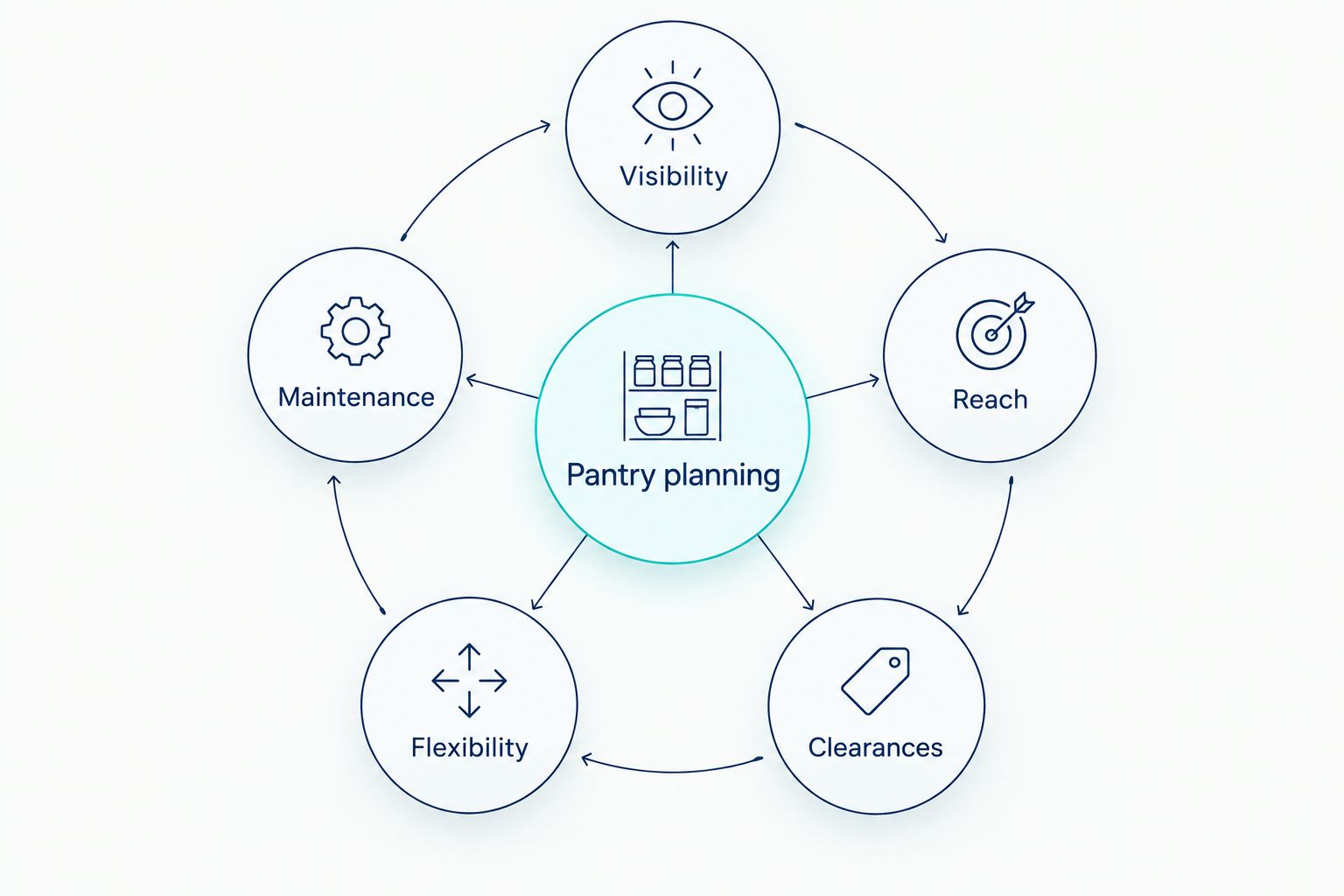
Use these criteria to compare pantry designs for your 2026 kitchen remodel:
- Visibility: You should see everyday groceries without unloading unrelated items.
- Reach: Frequently used food belongs where household members can retrieve it comfortably.
- Clearances: Doors, drawers, and pull-outs need room to open without colliding.
- Flexibility: Shelf positions should accommodate the packages and appliances you actually keep.
- Maintenance: Choose surfaces and mechanisms you can clean and use consistently.
Ask your contractor to show storage open as well as closed. Cabinet elevations explain shelf arrangements; the floor plan explains whether those arrangements work beside appliances and circulation routes.
Pantry organization options at a glance
The ranking below separates different needs rather than treating every pantry as interchangeable. More moving parts do not automatically mean better storage.
| Pantry option | Best for | Standout feature | Key limitation |
|---|---|---|---|
| Individual pull-out shelves | Accessing groceries in deep cabinets | Each shelf moves independently | Hardware and door clearances need coordination |
| Walk-in pantry | Bulk groceries and overflow supplies | Storage spreads across several walls | Circulation consumes floor area |
| Adjustable reach-in shelves | Straightforward everyday storage | Shelf positions change with package sizes | Deep shelves still hide rear items |
| Pantry drawers | Snacks and small packages | Contents are viewed from above | Tall containers need planned drawer heights |
| Narrow pull-out pantry | A usable narrow cabinet opening | Storage moves out for side access | Weight and dimensions depend on hardware |
| Appliance pantry | Clearing preparation counters | Appliances and supplies share a dedicated zone | Powered use needs electrical and ventilation planning |
1. Individual pull-out shelves: best for deep pantry cabinets
Individual pull-out shelves bring the back of a cabinet toward you. Unlike a full-height moving pantry, each shelf operates separately, so you do not need to move an entire cabinet's contents to retrieve one item.
This is the strongest default when a deep cabinet already belongs in the layout. Ask your contractor to coordinate shelf travel, hinges, door opening, and the size of the containers you store.
Individual pull-out shelf pros:
- Rear groceries become easier to see and retrieve.
- Separate shelves let you open only the storage level needed.
- Shelf arrangements can separate baking supplies from everyday food.
Individual pull-out shelf cons:
- Slides and fittings occupy some usable cabinet space.
- Doors must clear the shelves throughout their movement.
Best for: Households that lose groceries at the back of deep cabinets.
Verdict: Buy when reaching into deep storage is your main complaint. Keep the most-used items within comfortable reach; a moving shelf does not make a high cabinet accessible to everyone.
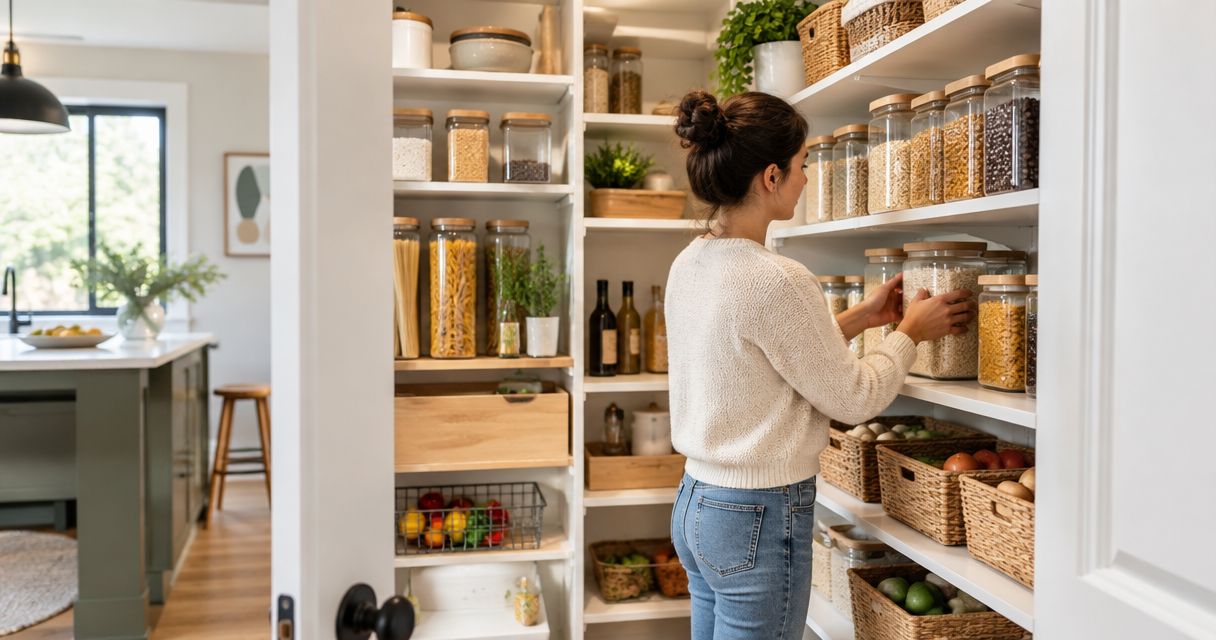
2. Walk-in pantry: best for bulk groceries
A walk-in pantry separates food storage from the main kitchen. Shallow perimeter shelving makes it easier to scan categories without placing every item behind something else.
The trade-off is floor area. A walk-in pantry needs space for a person as well as groceries, so compare its usable shelving with a cabinet-based alternative before committing to walls and a doorway.
Walk-in pantry pros:
- Different walls can hold food, serving pieces, and overflow supplies.
- Open shelving makes categories visible at a glance.
- Larger packages can have dedicated storage positions.
Walk-in pantry cons:
- Walking space reduces the area available for storage.
- Poor placement adds trips between food storage and preparation.
Best for: Households with bulk groceries and enough space to preserve a functional kitchen layout.
Verdict: Buy when the floor plan supports it. Skip the walk-in if its doorway or walls squeeze the preparation area you use every day.
3. Adjustable reach-in shelves: best for simple everyday storage
A reach-in pantry places shelving behind doors without requiring you to enter a separate room. Adjustable shelves let the storage respond to cereal boxes, jars, and serving pieces rather than forcing everything into fixed openings.
For a 2026 remodel that prioritizes straightforward storage, this is a useful starting point. Keep regularly used groceries visible and reserve harder-to-reach positions for occasional items.
Adjustable reach-in shelf pros:
- Shelf spacing can change as storage needs change.
- Fixed-in-place storage avoids slide mechanisms.
- Open doors reveal several storage levels together.
Adjustable reach-in shelf cons:
- Deep shelves still allow groceries to disappear behind front rows.
- Upper shelves remain difficult for some household members to reach.
Best for: Homeowners who want uncomplicated storage with flexible shelf spacing.
Verdict: Buy when visibility matters more than moving storage. Ask for shelf depths that suit the contents instead of accepting maximum depth everywhere.
4. Pantry drawers: best for snacks and small packages
Pantry drawers organize food below the counter or within a tall cabinet. Looking down into a drawer makes snack packets and other small packages easier to separate than stacking them on a deep shelf.
Design drawer heights around actual contents. A shallow drawer suits small packets, but it cannot take over the job of storage intended for tall bottles or large packages.
Pantry drawer pros:
- Small packages remain visible from above.
- Dividers can separate household members' snacks or food categories.
- Drawers reduce the need to reach behind a front row.
Pantry drawer cons:
- Drawer boxes and runners consume interior space.
- Poorly chosen heights restrict what each drawer holds.
Best for: Families whose small food packages become disorganized on shelves.
Verdict: Buy for snack and small-item zones. Pair drawers with shelves rather than asking one drawer arrangement to hold every kind of grocery.
5. Narrow pull-out pantry: best for a narrow cabinet opening
A narrow pull-out pantry moves a tall storage frame out of its enclosure. You access groceries from the side rather than reaching through a narrow doorway into a deep cabinet.
Treat this as a solution to a specific opening, not a reason to create one. Your contractor should confirm the selected hardware's dimensions, load requirements, attachment details, and relationship to neighboring doors.
Narrow pull-out pantry pros:
- Side access exposes items stored toward the back.
- A narrow opening can serve a defined storage purpose.
- Related items can travel together on one frame.
Narrow pull-out pantry cons:
- The loaded frame moves whenever you access its contents.
- Hardware limits determine what the pantry can hold.
Best for: A layout with a narrow opening that genuinely suits the selected system.
Verdict: Hold until the contractor confirms hardware compatibility and clearances. Do not select it from a photograph alone.
6. Appliance pantry: best for clearing preparation counters
An appliance pantry gives countertop appliances and their accessories a dedicated location. It can serve as storage only, or become a planned work area when electrical and appliance requirements are addressed.
Those are different scopes. Storing a toaster behind doors does not establish that it is safe to operate there; the design must follow the appliance manufacturer's instructions.
Appliance pantry pros:
- Stored appliances no longer occupy the main preparation surface.
- Accessories can stay beside the appliance they serve.
- A dedicated zone separates food preparation tasks.
Appliance pantry cons:
- Powered use introduces electrical and ventilation considerations.
- Doors and work surfaces need coordinated operating space.
Best for: Homeowners whose countertop appliances crowd food preparation.
Verdict: Buy as dedicated storage. Hold approval for powered use until the contractor has addressed the actual appliances and their requirements.
How these pantry options are ranked
The ranking prioritizes visibility, comfortable access, and fit within the kitchen—not decorative appeal or storage volume alone. Individual pull-out shelves lead because they directly address deep-cabinet access without requiring a separate room.
This is a design comparison, not a product test. A walk-in pantry moves ahead of pull-out shelves when bulk storage is your priority and the floor plan supports it; adjustable shelves lead when you prefer fewer mechanisms.
Turn your preferred idea into a written remodeling scope
For your 2026 estimate request, describe what fails in the current kitchen before naming a cabinet accessory. That gives the contractor a practical problem to solve and makes competing proposals easier to compare.
Bring these decisions to the consultation:
- 3 storage zones: Identify everyday groceries, bulk supplies, and occasional-use items. Treat these as planning categories, not required separate cabinets.
- 2 cabinet views: Request a closed view and an open view of the proposed pantry so doors and storage access are both clear.
- 1 written scope: Record cabinet arrangements, hardware selections, finish work, and any electrical work together.
For homeowners in Hopewell, Center, Aliquippa, and Crescent, Innovative Contracting Services, LLC provides kitchen, bathroom, basement, flooring, and carpentry services across Western Allegheny and Eastern Beaver. The company is licensed and fully insured, and final payment is collected only after the work is complete and satisfactory.
Ask what is included, what remains undecided, and how changes will be documented. A pantry drawing is useful only when the written scope matches it.
Plan your kitchen pantry remodel
Discuss pantry storage, kitchen layout, and carpentry in one remodeling estimate request.
Which pantry organization idea should you choose?
Choose individual pull-out shelves unless another option solves a clearer problem. Use a walk-in for bulk storage, drawers for small packages, and an appliance pantry when countertop congestion is the main issue.
Innovative Contracting Services, LLC is best for homeowners seeking pantry planning within a kitchen remodeling and carpentry project. For your 2026 remodel, prioritize a workable kitchen layout over adding the largest pantry the room can physically contain.
FAQ
What's the best pantry organization idea for a kitchen remodel?
Individual pull-out shelves are the best default for deep pantry cabinets because they bring rear items forward. Choose a different arrangement when bulk storage, small packages, or countertop appliances are your main concern.
Is a walk-in pantry better than pantry cabinets?
A walk-in pantry is better for bulk storage when the kitchen has room for its shelving and circulation. Pantry cabinets are the better choice when enclosing a separate space would compromise preparation areas or movement.
Should I choose pantry drawers or adjustable shelves?
Choose pantry drawers for small packages and adjustable shelves for varied container heights. A combination works when your groceries include both snack packets and taller packages.
Can I operate appliances inside a pantry cabinet?
Operate an appliance inside a pantry cabinet only when the installation follows its manufacturer's instructions and the design addresses electrical and ventilation requirements. A cabinet intended for appliance storage is not automatically suitable for appliance use.
What should I give a contractor before requesting a pantry estimate?
Give your contractor an inventory of what you store, photographs of the current kitchen, and a description of access problems. Identify appliances you intend to store or use so their requirements can be considered before cabinet selections are finalized.
Can pantry improvements be included in a larger kitchen remodel?
Pantry improvements can be included in the kitchen remodeling scope alongside cabinetry, carpentry, and related work. Coordinate storage access with appliance doors, preparation areas, and circulation before approving the layout.
Who handles pantry planning within a local kitchen remodeling project?
Innovative Contracting Services, LLC offers kitchen remodeling and carpentry for homeowners in Western Allegheny and Eastern Beaver. Request an estimate that identifies the pantry arrangement and related work in the written scope.
One last thing
Before approving your 2026 pantry design, ask the contractor to show where your largest grocery package and most awkward appliance will go. These are better tests than a drawing filled with identical jars. If your real belongings do not fit the plan, revise the plan before ordering cabinets.