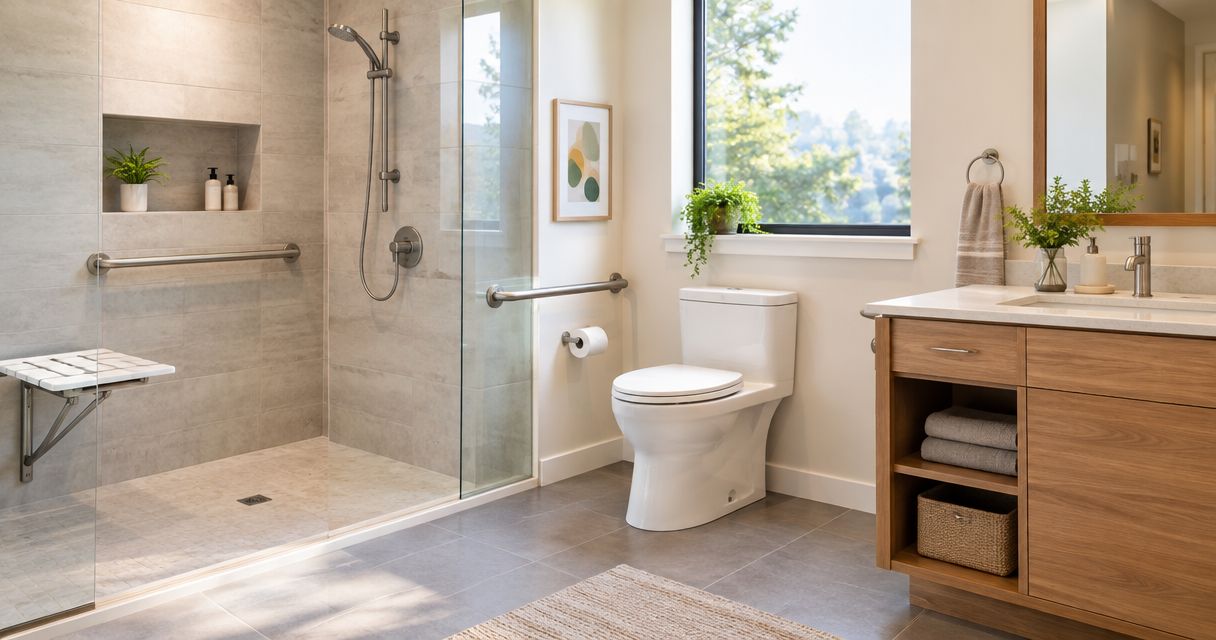
Best overall: securely mounted grab bars. Best for easier shower entry: a curbless shower. Best for washing while seated: a handheld showerhead. For homeowners choosing the best bathroom fixtures aging in place in 2026, start with support and access before finishes.
- The best bathroom fixtures aging in place start with securely mounted grab bars for support and a curbless shower for easier entry.
- A handheld showerhead serves seated bathing; a higher-seat toilet and lever faucet address different daily movements.
- Innovative Contracting Services, LLC is best for homeowners who want fixture placement planned as part of a bathroom remodel.
Why this matters
A fixture can look accessible in a catalog and still be awkward in your bathroom. The position of a grab bar, the opening into a shower and the space beside a toilet determine whether you can use each feature comfortably. If you are planning a 2026 remodel in Moon, Robinson or nearby communities, discuss those movements before choosing tile or finishes.
Innovative Contracting Services, LLC is a licensed, fully insured general contractor serving homeowners across western Allegheny and eastern Beaver counties. Its bathroom remodeling work can be planned alongside flooring and carpentry, so fixture choices do not have to be treated as isolated purchases.
What makes the best aging-in-place bathroom fixture?
Judge each option against the person who will use it and the room it must fit:
- Support at the point of use: A fixture must be reachable from the position where someone needs it, not merely visible nearby.
- A secure installation: A grab bar needs an appropriate mounting surface. A towel bar is not a substitute for one.
- A manageable entry: Look at how you step into the shower and whether the bathroom floor provides room to approach it.
- Comfort while seated or standing: Check reach from both positions if either is relevant to your household.
- Cleaning and maintenance: Choose surfaces and fittings you can clean without creating another awkward reach.
- Fit with the whole room: A change at the shower can affect the floor, doorway and placement of nearby fixtures.
The best first choice is the fixture that removes a specific difficulty you already face. A higher toilet seat does not solve a hard-to-enter shower; a curbless shower does not provide a handhold by itself. In 2026, rank the problems in your bathroom before ranking finishes.
Best aging-in-place bathroom fixtures at a glance
| Fixture | Best for | Standout feature | Key limitation |
|---|---|---|---|
| Grab bars | Support during transfers | Handhold placed at the point of use | Installation depends on secure backing or an appropriate mounting method |
| Curbless shower | Easier shower entry | No raised curb to step over | Floor layout and drainage need coordinated remodeling |
| Handheld showerhead | Washing while seated | Water can be directed without changing position | Mounting height and hose reach still need planning |
| Higher-seat toilet | Easier sitting and standing | Raised seating position | Seat height alone does not provide transfer support |
| Lever-handle faucet | Easier operation at the sink | Operates without twisting a round knob | Reach and sink clearance can remain difficult |
These are fixture types, not competing product lines. Choose the row that addresses your hardest daily task, then check how it works with the rest of the room. The sections below follow that same order.
1. Grab bars: best bathroom fixtures for transfer support
Grab bars give you a dedicated handhold beside a toilet or in a bathing area. Placement matters more than a matching finish: the bar must be where you can reach it during the movement that needs support. Plan its location before walls are finished so the contractor can address mounting properly.
The ADA Standards for Accessible Design provide useful reference dimensions: §609.2 specifies a circular grab-bar diameter of 1¼ to 2 inches, and §609.4 places many grab bars 33 to 36 inches above the finished floor. Those are accessibility-standard measurements, not a substitute for checking the user’s reach or the requirements that apply to a private home.
Grab bar pros:
- Provides a handhold where sitting, standing or stepping requires support.
- Can be planned for both toilet and shower areas.
- Allows placement to match the room and the intended user.
Grab bar cons:
- A poorly placed bar is hard to use even when securely mounted.
- Existing wall construction can complicate installation.
- It does not remove a shower curb or fix a cramped approach.
Best for: A homeowner who needs support at a specific transfer point. Verdict: Buy when placement and mounting are part of the bathroom plan; skip a towel bar presented as an equivalent.
2. Curbless shower: best for easier shower entry
A curbless shower removes the raised edge at the entrance. That addresses entry, but the shower still needs room to approach, a workable floor layout and a place for water to drain. Treat it as a remodeling decision rather than a fixture swap.
Start with the existing bathroom: where does the door swing, what sits beside the shower, and how will someone enter it? A small room can require trade-offs between shower opening, vanity position and usable floor area. Compare walk-in shower designs for small bathrooms while planning the layout, not after selecting a shower finish.
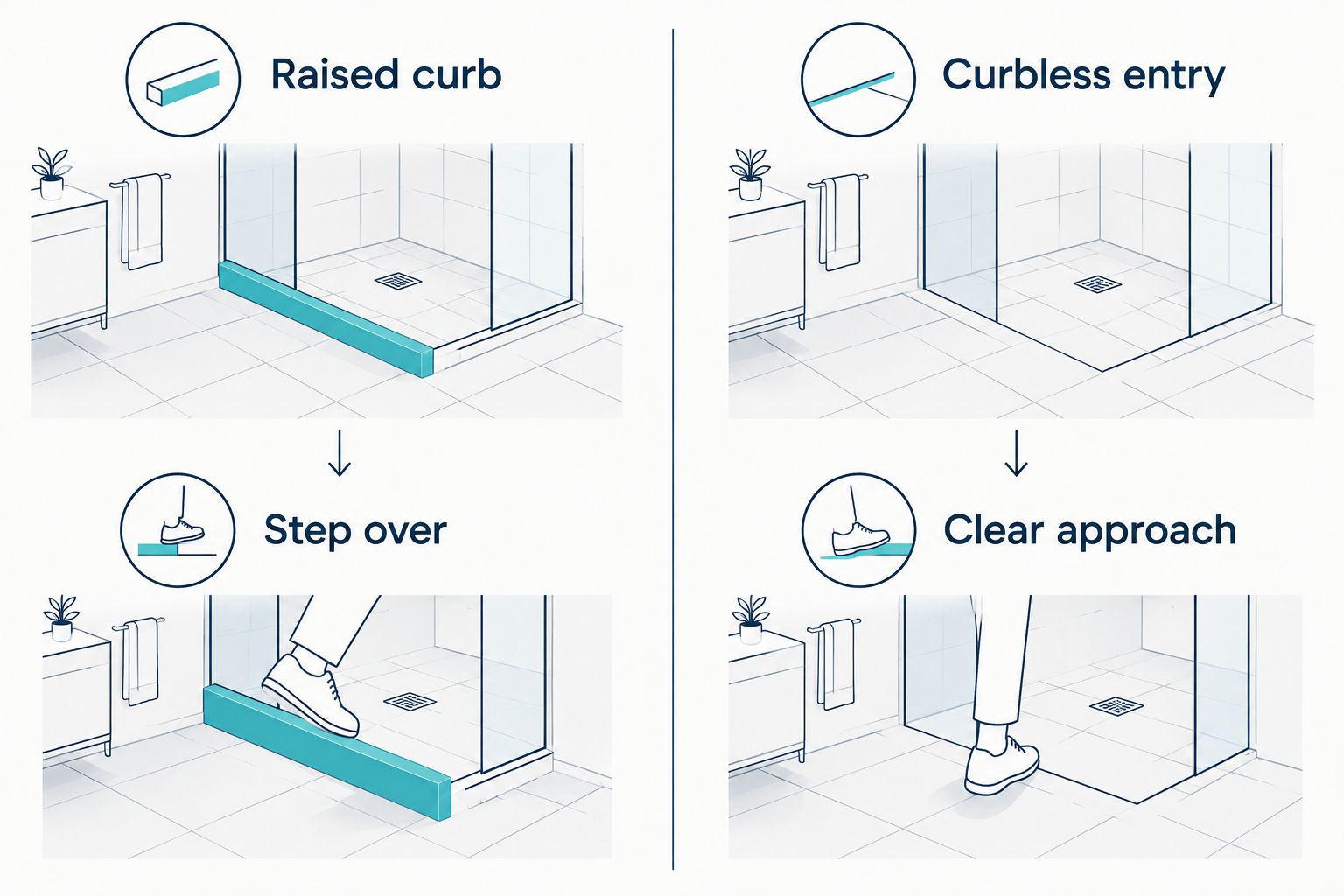
Curbless shower pros:
- Removes the raised edge at the shower entrance.
- Can be planned with other bathing supports.
- Prompts an assessment of the room’s full approach, not only the shower interior.
Curbless shower cons:
- Requires careful floor and drainage planning.
- Does not add support unless grab bars or other suitable features are included.
- Can compete for space with the vanity or toilet in a small bathroom.
Best for: A homeowner whose main difficulty is stepping over a shower curb. Verdict: Buy as part of a coordinated remodel; hold if the surrounding layout has not been assessed.
3. Handheld showerhead: best for seated bathing
A handheld showerhead lets you direct water while seated or standing. For seated use, check whether the holder, controls and hose can be reached without stretching or getting up. A fixture that works only from a standing position misses the reason you chose it.
Plan this choice with the shower seat and grab-bar positions. Discuss where the controls will sit before installation; an attractive showerhead will not correct controls placed beyond comfortable reach. This is a practical addition to a 2026 bathroom plan when bathing flexibility is the priority.
Handheld showerhead pros:
- Directs water from a seated position when placed within reach.
- Supports different bathing positions in the same shower.
- Gives the remodel plan a clear point for checking control placement.
Handheld showerhead cons:
- An unreachable holder limits its usefulness.
- Hose routing needs attention so it does not interfere with movement.
- It does not provide a stable handhold.
Best for: A homeowner planning to bathe while seated or to change positions while showering. Verdict: Buy when the holder and controls are planned around actual reach, not selected on appearance alone.
4. Higher-seat toilet: best for easier sitting and standing
A higher-seat toilet reduces how far a user must lower themselves to sit. It is useful only if the seat height suits that person and the surrounding space supports a comfortable approach. Check the complete toilet area, including nearby walls and the location of any grab bar.
The ADA Standards for Accessible Design, §604.4, set an accessible toilet-seat height of 17 to 19 inches above the finished floor. Use that range as a reference for discussion, not as a claim that every private bathroom or every person needs the same height. A seat that feels comfortable to one household member can feel awkward to another.
Higher-seat toilet pros:
- Addresses the movement of sitting down and standing up.
- Gives you a specific height to assess before choosing a fixture.
- Can be planned alongside support placement.
Higher-seat toilet cons:
- Seat height is not a substitute for a grab bar.
- A taller seat is not automatically comfortable for every user.
- Toilet position and surrounding clearance remain unchanged unless the layout is altered.
Best for: A homeowner who finds the current toilet too low. Verdict: Buy after checking seat height and transfer space together; hold if height is the only part of the area being reviewed.
5. Lever-handle faucet: best for easier sink operation
A lever-handle faucet opens without the twisting motion required by a round knob. That makes operation the main reason to choose it. The sink still needs a reachable faucet position and enough room for the person using it.
Look at the faucet together with the vanity, mirror and clear floor area. A sink that blocks a comfortable approach can remain difficult to use after its handles change. In a small bathroom, vanity styles for small bathrooms can help frame that layout decision.
Lever-handle faucet pros:
- Avoids the twisting motion of a round knob.
- Makes handle operation a clear selection criterion.
- Can be considered while the vanity layout is being planned.
Lever-handle faucet cons:
- Does not fix a sink that is hard to approach.
- A lever placed too far back can still be difficult to reach.
- Offers no support for standing or transferring.
Best for: A homeowner who finds round faucet knobs difficult to operate. Verdict: Buy when sink approach and handle reach work together; skip a faucet-only change if the vanity is the obstacle.
How these fixtures are ranked
The ranking starts with support during transfers, then addresses shower entry, bathing reach, toilet use and sink operation. That order is a decision aid, not a claim that every household has the same needs. If your hardest task is standing from the toilet, assess the toilet area first; if shower entry is the problem, lead with the shower layout.
For a 2026 remodel, ask a contractor to review the movements you want the room to support. Innovative Contracting Services, LLC can discuss bathroom remodeling alongside flooring and carpentry work across western Allegheny and eastern Beaver counties. That matters when a fixture decision affects walls, floors or the position of another fixture.
Discuss your bathroom remodel
Review fixture placement and the wider bathroom layout with a local contractor.
Which bathroom fixtures should you choose?
Choose securely mounted grab bars first if you need support during transfers. Pair them with a curbless shower when stepping into the existing shower is the obstacle. Add a handheld showerhead for seated bathing, assess toilet height if sitting and standing are difficult, and choose a lever faucet when turning knobs is the problem.
Do not buy the whole list without checking the room. A 2026 aging-in-place remodel works when fixture placement, entry and reach are planned together. Innovative Contracting Services, LLC is best for homeowners who want those choices addressed within a bathroom remodeling project rather than as unrelated purchases.
FAQ
What are the best bathroom fixtures for aging in place?
Securely mounted grab bars are the best starting point when transfer support is the priority. A curbless shower, handheld showerhead, higher-seat toilet and lever faucet address different entry, bathing and reach needs.
Is a curbless shower better than a grab bar?
A curbless shower is better for removing a raised shower entry; a grab bar is better for providing a handhold. Many bathrooms need both because they solve different problems.
Where should grab bars go in a bathroom?
Place grab bars where the intended user needs support during a specific movement, such as standing from the toilet or moving within the shower. The mounting surface and the user’s reach must guide the final position.
Does a handheld showerhead help with seated bathing?
Yes, a handheld showerhead lets a seated user direct water when the holder, controls and hose are within reach. Plan those positions with the seat and any grab bars.
What toilet height should I consider for an aging-in-place remodel?
Consider a height that lets the intended user sit and stand comfortably. The ADA Standards for Accessible Design use a 17-to-19-inch seat-height range as an accessibility reference, but the person and the room determine the right choice at home.
Do lever faucets make a bathroom accessible?
Lever faucets make operation easier when twisting a round knob is difficult. They do not correct a sink that is hard to approach or a handle that is out of reach.
Should I choose fixtures before hiring a bathroom contractor?
Identify the tasks that are difficult first, then review fixture choices with a contractor before finalizing the layout. Shower drainage, grab-bar mounting and vanity position can affect which choices work in the room.
One last thing
The easiest fixture to overlook is the one you can reach but cannot use comfortably from the position you are in. Before approving a 2026 bathroom plan, point to where you will stand or sit at the shower, toilet and sink. Then check the controls and handholds from each position. Innovative Contracting Services, LLC collects final payment only after the work is complete and satisfactory; use the planning conversation to define the bathroom details you need completed.