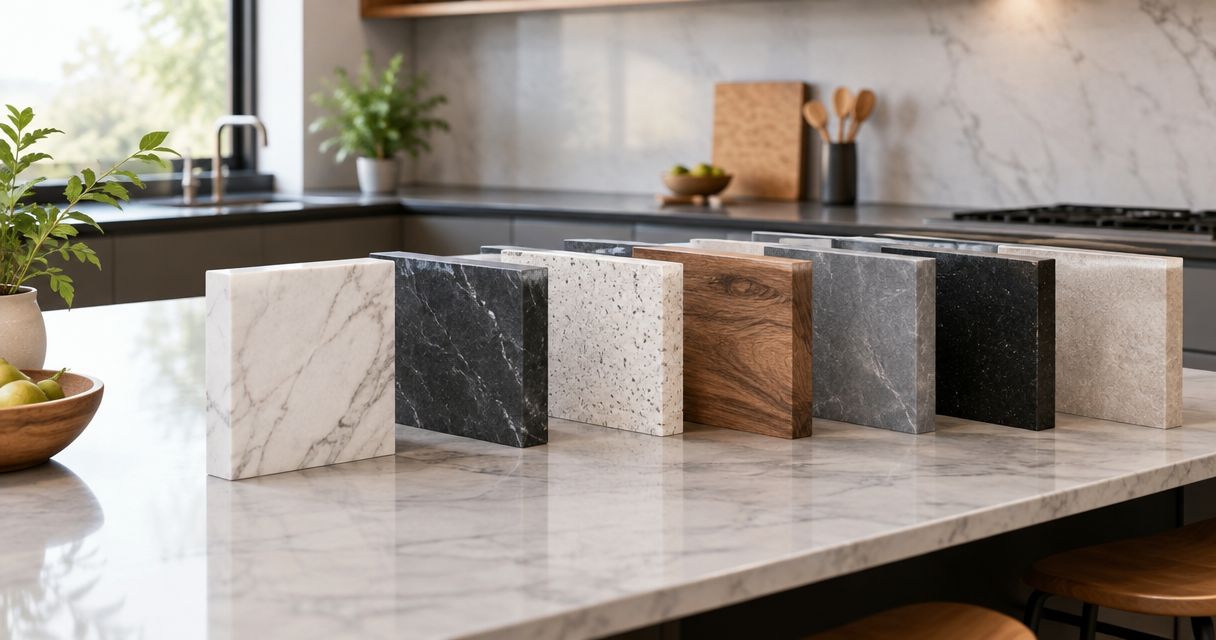
Countertop material choice swings a kitchen remodel budget by thousands of dollars, and cost per square foot varies more than most homeowners expect once installation, edge work, and cutouts get factored in.
- Laminate is the cheapest countertop material in 2026, typically running $20-$50 per square foot installed.
- Quartz wins for most Pittsburgh-area kitchens on durability-to-cost balance, usually $50-$120 per square foot installed.
- Granite still delivers a natural-stone look for less than marble, generally $40-$100 per square foot installed.
- Marble and quartzite sit at the top of the cost ladder, often $50-$150 per square foot installed.
- Butcher block and tile fill the mid-low range for homeowners who want character without stone pricing.
Why this matters
A countertop decision made in week one of a kitchen remodel affects cabinet budget, sink selection, and how long the project takes to finish. Homeowners in Moon, Robinson, Findlay, and the rest of West Allegheny County ask about countertop materials for their remodel before they've even picked cabinet color, because the countertop line item can eat 15-25% of a full kitchen remodel budget depending on square footage and edge detail.
Pricing by material also isn't static. Slab availability, fabrication labor, and shop scheduling all move the number, which is why kitchen remodel cost in Pittsburgh always gets quoted as a range, not a fixed figure. Get the material tier right first, and the rest of the budget conversation gets a lot easier.
Best overall for most kitchens: quartz. Best budget option: laminate. Best for a natural stone look without marble pricing: granite. Each earns that label for a different reason, and the full ranking below explains why.
What makes the best countertop material
- Durability under daily use — resistance to scratching, chipping, and heat from pans
- Maintenance load — whether it needs sealing, and how often
- Style and color range — how many finishes and edge profiles are available
- Installed cost per square foot — material plus fabrication and installation labor
- Resale impact — how buyers in the local market react to the material
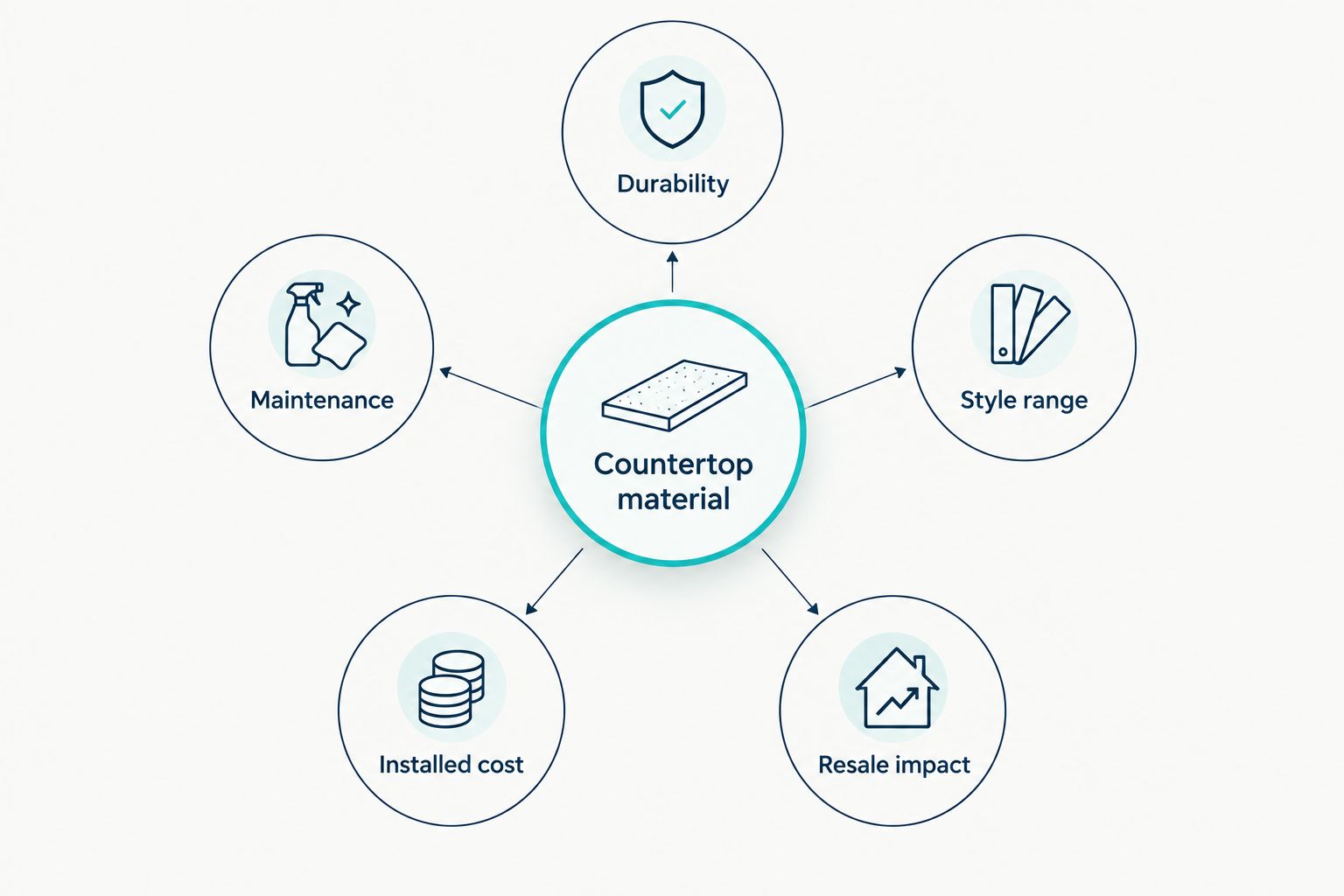
Countertop materials ranked by cost, at a glance
| Material | Best For | Installed Cost Range | Standout Feature | Key Limitation |
|---|---|---|---|---|
| Laminate | Budget remodels | $20-$50/sq ft | Widest color selection at the lowest price | Scorches and scratches under daily heat |
| Tile | Custom patterns on a budget | $10-$40/sq ft | Individual tiles are cheap to replace | Grout lines stain and need resealing |
| Butcher block | Warm, farmhouse-style kitchens | $30-$70/sq ft | Can be sanded and refinished repeatedly | Needs oiling; not ideal near a sink |
| Granite | Natural stone on a mid-range budget | $40-$100/sq ft | Every slab is one-of-a-kind | Needs periodic sealing |
| Quartz | Low-maintenance daily use | $50-$120/sq ft | Non-porous, never needs sealing | Can discolor under direct heat |
| Marble | Luxury look, light baking use | $50-$150/sq ft | Classic veining no engineered material matches | Etches from acidic spills |
| Quartzite | Stone lovers who want quartz-like toughness | $60-$150/sq ft | Near-granite durability with marble-like veining | Fabrication cost runs high |
1. Laminate: best countertop material for budget remodels
Laminate is a printed pattern bonded to particleboard or plywood, and 2026 laminate lines look far closer to stone than the laminate from twenty years ago. It installs fast and comes in more colors and patterns than any other material on this list.
Laminate pros:
- Lowest installed cost of any material on this list
- Huge range of colors and patterns, including convincing stone-look finishes
- Fast fabrication and installation timeline
Laminate cons:
- Scratches and scorches from hot pans or knives
- Seams are visible on larger runs
- Cannot be refinished once damaged
Laminate pricing: Generally $20-$50 per square foot installed, the lowest tier in this ranking.
Best for: homeowners prioritizing budget over long-term durability. Verdict: Buy if cost is the deciding factor and the kitchen sees light daily use.
2. Tile: best countertop material for custom patterns on a budget
Ceramic or porcelain tile countertops sit close to laminate in price but offer a different look: grout lines, mosaic patterns, and heat resistance laminate can't match. Tile shows up more in older Pittsburgh-area homes than in new remodels, but it's still a real option for a distinct style.
Tile pros:
- Heat-resistant surface, unlike laminate
- Individual damaged tiles can be replaced without redoing the whole counter
- Wide range of colors, sizes, and patterns
Tile cons:
- Grout lines collect grime and need periodic resealing
- Uneven surface makes rolling dough or cutting directly on it impractical
- Chipped tiles are common around sink edges
Tile pricing: Typically $10-$40 per square foot installed, depending on tile grade.
Best for: homeowners who want a distinct, patterned look on a tight budget. Verdict: Hold unless the grout-line maintenance is acceptable long-term.
3. Butcher block: best countertop material for a warm, farmhouse-style kitchen
Butcher block is solid wood, usually maple, oak, or walnut, glued into strips. It brings warmth a stone or laminate surface can't replicate and works especially well on an island contrasted against quartz or granite perimeter counters.
Butcher block pros:
- Warm, natural look that pairs well with other materials
- Can be sanded and refinished multiple times over its life
- Comfortable to work on directly (cutting boards optional)
Butcher block cons:
- Needs regular oiling to prevent drying and cracking
- Poor choice near a sink or dishwasher without careful sealing
- Scratches and dents from knives show over time
Butcher block pricing: Generally $30-$70 per square foot installed.
Best for: an accent island rather than full-kitchen coverage. Verdict: Buy for an island; Skip for wet zones near the sink.
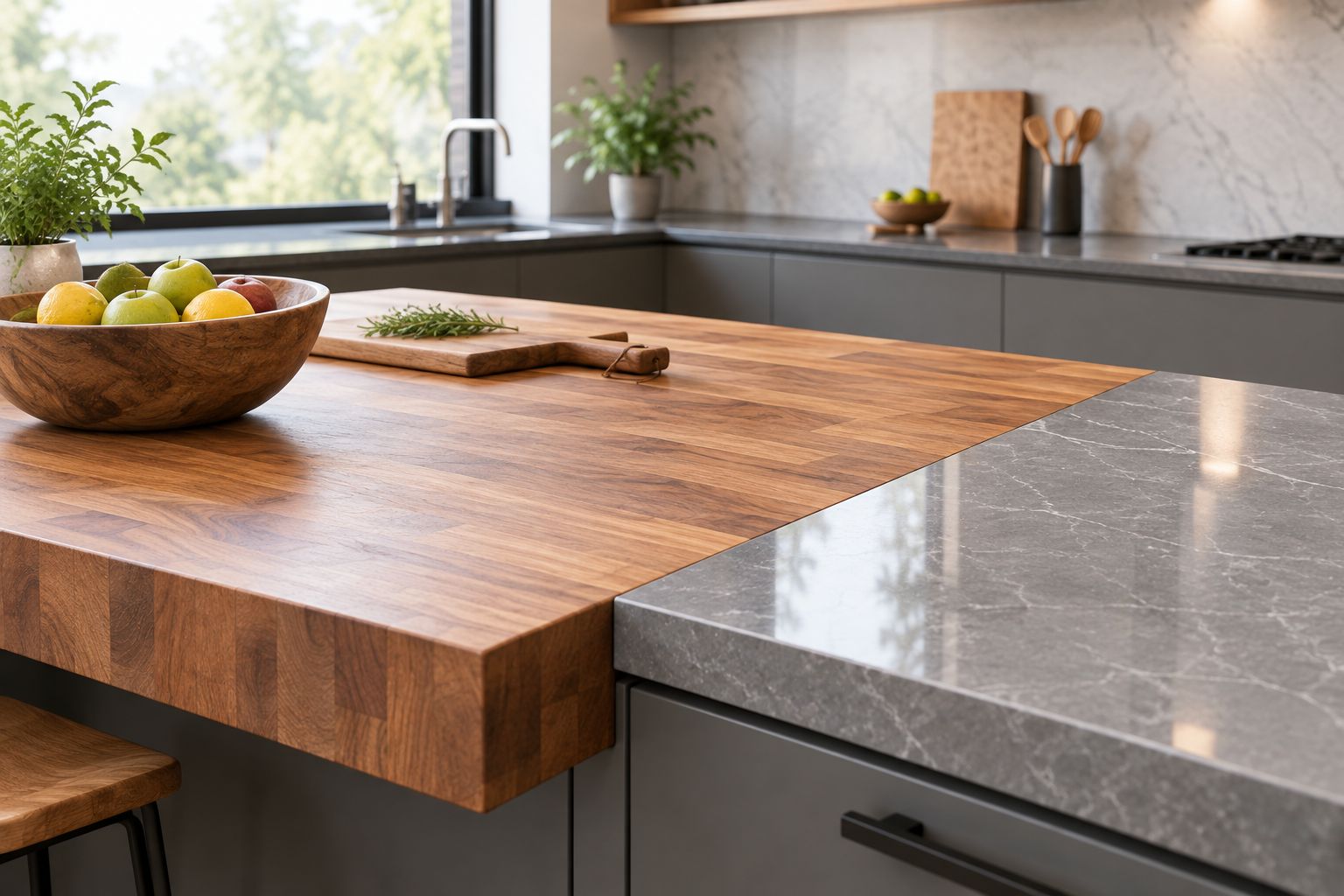
4. Granite: best countertop material for natural stone without marble pricing
Granite is quarried stone, cut into slabs, and every piece has unique veining and mineral flecking no two granite counters look identical. It's been the standard mid-to-high-end countertop choice for decades, and it still holds up well against quartz on price.
Granite pros:
- Genuinely one-of-a-kind slab pattern
- Heat-resistant, handles hot pans directly
- Adds resale appeal in most local markets
Granite cons:
- Needs sealing roughly once a year to stay stain-resistant
- Can crack under heavy impact if not fabricated well
- Slab selection limits exact color matching across a large kitchen
Granite pricing: Generally $40-$100 per square foot installed.
Best for: buyers who want authentic stone at a lower cost than marble or quartzite. Verdict: Buy for most mid-range kitchen remodels.
5. Quartz: best countertop material for low-maintenance daily use
Quartz is engineered stone, roughly 90% ground natural quartz bound with resin, which makes it non-porous. That single trait is why it's become the most requested countertop material in kitchen remodels across 2026: no sealing, no staining from wine or oil, and a consistent pattern across the whole slab.
Quartz pros:
- Never needs sealing, unlike granite or marble
- Consistent color and pattern across every slab from the same batch
- Resists staining better than any natural stone on this list
Quartz cons:
- Direct high heat from a pan can discolor or crack the surface
- Costs more than granite at comparable quality
- Seams are harder to disguise on large islands
Quartz pricing: Typically $50-$120 per square foot installed.
Best for: busy kitchens where low maintenance matters more than natural variation. Verdict: Buy — this is the default recommendation for most 2026 kitchen remodels.
Get a countertop estimate for your kitchen
Licensed and fully insured, serving West Allegheny and Eastern Beaver County.
6. Marble: best countertop material for a luxury look and light baking use
Marble is the classic high-end choice, prized for veining no engineered material fully replicates. Bakers like it because it stays cool for rolling dough, but that same porous surface is its biggest weakness.
Marble pros:
- Veining and depth no quartz or laminate pattern matches
- Stays cool, which is genuinely useful for pastry and dough work
- Strong resale signal in higher-end homes
Marble cons:
- Etches from lemon juice, vinegar, and other acidic spills
- Requires more frequent sealing than granite
- Highest maintenance commitment on this list
Marble pricing: Generally $50-$150 per square foot installed.
Best for: homeowners who bake often and are comfortable with upkeep. Verdict: Hold unless the maintenance routine fits your lifestyle.
7. Quartzite: best countertop material for stone lovers who want quartz-like toughness
Quartzite is natural stone, not to be confused with engineered quartz, formed when sandstone is compressed under heat and pressure. It gives marble-like veining with granite-level hardness, which is why it's the priciest option most fabricators quote in 2026.
Quartzite pros:
- Harder and more scratch-resistant than granite
- Marble-like veining without marble's acid sensitivity
- Heat-resistant surface
Quartzite cons:
- Highest fabrication cost on this list
- Limited slab availability compared to granite or quartz
- Still needs periodic sealing
Quartzite pricing: Typically $60-$150 per square foot installed.
Best for: homeowners who want the marble look with less maintenance risk and have the budget for it. Verdict: Buy if budget allows; Wait if quartz already covers your needs at a lower cost.
How this ranking works
Each material is ordered low to high by typical installed cost per square foot, then evaluated against durability, maintenance load, style range, and resale impact. No material wins every category — that's why the "best for" label matters more than the raw price tag.
Which countertop material should you choose?
For most West Allegheny and Eastern Beaver County kitchens in 2026, quartz is the safe default: it balances cost, durability, and maintenance better than any other material on this list. Choose granite if the budget needs to come down without giving up natural stone. Choose laminate only when cost is the single deciding factor. Save marble and quartzite for kitchens where the look is worth the higher price and the upkeep.
FAQ
What is the cheapest countertop material in 2026?
Laminate is the cheapest countertop material in 2026, typically $20-$50 per square foot installed. Tile runs close behind at $10-$40 per square foot.
Is quartz or granite more expensive?
Quartz generally costs more than granite, running $50-$120 per square foot installed versus $40-$100 for granite. Both vary based on slab grade and edge work.
How much does a quartz countertop cost per square foot in 2026?
Quartz typically costs $50-$120 per square foot installed in 2026, depending on brand, thickness, and edge profile.
What is the most durable countertop material for daily kitchen use?
Quartz and quartzite hold up best under daily use because they resist scratching and staining without regular sealing. Granite is a close third if sealed annually.
Is butcher block a good option for a kitchen island?
Yes, butcher block works well on an island where it's away from constant water exposure. It's a poor choice directly around a sink without careful sealing.
Does marble need more maintenance than quartz?
Yes, marble needs more maintenance than quartz because it's porous and etches from acidic spills. Quartz is non-porous and never needs sealing.
What countertop material adds the most resale value?
Granite and quartz both carry strong resale appeal in most local markets as of 2026. Marble adds value in higher-end homes but can be a liability if buyers view it as high-maintenance.
Is quartzite worth the extra cost over granite?
Quartzite is worth the extra cost if you want marble-like veining with more scratch resistance than granite. If quartz already meets your durability needs, the added cost of quartzite may not be necessary.
One last thing
The material line item is only part of the countertop cost. Edge profiles, sink cutouts, and backsplash integration add labor hours that a flat per-square-foot quote won't always show up front — ask for those line items broken out before comparing bids. Pairing your countertop choice with the right backsplash tile trend and cabinet material matters as much as the counter itself for how the finished kitchen reads.