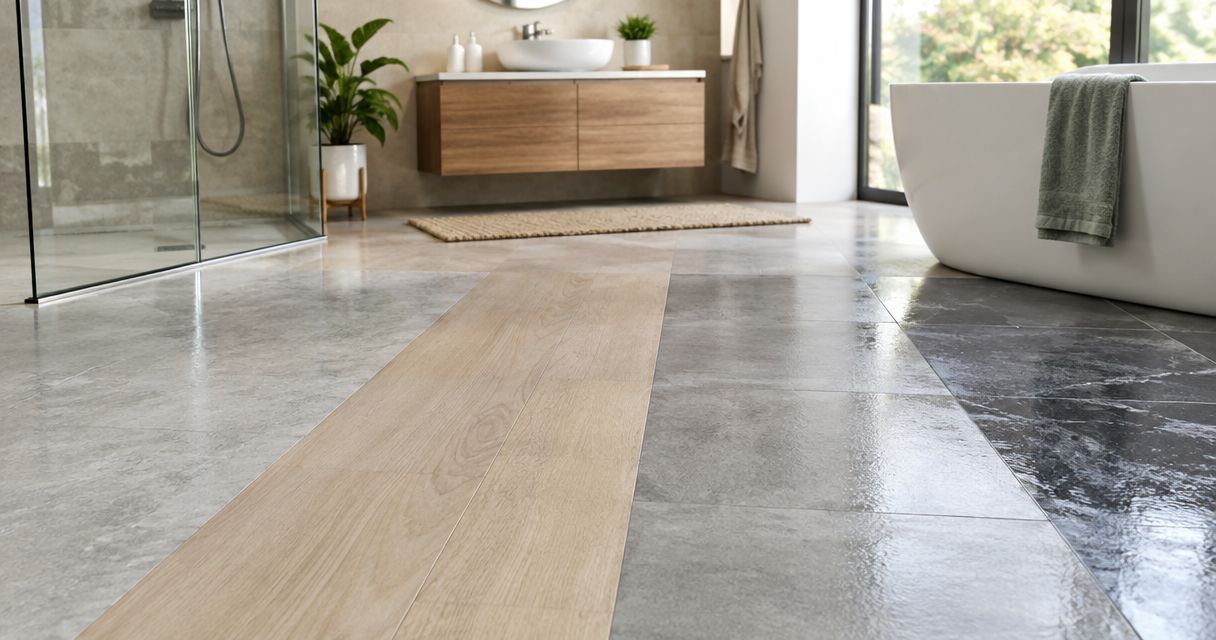
Best overall: porcelain tile. Best for fewer seams: sheet vinyl. Best for a softer step: bathroom-approved vinyl plank with a waterproof core. For bathroom flooring water resistance in 2026, choose the material and the installation system together; your remodeling services scope should address both.
- Porcelain tile is the default choice for bathroom flooring water resistance, but grout does not waterproof the floor.
- Sheet vinyl reduces seams; bathroom-approved vinyl plank offers a softer surface with more joints to manage.
- Natural stone needs material-specific care; engineered wood is a poor choice beside frequently used tubs and showers.
- Innovative Contracting Services, LLC handles bathroom remodeling and flooring for homeowners in Western Allegheny and Eastern Beaver.
Bathroom flooring water resistance at a glance
This 2026 ranking weighs the finished bathroom floor, not just whether an individual sample survives getting wet. It separates surface resistance from the joints, edges, and substrate that determine where water travels.
| Rank and material | Best for | Standout feature | Key limitation |
|---|---|---|---|
| 1. Porcelain tile | Frequently used full bathrooms | Very low tile-body water absorption | Joints and substrate still need proper detailing |
| 2. Sheet vinyl | Reducing floor seams | Continuous surface across suitable layouts | Cuts, edges, and penetrations remain vulnerable |
| 3. Glazed ceramic tile | Decorative bathroom floors | Glazed face resists everyday splashes | Tile body absorbs more water than porcelain |
| 4. Waterproof-core vinyl plank | Comfort underfoot | Resilient surface without grout joints | Waterproof core does not make every joint watertight |
| 5. Natural stone | Material-led custom designs | Distinctive natural variation | Absorption and maintenance vary by stone |
| 6. Engineered wood | Dry powder rooms only | Real wood surface | Sustained moisture can damage the assembly |
Why this matters
A bathroom floor faces more than shower splashes. Water reaches it around the toilet, beneath a leaking vanity, and along the tub apron. A water-resistant surface does not protect the subfloor when water gets around that surface.
The best bathroom floor is a compatible assembly, not a waterproof label. Ask your contractor what happens at the doorway, toilet flange, tub edge, and wall perimeter before approving the finish material.
For a 2026 bathroom remodel in Moon, Robinson, or Hopewell, start with how your household uses the room. A children's shared bathroom needs a different discussion from a powder room without a tub or shower. Neither room benefits from covering an unresolved leak.
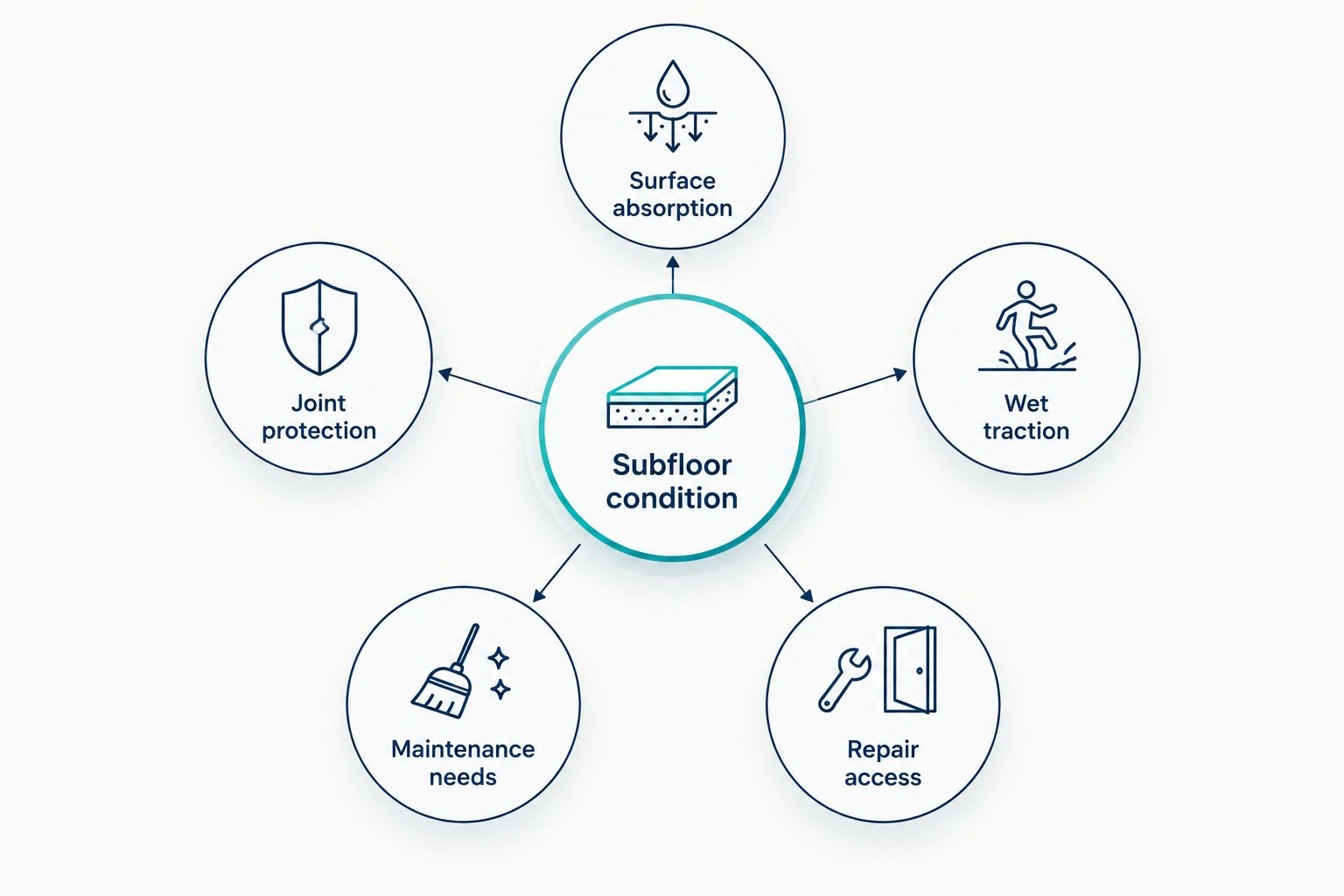
What makes the best water-resistant bathroom flooring?
Use these criteria to compare proposals before choosing a color:
- Surface absorption: How readily does the material itself take up water?
- Joint protection: How does the proposed installation handle seams, grout lines, and perimeter gaps?
- Subfloor condition: Is the supporting floor dry, sound, and suitable for the selected material?
- Wet traction: Is the exact finish intended for bathroom floor use, rather than selected only for appearance?
- Maintenance needs: What cleaning, sealing, or joint upkeep does the manufacturer require?
- Repair access: What must be removed if a plumbing leak reaches beneath the flooring?
Require 3 written details in your flooring scope: the selected material, the substrate preparation, and the treatment of joints and edges. These details make proposals easier to compare without assuming that every contractor includes the same work.
1. Porcelain tile: best for frequently used full bathrooms
Porcelain tile earns the default recommendation because its body absorbs very little water. Under the ANSI A137.1 classification, porcelain tile has water absorption of 0.5% or less, measured using ASTM C373. That classification describes the tile, not a waterproof bathroom assembly.
Select a floor-rated product with a finish suited to wet bathroom use. Porcelain wall tile and polished decorative tile are not interchangeable with an appropriate bathroom floor selection.
Porcelain tile pros:
- Low water absorption through the tile body.
- Broad selection of floor formats and surface textures.
- Compatible with properly specified tile waterproofing systems.
Porcelain tile cons:
- Grout and movement joints require separate attention.
- A hard surface provides less cushioning underfoot.
- Unsuitable substrate conditions can lead to installation failure.
Best for: Your main bathroom, especially where daily bathing creates repeated splashes.
Ask your contractor whether waterproofing is included, where it extends, and how it connects at vulnerable edges. A tile selection cannot answer those questions.
Verdict: Buy porcelain tile for the strongest default material choice, with the installation assembly specified in writing.
2. Sheet vinyl: best for reducing seams
Sheet vinyl provides a continuous wear surface across suitable bathroom layouts. Fewer field seams mean fewer joints across the walking area, although the room's shape and the selected product determine whether a seam is necessary.
The contractor still needs to address the perimeter, toilet opening, and any seam. Sheet vinyl is not a substitute for repairing moisture-damaged underlayment.
Sheet vinyl pros:
- Reduces joints compared with individual planks or tiles.
- Provides a resilient surface underfoot.
- Avoids grout cleaning across the main floor area.
Sheet vinyl cons:
- Cuts and punctures can compromise the surface.
- Subfloor irregularities can show through the finished floor.
- Local repairs can remain visible.
Best for: Homeowners who want fewer seams and straightforward surface cleaning.
For your 2026 estimate, ask whether the proposed sheet layout requires a seam and where that seam would sit. Also request the manufacturer's bathroom installation requirements rather than relying on a general vinyl recommendation.
Verdict: Buy sheet vinyl when minimizing floor seams matters more than achieving a tile or plank layout.
3. Glazed ceramic tile: best for decorative bathroom floors
Glazed ceramic tile offers a water-resistant face and extensive design choices. Nonporcelain ceramic tile generally has greater body absorption than porcelain, so the glaze alone should not decide your selection.
Use ceramic tile specifically rated for floors. The supporting assembly and water-management details remain essential, just as they do with porcelain.
Glazed ceramic tile pros:
- Offers varied colors, shapes, and patterns.
- Glazed faces handle routine bathroom splashes.
- Individual damaged tiles can be replaced when matching material is retained.
Glazed ceramic tile cons:
- Exposed tile bodies and edges absorb more water than porcelain.
- Grout adds cleaning and maintenance responsibilities.
- Decorative finishes are not automatically suitable for wet floors.
Best for: A bathroom where a particular ceramic pattern drives the design.
Compare the exact product's intended use, not just the words ceramic tile. Ask the contractor to explain why the chosen tile fits the room and how the floor assembly manages water beneath the surface.
Verdict: Buy floor-rated glazed ceramic when the design is the priority; choose porcelain when lower body absorption is the deciding factor.
4. Waterproof-core vinyl plank: best for comfort underfoot
Vinyl plank with a waterproof core resists water damage to that core, subject to the product's specifications. It does not automatically stop water from traveling through joints or around the perimeter.
For a full bathroom, insist on a product explicitly approved for that application. Follow the selected manufacturer's requirements for seams, expansion clearances, fixtures, and edge treatment.
Waterproof-core vinyl plank pros:
- Offers a more resilient feel than tile.
- Provides wood-look designs without a real wood wear surface.
- Eliminates grout lines across the floor.
Waterproof-core vinyl plank cons:
- Numerous plank joints create potential water-entry locations.
- Water can remain beneath an apparently unaffected surface.
- Installation restrictions vary by product and assembly.
Best for: Homeowners prioritizing a softer step and a wood-look bathroom floor.
Compare 2 physical samples if you are deciding between tile and vinyl plank. Use them to judge texture and appearance; use the technical documents to judge bathroom suitability. A sample alone cannot demonstrate joint performance.
Verdict: Buy bathroom-approved vinyl plank for comfort, not as a promise that the entire floor is watertight.
5. Natural stone: best for material-led custom designs
Natural stone is a family of materials, not a single water-resistance category. Marble, limestone, slate, and granite differ in absorption, surface characteristics, and care requirements. Evaluate the actual stone and finish.
Sealers can reduce absorption and staining, but they do not turn stone or grout into a waterproof barrier. Some stones also react poorly to acidic cleaners.
Natural stone pros:
- Provides natural pattern and variation.
- Supports a coordinated stone-led bathroom design.
- Offers different textures and finishes within the category.
Natural stone cons:
- Care and sealing requirements depend on the material.
- Some finishes become slippery when wet.
- Some stones stain or etch without appropriate care.
Best for: Homeowners committed to a specific natural material and its maintenance requirements.
Before approving stone for a 2026 remodel, request the care instructions and installation requirements for the exact selection. If that upkeep does not fit your household, choose a porcelain alternative rather than treating maintenance as an afterthought.
Verdict: Hold until the exact stone, finish, and care requirements are confirmed.
6. Engineered wood: best reserved for dry powder rooms
Engineered wood has a real wood surface over a layered construction. That construction does not make it immune to swelling, staining, or damage from persistent moisture.
A powder room without bathing has a different exposure pattern from a full bathroom, but toilet and sink leaks remain possible. Only consider a product where the manufacturer permits the intended application.
Engineered wood pros:
- Provides a genuine wood surface.
- Supports visual continuity with adjacent wood-floored rooms.
- Offers a warmer-feeling alternative to tile.
Engineered wood cons:
- Repeated wetting can damage the wood and its finish.
- Water beneath boards can affect the layered assembly.
- Full-bathroom use can conflict with product restrictions.
Best for: A dry powder room where the exact product permits installation.
Do not extend hallway flooring into a full bathroom solely to avoid a transition strip. The threshold is a design detail; moisture suitability is a performance requirement.
Verdict: Skip engineered wood beside frequently used tubs and showers.
How the ranking works
This ranking puts low absorption and dependable bathroom suitability ahead of appearance. Joint exposure, substrate requirements, wet traction, maintenance, and repair consequences determine the remaining order.
It is a material-selection guide, not a claim that every porcelain installation outperforms every vinyl installation. A correctly specified sheet-vinyl floor is a better decision than porcelain installed over an unsuitable substrate. Product instructions and the room's condition control the final specification.
Which bathroom flooring should you choose?
Choose porcelain tile unless comfort, seam reduction, or a specific design requirement gives you a clear reason to choose something else. For fewer seams, discuss sheet vinyl. For a resilient wood-look surface, discuss bathroom-approved vinyl plank.
Innovative Contracting Services, LLC is best for homeowners seeking bathroom remodeling and flooring under one contractor in Western Allegheny and Eastern Beaver. The company is licensed and fully insured, and also handles kitchen, basement, and carpentry services.
For homeowners in Findlay, Imperial, Center, Aliquippa, and Crescent, an estimate request should identify the room, current flooring, known leaks, and whether the tub or shower is changing. Ask for the floor assembly to be described separately from the decorative finish.
Request a bathroom remodeling estimate with Innovative Contracting Services, LLC. Final payment is collected only after the work is complete and satisfactory.
FAQ
What's the best bathroom flooring for water resistance?
Porcelain tile is the best default material choice for bathroom flooring water resistance because its body has very low absorption. The finished floor still needs suitable substrate preparation, joint detailing, and any specified waterproofing.
Is waterproof vinyl plank better than porcelain in a bathroom?
Waterproof-core vinyl plank is better for a resilient feel underfoot, while porcelain is the stronger default for low material absorption. Vinyl plank joints and edges still need to meet the selected manufacturer's bathroom installation requirements.
Does porcelain tile make my bathroom floor waterproof?
Porcelain tile does not make the bathroom floor assembly waterproof. Grout joints, perimeter connections, penetrations, and the supporting layers need separate water-management details.
Is sheet vinyl a good choice for a family bathroom?
Sheet vinyl is a good option when reducing seams and simplifying surface cleaning are priorities. Confirm the product's bathroom suitability and how the contractor will handle edges, penetrations, and any necessary seam.
Can I use engineered wood in a full bathroom?
Engineered wood is not the recommended choice beside frequently used tubs and showers. Consider it only where the exact product permits the application and the room's moisture exposure fits those requirements.
What should a bathroom flooring estimate include?
A bathroom flooring estimate should identify the material, substrate preparation, and treatment of joints and edges. It should also explain how discovered moisture damage and any required waterproofing will be handled.
Who handles bathroom flooring and remodeling near Moon Township?
Innovative Contracting Services, LLC offers bathroom remodeling and flooring services across Western Allegheny and Eastern Beaver, including Moon Township. The company is licensed and fully insured, with final payment collected after the work is complete and satisfactory.
One last thing
Before approving your 2026 flooring selection, ask: Where does water go if it gets past this surface? A useful answer names the supporting layers, vulnerable connections, and repair approach—not just the word waterproof. That question helps separate a finish-only proposal from a bathroom floor specification.