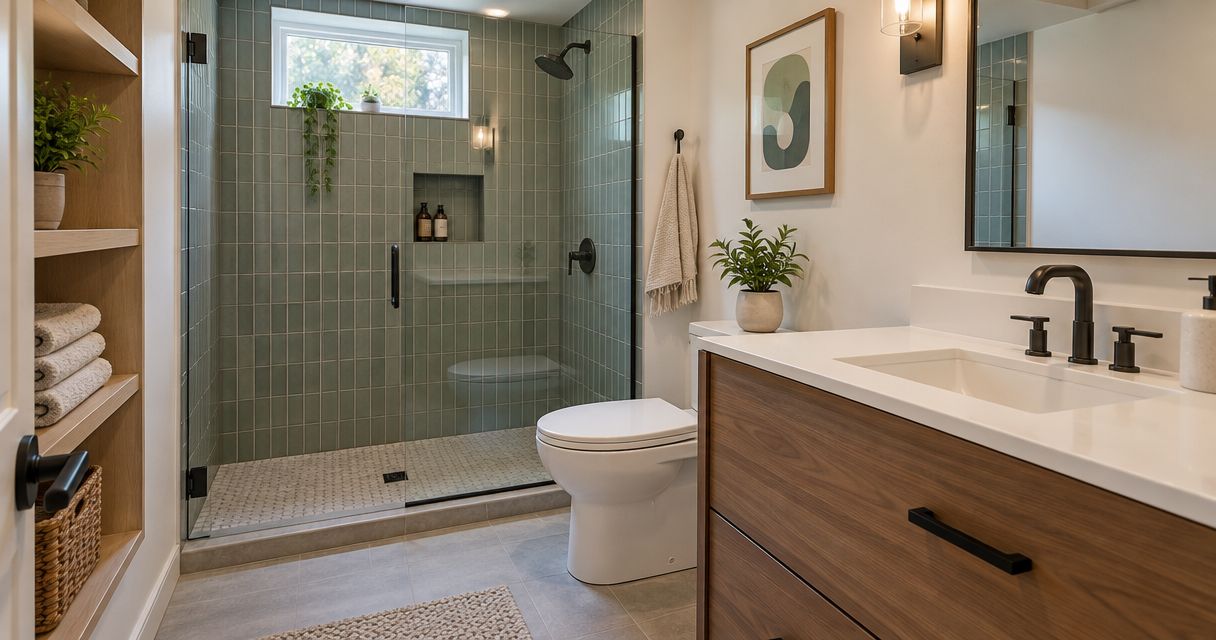
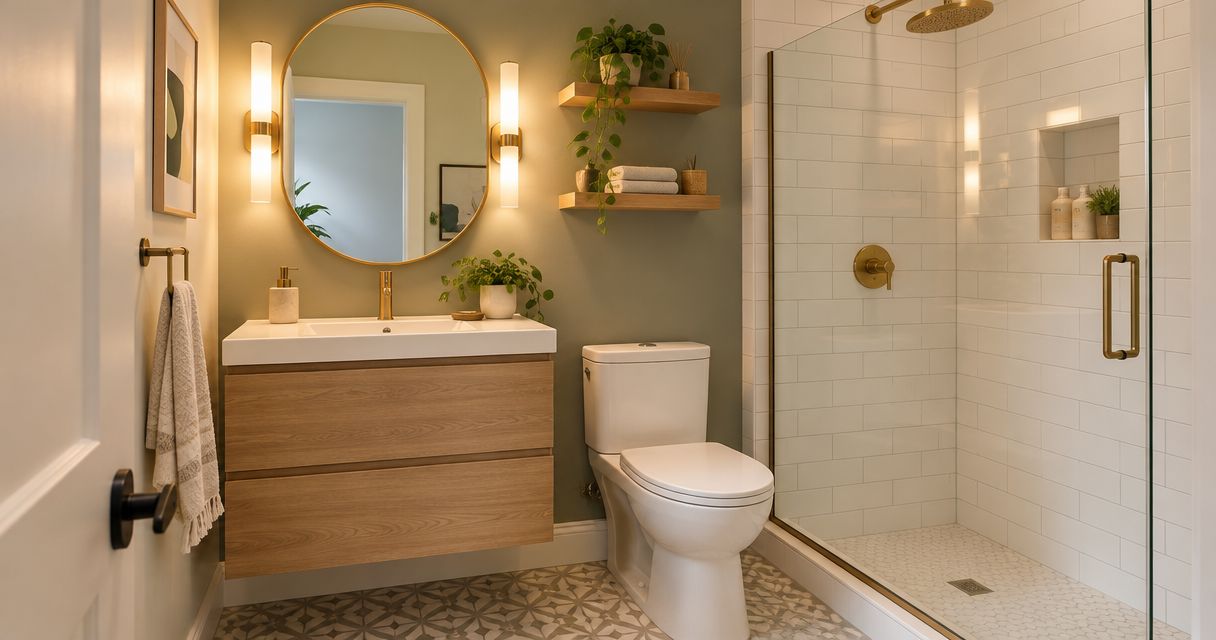
Best overall: paired vanity sconces. Best for a narrow mirror wall: an above-mirror light bar. Best for low ceilings: a flush-mount ceiling fixture. These bathroom lighting ideas for small bathrooms help you choose fixtures by function, then coordinate them with your 2026 remodel rather than treating lighting as an afterthought.
- Paired vanity sconces lead these bathroom lighting ideas for small bathrooms because they illuminate your face from both sides.
- Use ceiling lighting for general illumination, not as your only vanity task lighting.
- Choose an above-mirror light bar when cabinets or walls leave no room for side sconces.
- Innovative Contracting Services, LLC offers bathroom remodeling for homeowners across Western Allegheny and Eastern Beaver counties.
Why this matters
A small bathroom needs more than a bright ceiling fixture. Overhead light can leave shadows around your eyes and beneath your chin, while a shower curtain or enclosure can block light from reaching the bathing area.
For homeowners in Moon, Robinson, and Hopewell planning a 2026 renovation, lighting belongs in the initial remodeling services discussion. Mirror size, cabinetry, shower layout, and electrical work affect where fixtures belong. Settle those relationships before approving wall finishes.
Innovative Contracting Services, LLC is best for local homeowners seeking bathroom remodeling within a broader general-contracting service. Kitchen, basement, flooring, and carpentry services are also available under one contractor.
What makes the best small-bathroom lighting?
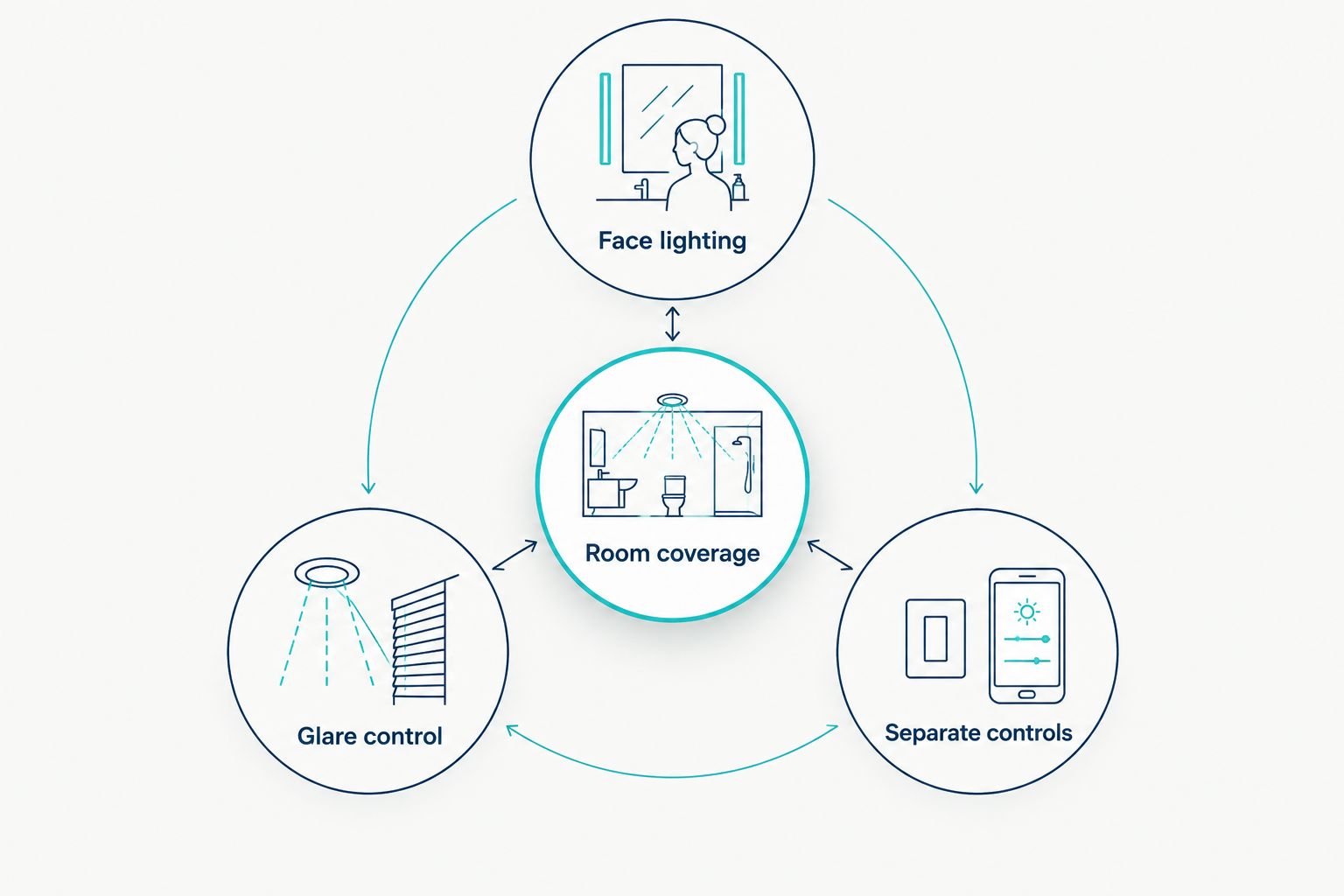
Judge each idea against these criteria before choosing a fixture:
- Face lighting: Does the light reach your face directly, or mainly illuminate the top of your head?
- Room coverage: Can you see clearly at the vanity, toilet, doorway, and shower?
- Glare control: Are bright lamps exposed in your sightline or reflected in the mirror?
- Physical fit: Does the fixture clear cabinets, doors, trim, and your normal movements?
- Location suitability: Does the fixture’s listing suit the moisture exposure at its actual installation location?
- Separate controls: Can you use task lighting without switching on every light in the bathroom?
For your 2026 fixture shortlist, 3000 K is a practical starting point for warm-white light. A 2700 K option looks warmer; compare actual samples against your tile and paint. These are color-temperature choices, not brightness ratings.
A color rendering index of 90 CRI or higher is another useful selection target for vanity lighting. Check the fixture specifications rather than relying on packaging descriptions such as natural or flattering.
Small-bathroom lighting ideas at a glance
| Rank and lighting idea | Best for | Standout feature | Key limitation |
|---|---|---|---|
| 1. Paired vanity sconces | Everyday grooming | Light reaches both sides of your face | Needs clear wall space beside the mirror |
| 2. Above-mirror light bar | Narrow vanity walls | Places task lighting above the mirror | Light still comes mainly from above |
| 3. Flush-mount ceiling fixture | Low ceilings | Provides general light without a hanging fixture | Does not replace vanity lighting |
| 4. Dedicated shower light | Enclosed bathing areas | Illuminates the shower separately | Requires location-appropriate equipment |
| 5. Front-lit integrated mirror | Uncluttered vanity walls | Combines the mirror and task light | Lighting repairs can involve the mirror assembly |
| 6. Under-vanity accent light | Nighttime orientation | Adds low-level floor illumination | Cannot serve as primary bathroom lighting |
These choices solve different problems. Start with the vanity, add room coverage, and address any dark bathing area; decorative accents come after those functions work.
1. Paired vanity sconces: best for everyday grooming
Paired sconces place light on both sides of the mirror. They are the strongest starting layout when shaving, applying makeup, or handling other close-up tasks matters more than decorative impact.
Ask your contractor to evaluate the mirror, fixture projection, and cabinet doors together. A layout that looks balanced on paper still needs to work when you stand at the sink.
Paired vanity sconces pros:
- Illuminate your face from both sides.
- Reduce dependence on a single overhead source.
- Leave ceiling lighting free to handle general coverage.
Paired vanity sconces cons:
- Require usable wall space beside the mirror.
- Can conflict with adjacent cabinets or narrow side walls.
Best for: A small bathroom with sufficient mirror-side clearance and frequent grooming use.
Verdict: Buy paired sconces when the wall layout supports them; skip forcing them into cramped corners.
2. Above-mirror light bar: best for narrow vanity walls
An above-mirror light bar puts task lighting where side sconces will not fit. It suits a vanity squeezed between walls or a mirror that occupies most of the available width.
Choose a fixture with a diffuser that softens the visible light source. Have your contractor check how its projection interacts with a recessed or surface-mounted medicine cabinet.
Above-mirror light bar pros:
- Preserves wall space beside the mirror.
- Keeps task lighting centered on the vanity.
- Offers an alternative when side fixtures conflict with storage.
Above-mirror light bar cons:
- Creates more downward facial shadows than balanced side lighting.
- Exposed lamps can create uncomfortable mirror glare.
Best for: Narrow bathrooms where cabinetry and wall clearances rule out sconces.
Verdict: Buy an above-mirror bar for constrained walls, with diffusion and projection checked before approval.
3. Flush-mount ceiling fixture: best for low ceilings
A flush-mount fixture provides general illumination without the drop of a pendant. It belongs in a compact bathroom where headroom and door clearances leave little room for hanging fixtures.
Use it alongside vanity lighting, not instead of it. The ceiling fixture helps you move through the room; the vanity fixture helps you see your face.
Flush-mount ceiling fixture pros:
- Keeps the fixture close to the ceiling.
- Provides broad general illumination.
- Avoids a hanging element in a tight room.
Flush-mount ceiling fixture cons:
- Leaves facial shadows when used alone.
- A central position does not guarantee light reaches an enclosed shower.
Best for: Small bathrooms with limited ceiling height and a separate vanity-lighting plan.
Verdict: Buy for room coverage; skip it as your only grooming light.
4. Dedicated shower light: best for enclosed bathing areas
A dedicated shower light addresses a dark bathing area directly. It is especially relevant when an opaque curtain, partition, or enclosure separates the shower from the room’s main fixture.
Your contractor must select equipment listed for its location and follow the manufacturer’s installation requirements. A fixture described as suitable for a bathroom is not automatically suitable for every shower position.
Dedicated shower light pros:
- Illuminates an area that general lighting can miss.
- Helps you see controls and bathing surfaces.
- Allows bathing-area lighting to be planned separately.
Dedicated shower light cons:
- Requires careful attention to location ratings and electrical requirements.
- Depends on available ceiling space and access.
Best for: A shower or tub enclosure that remains dim with the main bathroom light on.
Verdict: Buy when the bathing area needs its own light; hold fixture selection until installation suitability is confirmed.
5. Front-lit integrated mirror: best for an uncluttered vanity wall
A front-lit integrated mirror combines the mirror and a light source directed toward you. It reduces the need for separate fixtures around the mirror perimeter.
Distinguish front lighting from a backlit halo. A glow behind the mirror adds atmosphere, but it does not automatically provide adequate light for your face.
Front-lit integrated mirror pros:
- Combines task lighting and the mirror.
- Leaves adjacent wall areas free of separate sconces.
- Creates a straightforward focal point above the sink.
Front-lit integrated mirror cons:
- Driver or lighting repairs can involve the mirror assembly.
- Touch controls and dimming features vary by model.
Best for: Homeowners prioritizing a clear vanity wall and willing to check serviceability before purchase.
Verdict: Buy only after confirming front-light output, controls, and repair access; skip halo-only lighting as your sole task source.
6. Under-vanity accent light: best for nighttime orientation
Under-vanity lighting directs a low-level glow toward the floor. It works most naturally with a floating vanity or another cabinet configuration that leaves a suitable mounting location.
Treat it as an optional layer in your 2026 bathroom plan. Resolve face lighting, room coverage, and shower visibility first.
Under-vanity accent light pros:
- Provides floor-level orientation after dark.
- Can operate separately from bright task lights.
- Keeps the light source out of your direct view when properly concealed.
Under-vanity accent light cons:
- Does not provide enough light for grooming or cleaning.
- Adds components that need suitable placement and maintenance access.
Best for: Homeowners who want a separate nighttime setting and have compatible cabinetry.
Verdict: Hold until essential lighting is resolved; buy as an accent, not a substitute.
Coordinate electrical work before closing the walls
Changing fixture style and changing fixture location are different scopes. Ask your contractor to identify existing electrical-box positions, proposed controls, cabinet conflicts, and access needs before finalizing the lighting plan.
The scope for wiring a vanity light bar depends on the existing circuit and fixture requirements, not simply whether the new fitting covers the old mounting position. Have qualified professionals assess the connection rather than assuming a visual match means electrical compatibility.
For a 2026 estimate, request clear answers on:
- Fixture locations: Which positions remain, and which move?
- Control groups: Which lights operate together or separately?
- Wall repairs: Who handles openings, patching, and finish restoration?
- Product responsibilities: Who selects, supplies, and checks each fixture?
- Approvals: Which permits and inspections apply to the proposed work?
This is also the right time to coordinate lighting with vanity storage. A medicine-cabinet door must open without striking a sconce, and a mirror must fit without concealing required access.
How these lighting ideas are ranked
This 2026 ranking puts useful face lighting first, followed by solutions for restricted wall space, low ceilings, dark showers, uncluttered walls, and nighttime use. The criteria are placement, coverage, glare, fit, location suitability, and control—not an invented product test or a universal fixture count.
Paired sconces are the default recommendation because they address the vanity’s main task directly. Lower-ranked ideas remain the better choice when your room has a specific constraint. A flush-mount fixture and shower light complement vanity lighting rather than compete with it.
Which lighting layout should you choose?
For an undecided homeowner, start with paired vanity sconces plus separate general lighting. Substitute an above-mirror bar when side clearance is insufficient, then determine whether the shower needs dedicated illumination.
Bring photos of your existing bathroom and a list of daily frustrations to the estimate discussion. Mention dark mirror areas, glare, awkward switches, and cabinet-door conflicts—not just fixture styles you like.
Innovative Contracting Services, LLC is licensed and fully insured and serves Western Allegheny and Eastern Beaver counties, including Findlay, Imperial, Center, Aliquippa, and Crescent. Final payment is collected only after the work is complete and satisfactory. Use the contact page to request a bathroom-remodeling estimate with lighting included in the scope.
FAQ
What are the best bathroom lighting ideas for small bathrooms?
Paired vanity sconces with separate general lighting are the best starting layout when wall space allows. Use an above-mirror bar for narrow vanity walls and add dedicated shower lighting when the enclosure stays dark.
Are sconces better than a light above the bathroom mirror?
Paired sconces are better for balanced face lighting when both sides of the mirror have adequate clearance. An above-mirror bar is the more practical choice when walls or cabinets prevent side placement.
Is a ceiling light enough for a small bathroom?
A ceiling light alone is not the strongest choice for a bathroom used for grooming. It provides general illumination but can leave shadows on your face, so include a dedicated vanity light.
What color temperature should I choose for bathroom lighting?
Start by comparing 3000 K warm-white lighting against your finishes. A 2700 K option looks warmer; evaluate samples together so the vanity and ceiling sources do not create an unwanted mismatch.
Does a backlit mirror replace a vanity light?
A backlit halo alone does not automatically replace a vanity task light. Check whether the mirror directs adequate light toward your face rather than primarily onto the wall behind it.
Can any bathroom light go above a shower?
No, a bathroom fixture is not automatically suitable above a shower. Your contractor must verify the fixture’s listing, installation location, manufacturer requirements, and applicable electrical rules.
Who can coordinate lighting with a bathroom remodel near Moon or Hopewell?
Innovative Contracting Services, LLC offers bathroom remodeling across Western Allegheny and Eastern Beaver counties. Discuss lighting, cabinetry, wall repairs, and electrical scope together when requesting your estimate.
One last thing
The mirror is part of the lighting plan, not just a finishing accessory. Before approving fixtures, ask your contractor to review the mirror, cabinet-door movement, and lighting positions together. That single coordination check addresses fit and usability before the finished wall locks in your choices.