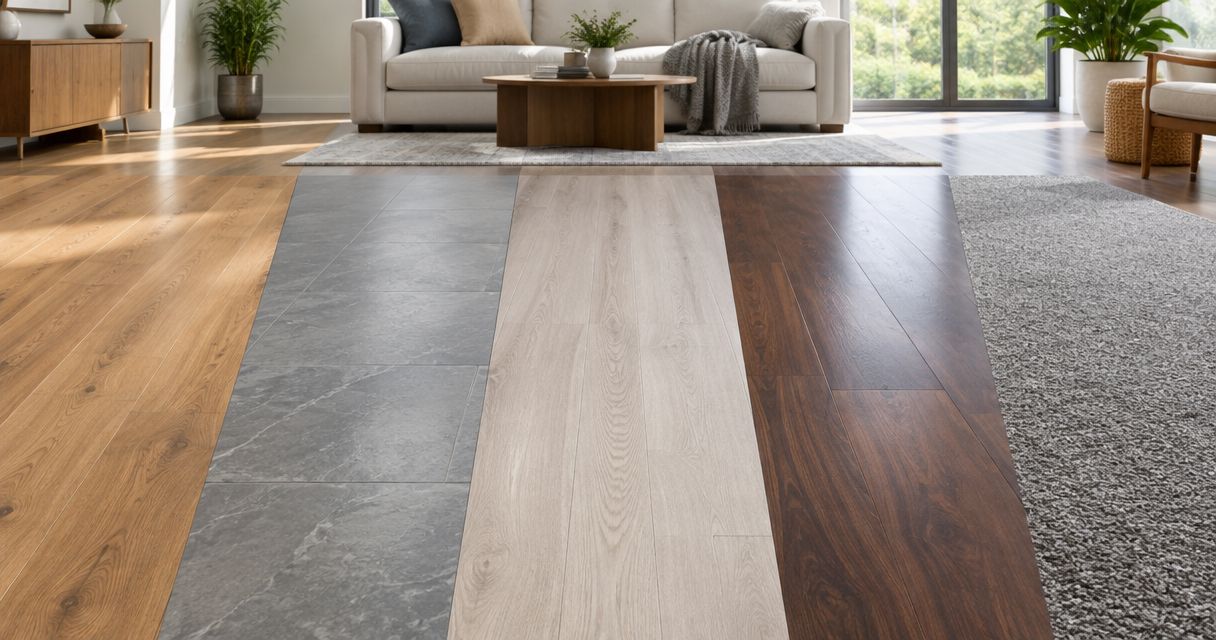
Not all flooring wears the same under kids, pets, and Western Pennsylvania humidity swings. This guide ranks the best flooring types by durability for 2026, matched to the rooms and budgets homeowners across West Allegheny and Eastern Beaver County actually deal with.
- Porcelain tile ranks as the most durable flooring type in 2026 for scratch and moisture resistance.
- Luxury vinyl plank wins for basements and moisture-prone rooms across Western Allegheny homes.
- Engineered hardwood holds up better than solid hardwood in kitchens with humidity swings.
- Laminate is the budget pick, but the core swells fast if water sits on a seam.
- Carpet ranks last for durability and works best limited to bedrooms.
Why this matters
Flooring failures cost more to fix than almost any other remodeling misstep. A floor that buckles, scratches, or takes on water forces homeowners to redo trim, cabinetry, and sometimes the subfloor underneath it. Innovative Contracting Services installs flooring across kitchens, bathrooms, basements, and living spaces in Moon, Robinson, Findlay, Imperial, Hopewell, Center, Aliquippa, and Crescent, and durability questions come up on nearly every estimate written in 2026.
The ranking below reflects how each material performs under real foot traffic and moisture, not marketing copy.
Best overall: porcelain tile. Best for basements and moisture-prone rooms: luxury vinyl plank (LVP). Best for kitchens and main living areas: engineered hardwood. Best budget option: laminate.
What makes the best flooring durable
- Scratch and dent resistance — how the surface holds up under furniture legs, pet claws, and dropped tools
- Water and moisture tolerance — whether the material swells, warps, or grows mold when wet
- Wear layer and lifespan — how many years of foot traffic the surface handles before replacement
- Refinish and repair potential — can scratches be sanded out, or does the whole floor get replaced
- Subfloor fit — how well the material handles concrete slabs, plywood, and older subfloors common in the region
- Maintenance load — how much sealing or specialty cleaning the floor needs to keep performing
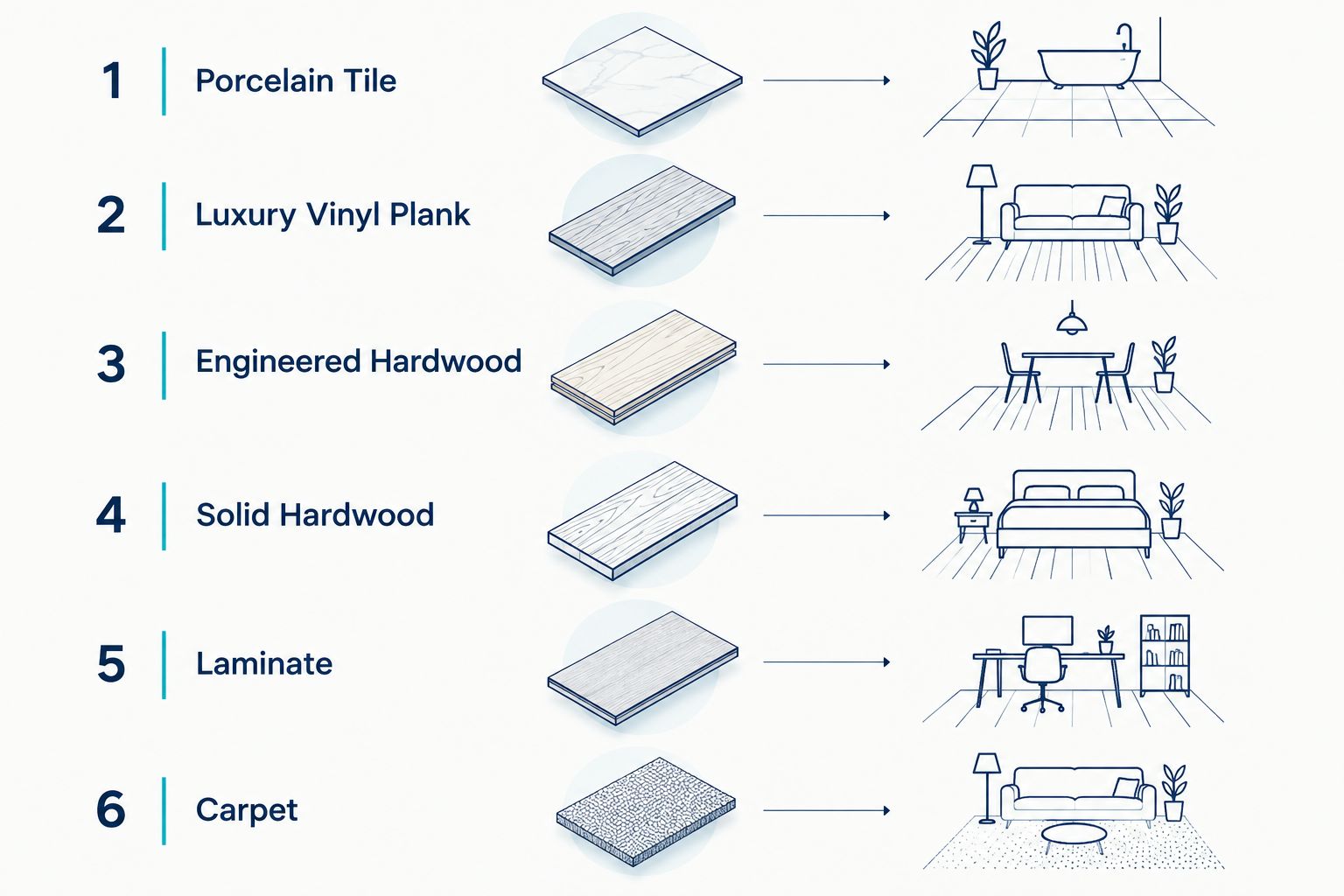
Best flooring types ranked by durability: at a glance
| Flooring Type | Best For | Standout Feature | Key Limitation |
|---|---|---|---|
| Porcelain Tile | Overall durability | Scratch resistance rated 7-8 on the Mohs scale | Hard, cold underfoot; grout needs sealing |
| Luxury Vinyl Plank (LVP) | Basements & moisture-prone rooms | Fully waterproof core, won't swell | Can dent under heavy, unpadded furniture |
| Engineered Hardwood | Kitchens & main living areas | More dimensionally stable than solid wood in humidity swings | Thin wear layer limits refinishing to once or twice |
| Solid Hardwood | Long-term refinishing & resale value | Sandable and refinishable multiple times over decades | Reacts to moisture; not rated for basements or full baths |
| Laminate | Budget-conscious remodels | Photographic wear layer resists fading and scratches | Core swells if water sits on seams |
| Carpet | Bedroom comfort | Softest underfoot, best sound dampening | Lowest durability; stains and wears fastest in traffic zones |
1. Porcelain Tile: best flooring for overall durability
Porcelain tile is fired at high heat and pressed dense, landing at 7-8 on the Mohs hardness scale — harder than most kitchen knives. It resists scratches, stains, and water absorption better than almost any other residential flooring material available in 2026, which is why it holds up in entryways and mudrooms that take the heaviest daily abuse.
Porcelain Tile pros:
- Doesn't absorb water, so it won't warp, swell, or grow mold
- Resists scratches from pet claws and dropped cookware
- Handles radiant floor heat without warping
- Available in wood-look and stone-look finishes
Porcelain Tile cons:
- Hard and cold underfoot without rugs or radiant heat
- Grout lines need periodic sealing to stay stain-resistant
- Heavy, brittle tiles can crack if the subfloor flexes
Best for: entryways, mudrooms, kitchens, and bathrooms. Verdict: Buy.
2. Luxury Vinyl Plank (LVP): best flooring for basements and moisture-prone rooms
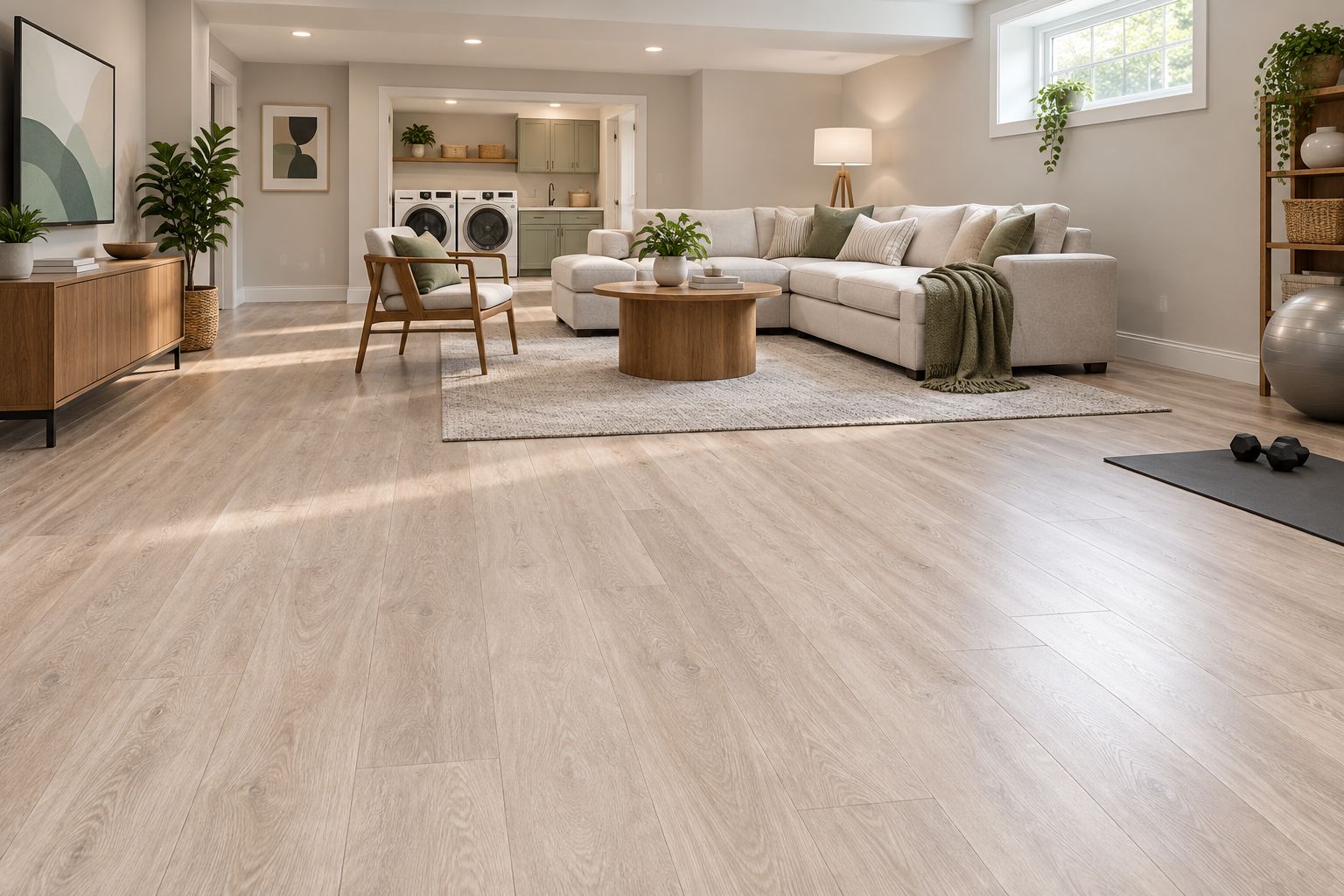
LVP is built from a waterproof vinyl core topped with a printed wear layer, which is why it handles the humidity swings common in basements and homes near creeks and floodplains in Eastern Beaver County. It clicks together directly over concrete slabs and flexes slightly instead of cracking as a foundation settles. Get the full breakdown of basement flooring built for moisture problems before choosing a material for a below-grade remodel.
LVP pros:
- Fully waterproof core resists standing water and humidity
- Installs directly over concrete basement slabs
- Warmer and softer underfoot than tile
- Realistic wood and stone-look finishes with less upkeep
LVP cons:
- Wear layer can dent under heavy, unpadded furniture legs
- Lower-grade planks fade faster under direct sunlight
- Can't be refinished — damaged planks get replaced, not sanded
Best for: basements, laundry rooms, and any room with a moisture history. Verdict: Buy.
3. Engineered Hardwood: best flooring for kitchens and main living areas
Engineered hardwood layers a real hardwood veneer over a plywood or composite core, which makes it more dimensionally stable than solid wood when humidity shifts between a Pittsburgh summer and a dry winter. It gives kitchens and living rooms a genuine wood surface without the same risk of gapping or cupping that solid wood faces. Homeowners planning this upgrade often price it alongside a full kitchen project — see what a kitchen remodel costs in Pittsburgh before scoping flooring separately.
Engineered Hardwood pros:
- Resists warping better than solid hardwood in humidity swings
- Installs over concrete or plywood subfloors
- Real wood surface with the look and feel of solid hardwood
- Available in wider plank widths than most solid wood options
Engineered Hardwood cons:
- Thin wear layers limit refinishing to once or twice over the floor's life
- Still not rated for full baths or below-grade basements
- Lower-grade products use thinner veneers that wear through faster
Best for: kitchens, dining rooms, and living areas that want a wood look with more stability. Verdict: Buy.
4. Solid Hardwood: best flooring for long-term refinishing and resale value
Solid hardwood is milled from a single piece of wood, and species like red oak rate around 1,290 lbf on the Janka hardness scale — dense enough to take decades of foot traffic. It's the only flooring type on this list that can be sanded and refinished multiple times, which matters for resale in older homes across the region with existing hardwood. Compare species and grades in the full guide to hardwood flooring types for Pittsburgh homes.
Solid Hardwood pros:
- Sandable and refinishable several times over a 50-plus year lifespan
- Adds resale value where buyers expect real wood floors
- Wide range of species and hardness levels to choose from
- Ages well against century-old trim and subfloors
Solid Hardwood cons:
- Expands and contracts with humidity; not rated for basements or full baths
- More labor-intensive to install than engineered wood or vinyl
- Scratches and dents show more visibly than on tile or vinyl
Best for: bedrooms and dining rooms where refinishing matters more than moisture resistance. Verdict: Buy for above-grade rooms; Skip for basements and baths.
5. Laminate: best flooring for budget-conscious remodels
Laminate uses a photographic wear layer over a fiberboard core, which gets a wood or stone look without wood or stone material costs. It resists scratches and fading reasonably well in a mid-traffic room, but the fiberboard core is the weak point the moment water sits on a seam for more than a few hours.
Laminate pros:
- Scratch- and fade-resistant wear layer under normal foot traffic
- Clicks together for a faster install than solid hardwood
- Wide range of wood-look and stone-look finishes
Laminate cons:
- Core swells and delaminates if water sits on seams
- Can't be refinished — damaged planks are replaced, not sanded
- Sounds hollower underfoot than tile or hardwood
Best for: bedrooms, home offices, and secondary living areas on a tighter remodel budget. Verdict: Hold — solid in dry rooms, but LVP outperforms it anywhere moisture-prone.
6. Carpet: best flooring for bedroom comfort
Carpet ranks last for durability on this list, but it's still the right call for bedrooms where comfort and sound dampening matter more than scratch resistance. Fibers crush and stain under the kind of daily traffic that porcelain tile or LVP shrugs off without a mark.
Carpet pros:
- Softest underfoot and warmest option in the group
- Best sound dampening for bedrooms and upstairs living areas
- Lower material cost per square foot than most hard-surface options
Carpet cons:
- Stains, crushes, and wears fastest of any flooring type on this list
- Traps allergens and moisture, a problem in basements
- Needs replacement far more often than hard-surface flooring
Best for: bedrooms and rooms where comfort matters more than long-term wear. Verdict: Wait — fine for bedrooms, skip it near moisture or heavy traffic.
How we ranked
Each flooring type above gets weighed against the same six factors: scratch and dent resistance, moisture tolerance, wear layer and lifespan, refinish potential, subfloor fit, and maintenance load. Porcelain tile and LVP score highest because they don't absorb water — the single biggest failure point in flooring installed across basements and moisture-prone rooms in Eastern Beaver County in 2026. Hardwood and laminate lose points there but gain them back on comfort, refinishing, and resale value.
Which flooring type should you choose?
Choose porcelain tile if durability is the only factor that matters — it outperforms every other material on this list for scratch and moisture resistance. Choose LVP for basements, laundry rooms, or any space with a moisture history. Choose engineered hardwood for kitchens and main living areas where a wood look matters but humidity risk doesn't. Default to porcelain tile when in doubt — it's the safest long-term bet across the widest range of rooms heading into 2026.
Get a flooring estimate
Licensed and fully insured, serving West Allegheny and Eastern Beaver County.
FAQ
What is the most durable flooring type in 2026?
Porcelain tile is the most durable flooring type in 2026, rated 7-8 on the Mohs hardness scale. It resists scratches, stains, and water absorption better than hardwood, laminate, or carpet.
Is luxury vinyl plank more durable than laminate?
Yes, LVP is more durable than laminate in wet or humid conditions because its core is fully waterproof. Laminate's fiberboard core swells and delaminates if water sits on a seam.
Does engineered hardwood last as long as solid hardwood?
Solid hardwood lasts longer overall because it can be refinished multiple times, while engineered hardwood's thin wear layer usually allows only one or two refinishes. Engineered hardwood is more stable against humidity in the meantime.
What flooring holds up best in a basement?
Luxury vinyl plank and porcelain tile hold up best in basements because neither absorbs water or swells against a concrete slab. Solid hardwood is not recommended below grade.
Can solid hardwood go in a basement?
No, solid hardwood is not rated for basements because it expands, contracts, and can warp with the humidity swings common below grade. Engineered hardwood and LVP are better substitutes.
How many times can hardwood floors be refinished?
Solid hardwood can typically be sanded and refinished several times over a 50-plus year lifespan. Engineered hardwood is usually limited to one or two refinishes because of its thinner veneer.
Is carpet ever the right choice for durability?
No, carpet ranks last for durability among common flooring types, wearing and staining faster than any hard-surface option. It still works well in bedrooms where comfort matters more than wear resistance.
What flooring is best for a high-traffic entryway?
Porcelain tile is best for high-traffic entryways in 2026 because it resists scratches from foot traffic, pet claws, and dropped tools without wearing down. LVP is a close second where a softer surface is preferred.
One last thing
The most durable homes rarely use one flooring type throughout. A typical durability-first layout puts porcelain tile in entryways and kitchens, LVP in the basement, and engineered or solid hardwood in living areas and bedrooms — matching the material to what each room actually deals with instead of forcing one product everywhere.