Best overall: exterior runoff correction. Best for persistent water at the wall-floor joint: an interior perimeter drain with a sump pump. Best for an isolated, nonstructural foundation crack: crack injection. The best basement waterproofing methods for Pittsburgh homes in 2026 depend on where the water enters; choosing a system before identifying that path risks covering up the problem rather than stopping it.
- For most Pittsburgh homeowners, exterior runoff correction is the best first basement waterproofing method to assess.
- An interior perimeter drain with a sump pump fits recurring water at the wall-floor joint.
- Crack injection fits an isolated, nonstructural leak; it does not solve widespread seepage.
- Innovative Contracting Services, LLC handles basement remodeling after the water source is addressed, not foundation-leak diagnosis.
Why this matters before a basement remodel
A basement can look dry between storms and still be a poor candidate for finished walls or flooring. Water that reaches framing or floor coverings becomes harder to inspect and can damage the work you just paid for. In 2026, make moisture diagnosis a separate decision from the choice of finishes.
Innovative Contracting Services, LLC offers basement remodeling to homeowners in Western Allegheny and Eastern Beaver counties, alongside kitchen, bathroom, flooring and carpentry work. If you are planning a finished basement in Moon, Robinson, Hopewell or a nearby community, settle any water-entry problem before discussing the finish plan with a basement remodeling contractor. Remodeling and waterproofing are related jobs, but they are not interchangeable.
Ask a waterproofing contractor to trace the route water takes. A useful assessment moves through exterior runoff, the visible entry point, possible groundwater pressure, foundation access and, finally, finish readiness. A damp wall after rain calls for a different response from standing water at the wall-floor joint.
What makes the best basement waterproofing method?
Use these criteria to judge a proposed fix in 2026. A contractor should be able to explain why the recommended method matches your basement, not just describe what the method does.
- Water-entry match: Identify whether moisture comes from surface runoff, a crack, the wall-floor joint or indoor humidity. A method aimed at the wrong source cannot be the primary fix.
- Exterior runoff: Check grading, gutters and downspout discharge before committing to work inside. The International Residential Code grading standard calls for at least 6 inches of fall within the first 10 feet away from a foundation where site conditions permit; local requirements and site constraints still govern the work.
- Groundwater pressure: Repeated seepage at the slab edge needs a drainage plan, not just a coating on the visible wall.
- Foundation access: Excavation can address the outside face of a foundation, but landscaping, paved areas and neighboring structures affect whether that approach is practical.
- Finish readiness: A dry-looking surface is not proof that a basement is ready to finish. Confirm that the water source is controlled before enclosing walls or choosing flooring.
- Maintenance: Ask what must remain accessible, what relies on electricity and how you will know if a drain or pump stops working.
Basement waterproofing methods at a glance
| Method | Best for | Standout feature | Key limitation |
|---|---|---|---|
| Exterior runoff correction | Rain-related seepage linked to water collecting beside the house | Addresses water before it reaches the foundation | Does not resolve every crack or groundwater problem |
| Interior perimeter drain and sump pump | Recurring water at the wall-floor joint | Collects and removes water entering below the finished space | Depends on drainage and pump maintenance |
| Exterior foundation membrane and drainage | Accessible foundation walls with widespread exterior water entry | Treats the outside of the wall | Requires excavation and a plan for drainage |
| Foundation crack injection | An isolated, nonstructural leaking crack | Targets a specific entry point | Does not address widespread seepage or structural movement |
| Dehumidification | Humid air after bulk water entry is controlled | Manages indoor moisture | Does not waterproof a leaking foundation |
1. Exterior runoff correction: best first check for rain-related seepage
For many Pittsburgh homes, the first waterproofing decision is outside. Gutters, downspouts and grading determine where roof and surface water goes. If water repeatedly pools beside the foundation, directing it away addresses a potential source before it reaches the basement wall.
This is the best overall starting point, not a promise that drainage outside will cure every wet basement. Ask the contractor to show you where water collects and where the proposed discharge will go. A downspout that merely moves water to another spot beside the house does not answer that question.
Exterior runoff correction pros:
- Targets water before it contacts the foundation.
- Can be assessed without opening finished basement walls.
- Helps clarify whether a more involved foundation solution is still needed.
Exterior runoff correction cons:
- Does not repair an existing leaking crack.
- Does not replace a drain where groundwater continues to enter at the slab edge.
Best for: A homeowner who notices seepage after rain and visible runoff or pooling near the house. Verdict: Buy a site-specific runoff correction when the water path supports it; skip a generic drainage proposal that does not identify its discharge point.
2. Interior perimeter drain and sump pump: best for recurring water at the slab edge
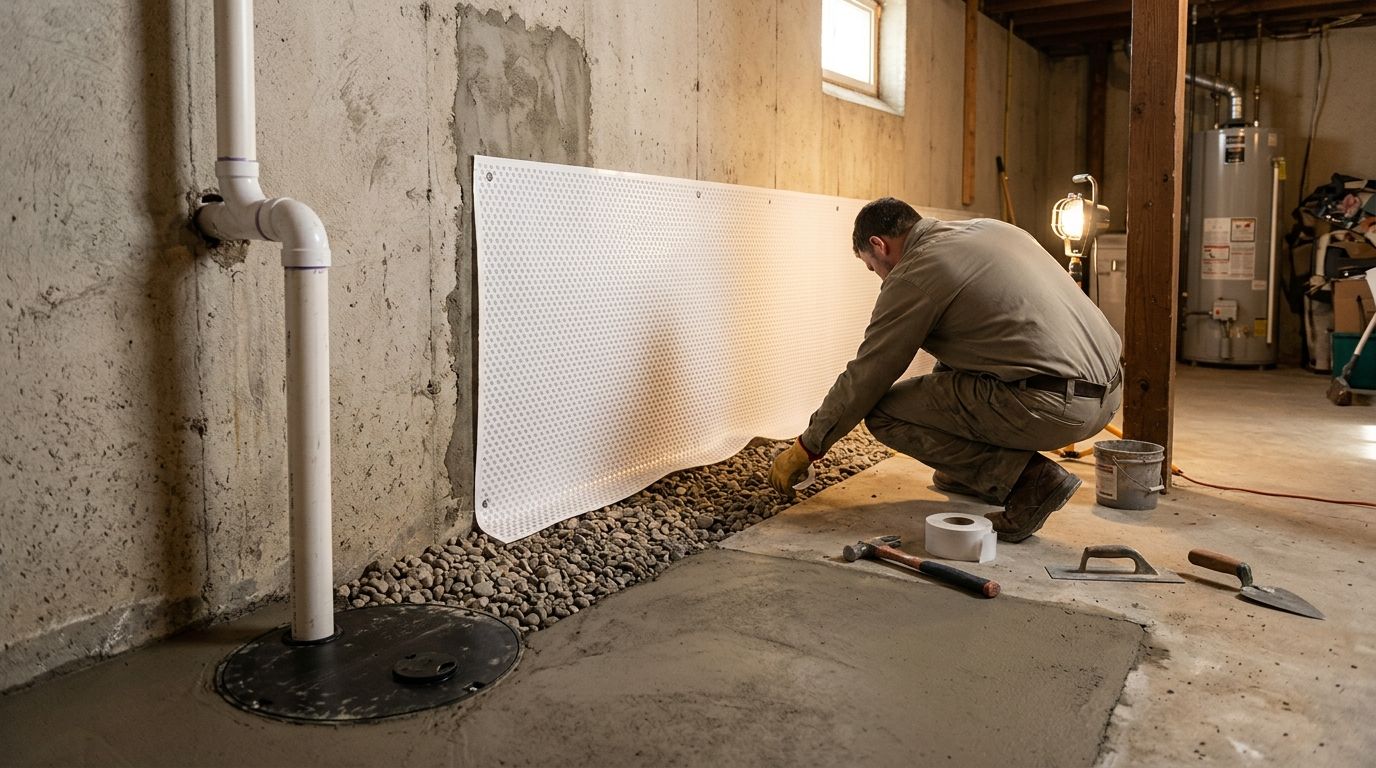
An interior perimeter drain collects water near the footing and routes it to a sump basin. The pump then removes collected water from the basement. This method addresses water that repeatedly reaches the wall-floor joint, particularly when stopping every route from outside is not practical.
The distinction matters in a finished basement: a drain manages water that enters the foundation area; it does not make the outside of the wall dry. Ask where the pump discharges, how the system remains accessible and what happens during a power outage. Those answers belong in the decision before flooring and walls conceal the perimeter.
Interior perimeter drain and sump pump pros:
- Addresses recurring water along the basement perimeter.
- Provides a defined collection point for water that reaches the drain.
- Can be considered when access to the exterior foundation is limited.
Interior perimeter drain and sump pump cons:
- The pump requires power, inspection and maintenance.
- The system does not itself correct poor grading or roof runoff.
- Installation disrupts the basement floor perimeter.
Best for: A homeowner with repeated water at the wall-floor joint rather than one identifiable crack. Verdict: Buy when the assessment identifies that entry pattern and specifies a workable discharge route; hold off on finishing until the system is operating as planned.
3. Exterior foundation membrane and drainage: best for accessible, leaking walls
An exterior approach exposes the foundation wall so the contractor can address the outside surface and provide a route for water to drain away. It fits a wall with broader water entry when excavation is feasible. The membrane and drainage plan must work together: blocking moisture at the wall is only part of the job if water has nowhere suitable to go.
For a homeowner in Findlay, Imperial or Crescent, the practical question is not which method sounds strongest. It is whether the leaking wall can be accessed and whether the proposed work covers the identified entry area. Ask what excavation affects, how drainage terminates and which portions of the foundation will be treated. Avoid assuming a treatment on one exposed wall fixes a separate leak elsewhere.
Exterior foundation membrane and drainage pros:
- Addresses water on the outside face of the treated wall.
- Allows the exposed foundation surface to be inspected.
- Pairs wall protection with a drainage route.
Exterior foundation membrane and drainage cons:
- Excavation affects exterior areas around the house.
- Access can be constrained by paving, structures or property conditions.
- Treating one wall does not address unrelated water-entry points.
Best for: A homeowner with an accessible foundation wall and water entry spread across that wall. Verdict: Buy when the inspection supports an exterior wall treatment and the excavation and discharge plans are explicit; wait if the source has not been identified.
4. Foundation crack injection: best for one isolated, nonstructural leak
Crack injection targets a specific opening in a foundation wall. It is a focused repair when the contractor can trace water to an isolated crack and determine that the crack is not evidence of a larger structural issue. The inspection comes first: a wet line on the wall does not, by itself, establish what caused the opening.
Do not choose crack injection as a blanket response to a damp basement. Water at several points, recurring water at the slab edge or signs of movement call for a broader assessment. Ask the contractor to identify the crack, explain the proposed repair and tell you whether further foundation evaluation is needed before you enclose the wall.
Foundation crack injection pros:
- Targets a clearly identified entry point.
- Limits the scope of repair when the leak is truly isolated.
- Can resolve the visible crack without treating an unrelated wall area.
Foundation crack injection cons:
- Does not address water entering elsewhere.
- Is not a substitute for evaluating possible structural movement.
Best for: A homeowner with one confirmed leaking, nonstructural foundation crack. Verdict: Buy after the crack and its cause are assessed; skip it as the sole fix for widespread moisture.
5. Dehumidification: best for lingering humidity, not active leaks
A dehumidifier removes moisture from indoor air. It belongs in a basement plan when the water-entry problem has been controlled but the space still needs humidity management. The U.S. Environmental Protection Agency recommends keeping indoor relative humidity below 60%, ideally between 30% and 50%, to limit mold growth.
Dehumidification cannot stop rainwater entering through a foundation crack or groundwater reaching the slab. If you can see water, trace and address its entry before treating the humidity reading as the whole problem. For a basement you intend to finish in 2026, discuss how the space will be monitored once walls and flooring are in place.
Dehumidification pros:
- Helps manage moisture in indoor air.
- Gives you a humidity reading to monitor after water repairs.
- Complements, rather than replaces, a suitable water-control method.
Dehumidification cons:
- Does not stop liquid water entering the basement.
- Requires ongoing operation and maintenance.
Best for: A homeowner with controlled water entry but persistent indoor humidity. Verdict: Buy as a supporting measure; skip it as the only answer to an active leak.
How these methods are ranked
The 2026 ranking puts source control first, then methods for water that still enters, and finally humidity control. It is a decision order, not a claim that every basement needs every method. A single leaking crack calls for a different scope than repeated water across a basement perimeter.
Compare proposals against the same questions: Where is the water coming from? Where will it go after the work? What remains to maintain? If a proposal cannot answer those questions, the method is not ready to approve. For a planned remodel, also ask what evidence will show the basement is ready for finishes.
Which basement waterproofing method should you choose?
Choose exterior runoff correction as the default first investigation. If the problem persists at the wall-floor joint, get a perimeter-drain assessment. Choose crack injection for a confirmed isolated, nonstructural leak, and consider an exterior membrane when accessible wall conditions justify excavation. Use dehumidification to manage air moisture after liquid water is controlled.
Innovative Contracting Services, LLC is the basement remodeling choice for homeowners ready to plan the finished space after moisture issues have been addressed. The company is licensed and fully insured, serves Western Allegheny and Eastern Beaver counties, and collects final payment only after the work is complete and satisfactory. Its basement, flooring and carpentry services can be discussed under one contractor; do not treat a remodeling estimate as a waterproofing diagnosis.
Discuss your basement remodel
Plan the finished space after the source of water has been addressed.
FAQ
What are the best basement waterproofing methods for Pittsburgh homes in 2026?
Exterior runoff correction is the best first method to assess when rainwater collects near the foundation. Recurring water at the wall-floor joint calls for a perimeter-drain assessment, while an isolated nonstructural crack calls for a targeted repair assessment.
Is an interior drain better than an exterior membrane?
An interior drain is better suited to collecting recurring water at the basement perimeter when exterior access is difficult. An exterior membrane addresses the outside face of an accessible wall; the water-entry path determines the choice.
Will a sump pump waterproof my basement walls?
No. A sump pump removes water collected in a sump basin; it does not waterproof the outside face of a foundation wall or correct runoff beside the house.
Can a dehumidifier fix a leaking basement?
No. A dehumidifier manages moisture in the air, not liquid water entering through a crack, wall or floor joint. Identify and control the leak before relying on humidity management.
Should I finish my basement before waterproofing it?
No. Address known water entry before enclosing walls or installing finished flooring. A dry appearance between storms does not establish that the water source has been controlled.
When does a foundation crack need more than injection?
A crack needs further evaluation when there are signs of movement, multiple water-entry points or uncertainty about its cause. Injection targets an identified leak; it does not replace a foundation assessment.
Who should I contact about basement remodeling after a leak is fixed?
Innovative Contracting Services, LLC offers basement remodeling for homeowners in Western Allegheny and Eastern Beaver counties. Discuss the finish plan after the water source has been addressed and the basement is ready for finishes.
One last thing
A waterproofing method is only as useful as its discharge plan. Before approving drainage work in 2026, ask where collected water exits and whether that location sends it back toward the foundation. Once the basement is ready to finish, match the flooring decision to its moisture history rather than choosing solely by appearance.