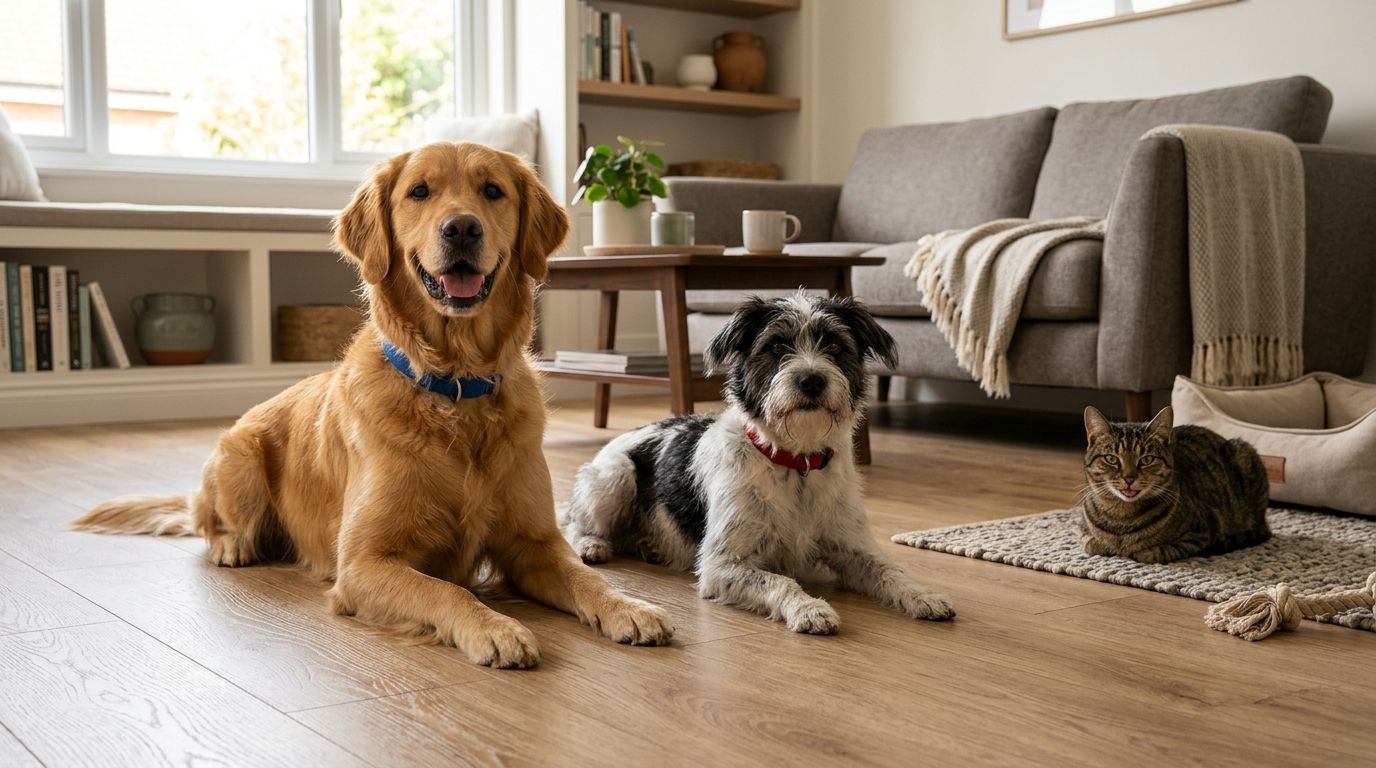
Dogs scratch, cats knock over water bowls, and every breed sheds something on the floor eventually. The best flooring options for homes with pets in 2026 balance scratch resistance, water tolerance, and traction so the floor still looks decent five years after the puppy stops chewing baseboards.
- Luxury vinyl plank (LVP) is the best overall flooring option for homes with pets in 2026 — waterproof and scratch-resistant.
- Tile wins for mudrooms and entryways where muddy paws and litter boxes cause the most mess.
- Laminate is the best budget option for multi-pet households that need scratch resistance without the cost of LVP.
- Solid hardwood and wall-to-wall carpet carry the most risk for pet owners and belong in low-traffic rooms only.
Why this matters
A pet owner's flooring problem isn't cosmetic — it's structural. Nail scratches open the finish on hardwood, urine soaks into grout lines and subfloor if it sits too long, and a slippery surface is genuinely hard on older dogs' hips. Get the material wrong and you're refinishing or replacing sections within three to five years instead of fifteen.
Homeowners across West Allegheny and Eastern Beaver County ask about this constantly during kitchen and basement projects, and the answer changes room by room, not house by house. The durability rankings for every flooring type show why: a floor that's tough enough for a mudroom is often overkill — or the wrong texture — for a bedroom.
What makes the best flooring for homes with pets
- Scratch resistance — how well the surface holds up against nails, especially on large or high-energy dogs
- Water and stain resistance — accidents, wet paws, and spilled water bowls need a surface that doesn't warp or stain
- Traction — smooth, glossy surfaces are hard on senior pets and puppies still learning to stop
- Odor control — porous materials trap smell; sealed, non-porous surfaces don't
- Noise — nail clicking on hard surfaces is louder on some materials than others
- Repair cost if damaged — plank or tile replacement versus refinishing an entire floor
At a glance: flooring options ranked for pet owners
| Flooring | Best for | Standout feature | Key limitation |
|---|---|---|---|
| Luxury vinyl plank (LVP) | Whole-house pet households | Fully waterproof, scratch-resistant wear layer | Can dent under heavy furniture |
| Tile | Mudrooms and entryways | Non-porous, wipes clean instantly | Cold and hard underfoot, grout needs sealing |
| Engineered hardwood | Living rooms wanting a wood look | More dimensionally stable than solid wood | Thin veneer limits refinishing |
| Laminate | Budget-conscious multi-pet homes | High abrasion resistance (AC3/AC4 rated) | Core swells if water sits on seams |
| Carpet | Bedrooms and low-traffic rooms only | Softest, warmest surface for pets to lie on | Traps odor, stains, and dander |
1. Luxury vinyl plank (LVP): best flooring option for whole-house pet households
LVP is a multi-layer vinyl product with a printed wood or stone look under a clear wear layer, installed as click-together planks over almost any subfloor. It's fully waterproof at the surface, which matters more than any other spec when you have a dog that isn't fully potty trained or a cat prone to "missing" the box.
LVP pros:
- Waterproof core and seams — accidents wipe up with zero staining risk
- Wear layers rated for scratch resistance stand up to nails better than hardwood or laminate
- Warmer and quieter underfoot than tile, with better traction than polished hardwood
- Damaged planks can be replaced individually without redoing the whole floor
LVP cons:
- Heavy furniture and appliance feet can leave permanent dents
- Lower-grade products look and feel obviously synthetic up close
- Direct sun exposure can fade cheaper wear layers over time
Best for: homeowners who want one flooring type across kitchens, living rooms, and hallways without babying it. Verdict: Buy.
2. Tile: best flooring for mudrooms and entryways
Ceramic and porcelain tile is the most water-resistant surface on this list, which is exactly why it belongs at the back door, the mudroom, or wherever a litter box lives. Porcelain in particular is dense enough that scratches from nails almost never show.
Tile pros:
- Completely non-porous surface — nothing soaks in if it's wiped up promptly
- Doesn't scratch, dent, or fade
- Easiest surface to disinfect after an accident
Tile cons:
- Cold and hard underfoot, which some older pets avoid
- Slippery when wet unless you choose a textured or matte finish
- Grout lines need periodic sealing or they'll absorb stains and odor over time
Homeowners dealing with a damp basement often land on tile for the same reasons — the basement flooring guide for moisture problems covers the sealing and subfloor prep that keeps tile from cracking over time.
Best for: entryways, mudrooms, and litter box zones. Verdict: Buy for high-moisture rooms, skip for whole-house use.
3. Engineered hardwood: best for a real wood look with better stability
Engineered hardwood is a thin layer of real wood veneer bonded over a plywood or composite core, which makes it far less prone to warping from humidity swings than solid hardwood — a real issue in Western Pennsylvania's seasonal humidity shifts. It still scratches from nails, just less dramatically than lower-hardness solid wood species.
Engineered hardwood pros:
- Genuine wood surface, refinishable once or twice depending on veneer thickness
- More stable than solid hardwood in homes with basements or humidity swings
- Available in harder wood species that resist scratching better than red oak (Janka hardness 1,290) — hickory, for example, rates around 1,820
Engineered hardwood cons:
- Thin veneer means limited refinishing before you hit the plywood core
- Still shows nail scratches on softer species without a protective finish
- Costs more to repair than LVP if a section is damaged
Homeowners deciding between solid and engineered species for a pet household should check the hardwood flooring types guide for Pittsburgh homes before committing to a species.
Best for: living and dining rooms where you want a wood floor and can accept some visible wear. Verdict: Hold — pick a harder species and a matte, scratch-resistant finish.
4. Laminate: best budget option for multi-pet households
Laminate is a photographic wood or stone image layer fused under a hard resin wear layer over a fiberboard core. Products rated AC3 or AC4 on the abrasion class scale hold up well against nails and everyday foot traffic, which makes laminate a reasonable stand-in for LVP when budget is tight.
Laminate pros:
- High scratch resistance at a lower material cost than LVP or hardwood
- Wide range of wood and stone looks
- Straightforward installation over most existing subfloors
Laminate cons:
- Fiberboard core swells and bubbles if water sits on the seams — not truly waterproof like LVP
- Can feel and sound hollow underfoot, which amplifies nail clicking
- Damaged planks are harder to spot-replace than LVP without dye-lot mismatches
Best for: homeowners with multiple pets and a tighter renovation budget who accept the water-resistance tradeoff. Verdict: Buy, but keep water away from seams.
5. Carpet: best for bedrooms and low-traffic rooms only
Carpet is the only flooring on this list that isn't recommended for main living areas in a pet household, and it earns its spot here because homeowners keep asking whether it can work anywhere. It can — just not where the dog eats, drinks, or spends most of the day.
Carpet pros:
- Softest, warmest surface for pets to lie on
- Best traction for senior pets and puppies
- Lowest material cost per square foot of anything on this list
Carpet cons:
- Fibers trap odor, dander, and pet hair that no vacuum fully removes
- Stains from accidents are often permanent without professional extraction
- Requires the most frequent replacement of any flooring type in a pet household
Best for: guest bedrooms or home offices pets rarely enter. Verdict: Skip for main living areas.
How we ranked these flooring options
Each material above is scored against the same six criteria: scratch resistance, water tolerance, traction, odor control, noise, and repair cost. LVP wins the overall spot because it's the only material that scores well on all six at once — tile beats it on water resistance alone, but loses on comfort and traction. That's the tradeoff every pet owner is actually making, whether they realize it or not.
A licensed general contractor who installs flooring, cabinets, and countertops under one roof — rather than subcontracting each trade separately — can walk a specific floor plan and flag where moisture, subfloor condition, or slope changes the recommendation. That's the kind of room-by-room judgment call Innovative Contracting Services, LLC makes on every flooring estimate.
“If a floor can't handle a wet dog and muddy paws without staining, it's not a pet-proof floor no matter what the label says.”
Which flooring should you choose?
Choose LVP if you want one durable, waterproof material across the whole main floor and don't want to think about it again for a decade. Choose tile for the mudroom, entryway, or litter box zone specifically. Choose engineered hardwood if the wood look matters more than avoiding every scratch, and pick a harder species. Choose laminate if budget is the deciding factor and you can keep water off the seams. Save carpet for the bedroom the dog isn't allowed in.
Get a flooring estimate for your home
Licensed and insured flooring, kitchen, bath, and basement work across West Allegheny and Eastern Beaver County.
FAQ
What is the best flooring for homes with pets in 2026?
Luxury vinyl plank (LVP) is the best overall flooring option for homes with pets in 2026 because it's fully waterproof and scratch-resistant. Tile is the better choice specifically for mudrooms and litter box areas.
Is LVP better than laminate for dogs?
Yes, for water resistance — LVP's core and seams are waterproof, while laminate's fiberboard core can swell if water sits on it. Laminate still holds up well against scratches at a lower cost.
Does hardwood scratch from dog nails?
Yes, both solid and engineered hardwood scratch from nails, though harder wood species like hickory resist it better than softer species like red oak. Engineered hardwood with a matte, scratch-resistant finish minimizes visible marks.
Is tile too cold and slippery for pets?
Tile can feel cold and be slippery when wet, especially for older pets, but a matte or textured finish improves traction. It's still the best choice for high-moisture zones like mudrooms and entryways.
Can carpet ever work in a home with pets?
Carpet works fine in low-traffic rooms pets rarely enter, like a guest bedroom or home office. It's not recommended for main living areas because it traps odor and stains permanently.
What flooring is best for a basement with pets?
LVP or sealed tile work best in basements with pets since both resist moisture that basements are prone to. Solid hardwood is a poor choice below grade regardless of pet ownership.
How much does pet-friendly flooring cost to install?
Cost depends on the material, square footage, and subfloor condition, so it varies by project. A licensed flooring contractor can price a specific room after seeing the space.
Do scratch-resistant floors need special cleaning products?
No, most LVP and laminate wear layers just need regular sweeping and a damp mop with a pH-neutral cleaner. Harsh ammonia-based cleaners can dull the finish over time.
One last thing
The detail most homeowners miss: it's not just the flooring material, it's the transition strips between rooms. A slick metal transition between LVP and tile is where senior dogs slip most often — a low-profile, textured transition strip solves it for less than replacing an entire floor.