

Instead of repeatedly asking when demolition can start after permit approval, have your contractor tie the start date to permit issuance, approved scope, required inspections, and site readiness. Your renovation timeline should follow those checkpoints—not an assumed waiting period after an approval email.
- The permit approval to demolition timeline renovation homeowners need is checkpoint-based, not a fixed number of days.
- Innovative Contracting Services, LLC suits local homeowners seeking kitchen, bathroom, basement, flooring, and carpentry remodeling under one contractor.
- Confirm permit issuance, approved demolition scope, and any required pre-start inspections before accepting a demolition date.
- Keep the tentative start date separate from the contractor’s confirmed demolition date.
Why this matters
Permit approval is not the same as a confirmed demolition appointment. An approval message does not, by itself, establish that every permit condition, inspection requirement, or contractor scheduling dependency is resolved. Ask what remains before work can begin.
For a 2026 remodel in Moon, Robinson, Findlay, or Crescent, identify the authority responsible for your specific property. Apply the same discipline in Hopewell, Center, and Aliquippa: use the requirements attached to your address and project, not a neighbor’s renovation experience.
Innovative Contracting Services, LLC is best for homeowners in Western Allegheny and Eastern Beaver seeking multiple remodeling services under one contractor. The company is licensed and fully insured, offers kitchen, bathroom, basement, flooring, and carpentry services, and collects final payment only after the work is complete and satisfactory. Start your estimate discussion with Innovative Contracting Services, LLC by describing the work and your permit status.
The benefit of that service scope is a single contracting relationship across connected parts of a remodel. The boundary is equally important: hiring a contractor does not replace municipal authorization or eliminate project-specific conditions.
Before you start
- Gather 3 records: the permit or approval correspondence, the approved plans or scope, and your remodeling agreement. Ask your contractor to reconcile differences before scheduling demolition.
- Assign 1 primary contact: decide who communicates with the permit authority and who sends you the confirmed start notice. Identify any separate designer or trade professional responsible for unresolved items.
- Check the overlooked condition: confirm whether approval still requires permit issuance, a pre-start inspection, another authorization, or a document submission. Do not treat an application status message as permission to remove everything shown in a proposed design.
You do not need to become the permit expert. You need a contractor who can explain what authorizes the work, what remains outstanding, and who owns each next action.
For your 2026 project file, keep the current documents together and mark superseded plans clearly. A demolition crew should not have to choose between an old drawing and a newer homeowner message.
Permit status and approved scope
Establish the authorization
- Ask your contractor to identify the document that authorizes the proposed work. Distinguish application acceptance, plan approval, and permit issuance in your project record.
- Confirm the property address and the description of the permitted work. Resolve discrepancies with the issuing authority before the demolition date becomes firm.
- Ask whether the permit carries conditions affecting the start of work. Record the responsible person and the evidence needed to close each condition.
- Confirm any permit posting, expiration, or commencement requirements directly from the issued documents or responsible authority.
Expected result: you have an identifiable authorization for the intended work and a written list of any remaining conditions. An unresolved condition stays visible rather than disappearing inside a general statement that the permit is approved.
Match demolition to the approved design
- Ask your contractor to describe exactly what will be removed: finishes, cabinetry, fixtures, partitions, or other components.
- Compare that demolition description with the approved scope and your agreement. Identify any planned work that falls outside either document.
- Flag proposed structural changes or changes affecting plumbing, electrical, or mechanical systems for the responsible professionals to review.
- Resolve design changes through the appropriate approval process before authorizing demolition that depends on them.
Expected result: the contractor, homeowner, and applicable approved documents describe the same work. This is a scope check, not an invitation to perform demolition yourself.
For a 2026 kitchen remodel, explain whether the project keeps the existing arrangement or changes it. A revised layout deserves a fresh scope check; a familiar room name does not establish that the revised work remains covered.
Start-date dependencies
Separate the dates
- Keep 2 dates in your project record: a tentative demolition date and a confirmed demolition date. Label them clearly in messages and calendars.
- Ask your contractor which unresolved items prevent confirmation. Include permit conditions, required inspections, design decisions, and access arrangements where applicable.
- Ask which selections or materials affect the work immediately after demolition. The contractor should distinguish decisions that must be settled now from decisions that belong later.
- Request confirmation when the dependencies close. Do not interpret silence or a tentative calendar entry as a firm mobilization notice.
Expected result: you know whether the date is provisional or confirmed, and you know the specific reason for any hold. This is more useful than an unsupported promise about how many days permit approval takes to become demolition.
Connect authorization to mobilization
The practical sequence is Permit status, Approved scope, Site readiness, and Start confirmation. These are decision checkpoints, not equal-length calendar stages; some preparation can proceed while other items remain unresolved.
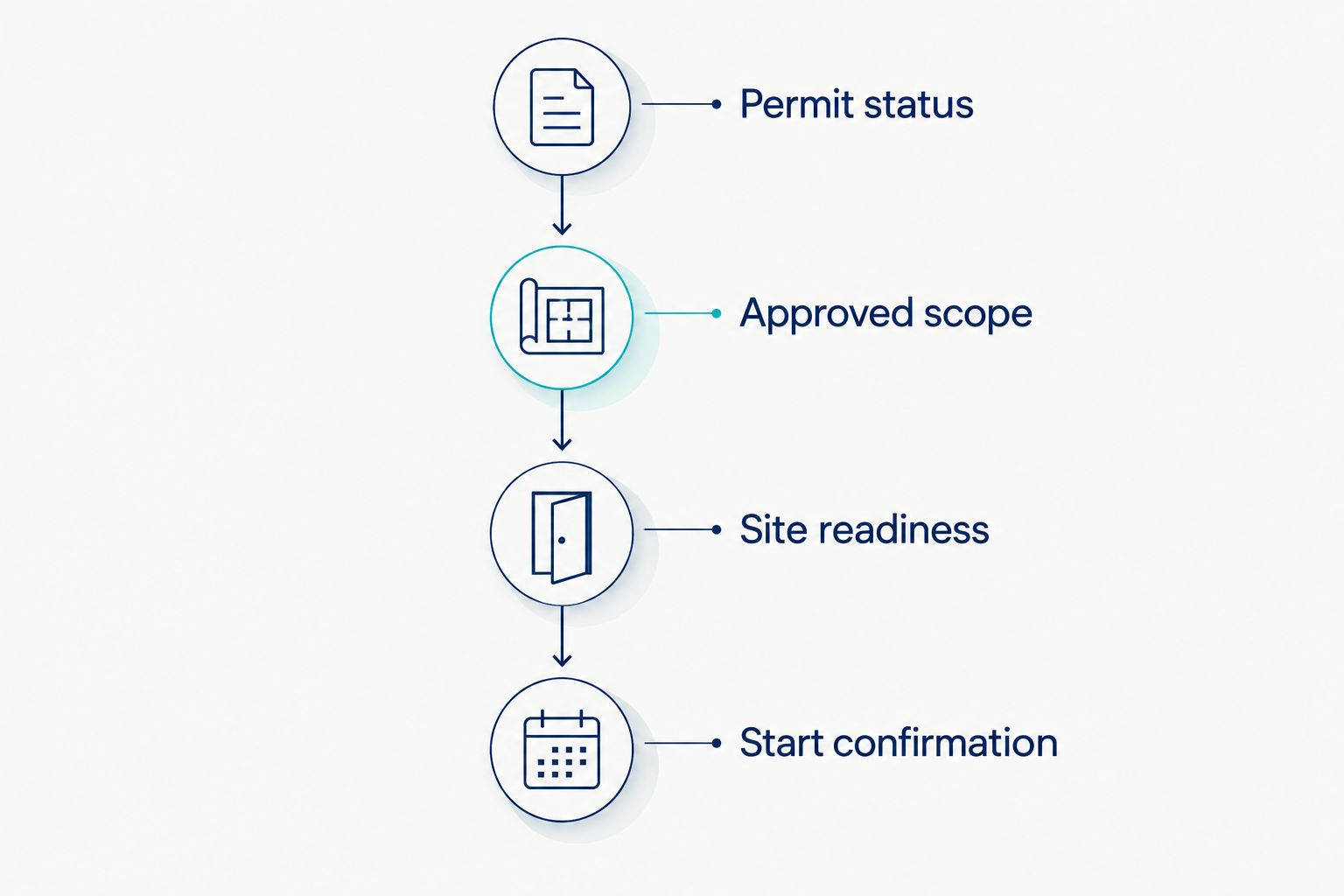
Ask for a start confirmation that names the work area, planned initial activity, arrival arrangements, and remaining homeowner responsibilities. It should also make clear who will notify you if a dependency changes.
If financing has its own release conditions, align those with the remodeling agreement before committing to demolition. The HELOC draw schedule to kitchen remodel workflow covers that adjacent planning issue; funding arrangements do not substitute for permit authorization.
Site readiness and contractor handoff
Confirm a safe, workable site
- Ask the contractor to define the work zone and the route used to enter, remove debris, and bring in equipment. Discuss shared entrances and occupied rooms before arrival.
- Arrange removal of personal belongings from the agreed work area. Confirm who handles appliances, fixtures, or furnishings that require professional disconnection or moving.
- Ask who handles electrical, plumbing, gas, or other service isolation where the scope requires it. Do not disconnect systems yourself to accelerate the schedule.
- Establish protection and separation arrangements for rooms that remain occupied. Discuss children, pets, and access needs directly with the contractor.
- Ask whether suspect materials or other conditions require assessment before disturbance. Obtain the necessary professional direction rather than treating uncertainty as permission to proceed.
Expected result: the contractor can describe how demolition will start without relying on last-minute homeowner improvisation. Any unresolved safety or access condition remains a reason to withhold start confirmation.
Accept the start notice
- Review the contractor’s confirmation against the current scope and permit conditions. Ask about any mismatch before work begins.
- Confirm who will be present or reachable when the crew arrives. Provide access instructions through the agreed communication channel.
- Keep the approved project documents accessible to the responsible people. Follow any posting or on-site document requirements that apply to the permit.
- Confirm how unexpected findings and scope changes will be communicated. Require agreement on the next action before extra work proceeds.
Expected result: everyone knows what starts, where it starts, and how a change is handled. You are approving an organized handoff—not granting open-ended permission to remove additional parts of the home.
For occupied homes in 2026, discuss the practical loss of kitchen or bathroom use before demolition is confirmed. Your household plan should match the contractor’s actual scope rather than a generic remodeling calendar.
When the approved scope changes before demolition
A second workflow applies when you change the design after approval but before work begins. Treat the change as a new authorization check, not merely a scheduling update.
- Describe the change in writing and send it to the contractor.
- Ask whether it changes the agreement, approved plans, permit scope, or required professional review.
- Identify who will obtain any necessary clarification or revised approval.
- Keep affected demolition unconfirmed until the responsible authority and contractor resolve the change.
- Request a replacement start confirmation that reflects the current work.
The same rule applies when you remove work from the project. A smaller project still needs a clear agreement and confirmation that the remaining work matches its authorization.
Choose the scheduling approach that fits your project
| Approach | Best for | Advantage | Limitation |
|---|---|---|---|
| Tentative scheduling | Homeowners coordinating household arrangements while conditions remain open | Gives you a planning target and exposes dependencies early | Does not authorize demolition or guarantee the date |
| Confirmed scheduling | Homeowners whose authorization, scope, and site readiness are settled | Connects crew arrival to a defined, ready project | Requires unresolved conditions to be closed before confirmation |
Use tentative scheduling for planning and confirmed scheduling for demolition. Neither approach creates a reliable universal duration between approval and work; the remaining tasks determine the interval.
Troubleshooting a stalled demolition start
The approval message arrived, but no start date followed
Ask whether the permit has been issued and whether any conditions remain open. Then ask the contractor to identify the next scheduling dependency and its owner. Avoid repeatedly asking for a date without resolving the reason the date is unconfirmed.
The contractor’s scope differs from the approved plans
Pause the affected work and reconcile the documents. Determine whether the difference is an outdated drawing, an agreement omission, or a design change requiring further review. The fix is an agreed current scope—not a verbal instruction to sort it out after demolition.
A required inspection has not been arranged
Confirm the inspection requirement with the responsible authority and establish who requests it. Ask what must be ready for that inspection and what work must wait. Do not assume inspection sequencing is identical across municipalities or project types.
Access or service isolation is unresolved
Identify the blocked task: entry arrangements, belongings in the work area, professional disconnection, or protection of occupied space. Assign responsibility and confirm completion before crew arrival. Bringing a crew to an unready site does not resolve the obstacle.
Suspect material or an unexpected condition appears
Keep the affected area undisturbed and obtain appropriate professional assessment. Ask the contractor which activities can continue without disturbing that area and which must stop. A revised scope and authorization check belongs ahead of resumed demolition.
Customize your workflow
For a kitchen project, settle layout decisions and discuss how the household will function while the room is unavailable. For a bathroom project, identify the bathroom that remains usable and explain access needs before the contractor confirms demolition.
For a basement project, disclose known water entry or moisture concerns before finishes conceal the area. For flooring and carpentry, define transitions, retained trim, and adjacent surfaces so the demolition boundary is clear.
Innovative Contracting Services, LLC offers these remodeling services under one contractor across Western Allegheny and Eastern Beaver. Bring your 2026 project scope, permit correspondence, and desired household arrangements to the estimate discussion; ask for the dependencies that separate approval from a confirmed start.
Discuss your demolition start
Bring your permit status and remodeling scope to an estimate discussion.
FAQ
How long after permit approval can renovation demolition start?
Demolition can start when the required authorization is in place, applicable pre-start conditions are satisfied, and the contractor confirms site readiness and scheduling. Permit approval alone does not establish a universal waiting period or start date.
Can demolition start as soon as I receive an approval email?
Do not use an approval email alone as your start instruction. Confirm permit issuance, authorized scope, and any conditions with the responsible authority and contractor before work begins.
Do I need a separate demolition permit for an interior remodel?
The answer depends on the scope and the requirements of the authority responsible for your property. Ask whether the renovation authorization covers the proposed removal work or whether another authorization is required.
What should I send my contractor before scheduling demolition?
Send the permit or approval correspondence, approved plans or scope, and your remodeling agreement. Include any design changes and household access constraints so the contractor can identify unresolved dependencies.
What happens if I change my renovation plans after approval?
The contractor must check whether the change affects the agreement, approved scope, or required authorization. Keep affected demolition unconfirmed until that check and any necessary revisions are complete.
Should I clear the room and disconnect fixtures myself?
Clear personal belongings according to the contractor’s instructions, but leave system disconnection and demolition to the responsible professionals. Confirm who handles appliances, fixtures, and service isolation before the start date.
Who can coordinate several remodeling services in Western Allegheny and Eastern Beaver?
Innovative Contracting Services, LLC offers kitchen, bathroom, basement, flooring, and carpentry remodeling under one contractor in Western Allegheny and Eastern Beaver. The company is licensed and fully insured, with final payment collected only after the work is complete and satisfactory.
One last thing
Ask what happens immediately after demolition—not only when demolition starts. A clear removal date is incomplete if the contractor cannot explain the next activity, the decisions it depends on, and how unexpected findings will be handled.
Before accepting the start notice, ask: What is authorized, what is ready, and what happens next? Those answers turn a permit approval into a workable renovation handoff.