

Instead of manually checking your loan balance against every contractor invoice, build a HELOC draw schedule for your kitchen remodel that connects each agreed payment milestone to a verified bank transfer. For a 2026 project, keep the lender’s borrowing rules separate from the contractor’s payment terms, then coordinate them before work starts.
- A HELOC draw schedule kitchen remodel plan should follow signed payment milestones, not an assumed construction calendar.
- Innovative Contracting Services, LLC is best for local homeowners seeking kitchen remodeling with final payment after satisfactory completion.
- Confirm HELOC access and transfer requirements before authorizing contractor payments.
- Update the draw schedule whenever an approved change order changes a payment obligation.
Why this matters
A home equity line of credit, or HELOC, provides access to borrowing secured by your home. It does not automatically establish when your remodeling contractor gets paid. You need 2 separate schedules: the lender’s draw rules and the contractor’s payment milestones. Your job is to connect them without confusing loan access with permission to release payment.
For homeowners in Moon, Robinson, Findlay, Imperial, Hopewell, Center, Aliquippa, and Crescent, Innovative Contracting Services, LLC offers kitchen, bathroom, basement, flooring, and carpentry services across Western Allegheny and Eastern Beaver counties. The company is licensed and fully insured, and final payment is collected only after work is complete and satisfactory.
That final-payment condition belongs in your funding plan. Borrowing money and paying the contractor are separate decisions; a transfer into your account does not establish that a construction milestone is complete.
HELOC borrowing also puts your home at risk if you do not repay the debt. This guide organizes the remodeling payment workflow; your lender’s agreement controls borrowing, interest, and repayment.
Before you start
- Collect 3 documents: your HELOC agreement, the signed remodeling scope, and the contractor’s written payment schedule. Confirm who can authorize transfers and who approves construction payments.
- Confirm the account receiving borrowed funds, the lender’s transfer procedure, and any processing requirements. Ask the lender about minimum draws, fees, interest calculation, and the end of the draw period rather than assuming those terms.
- Resolve the non-obvious gotcha: an approved credit line is not the same as funds received in your payment account. Confirm access, transfer timing, and any restrictions before committing to a contractor payment date.
Do not start demolition simply because financing has been approved. First establish that the signed scope, payment obligations, and borrowing access fit together. This is a hiring and payment-control workflow, not a do-it-yourself construction guide.
Scope and payment milestones
Your 2026 funding plan starts with the contract, not the lender’s account screen. A vague scope produces a vague payment schedule, making it harder to judge whether an invoice matches the work you authorized.
- Confirm the kitchen scope. Ask your contractor to identify included work, exclusions, owner-supplied items, and decisions still outstanding. Specify whether flooring and carpentry are part of the same agreement so those payments do not appear as unexpected additions.
- Define each payment trigger. Request a written description of what makes each payment due. Distinguish signing-related obligations, material-related obligations, completed-work milestones, and final payment wherever they appear in your actual contract.
- Create the payment register. Record the milestone, required evidence, contractual due date, invoice reference, funding source, and payment status. Use 1 payment record per invoice so a revised invoice cannot be mistaken for a new obligation.
Expected result: every planned contractor payment has a contractual reason and a clear approval point. You can identify what you are paying for without relying on a verbal explanation.
If layout decisions remain unresolved, review kitchen layouts for small Pittsburgh homes before finalizing the scope. Moving fixtures or changing cabinetry after signing requires a fresh scope review; it should not silently alter the payment register.
Keep final completion distinct from substantial progress. With Innovative Contracting Services, LLC, the stated final-payment condition is completed, satisfactory work. Your register should preserve that condition rather than replacing it with a projected finish date.
Lender access and transfer plan
The lender controls how you access your HELOC. Your remodeling contractor controls neither the lender’s processing procedures nor your repayment obligations. Confirm the actual borrowing mechanics for your 2026 project before assigning transfer dates.
- Verify draw access. Ask the lender to confirm that the line is open for borrowing and explain the permitted withdrawal method. Check whether unresolved conditions prevent access and whether the planned project extends beyond the draw period.
- Confirm the receiving account. Identify where borrowed funds will arrive and how you will pay the contractor from that account. Verify transfer instructions through a trusted contact method, especially if anyone sends changed payment details.
- Set a funding checkpoint. Work backward from each contractual payment date using the lender’s confirmed processing requirements. Record when you must request the transfer and when you must verify receipt; do not substitute an assumed processing interval.
Expected result: each payment milestone has a funding route you have confirmed with the lender. You know the difference between a submitted transfer request and funds received for payment.
Ask how interest accrues on drawn funds and whether your agreement includes transaction charges or draw restrictions. Generally, HELOC interest applies to the outstanding borrowed balance, but the agreement governs the calculation. Drawing earlier than needed changes that balance sooner.
Do not infer approval from a scheduled transfer notification. Check the completed transaction and receiving account before treating the milestone as funded.
Invoice approval and draw requests
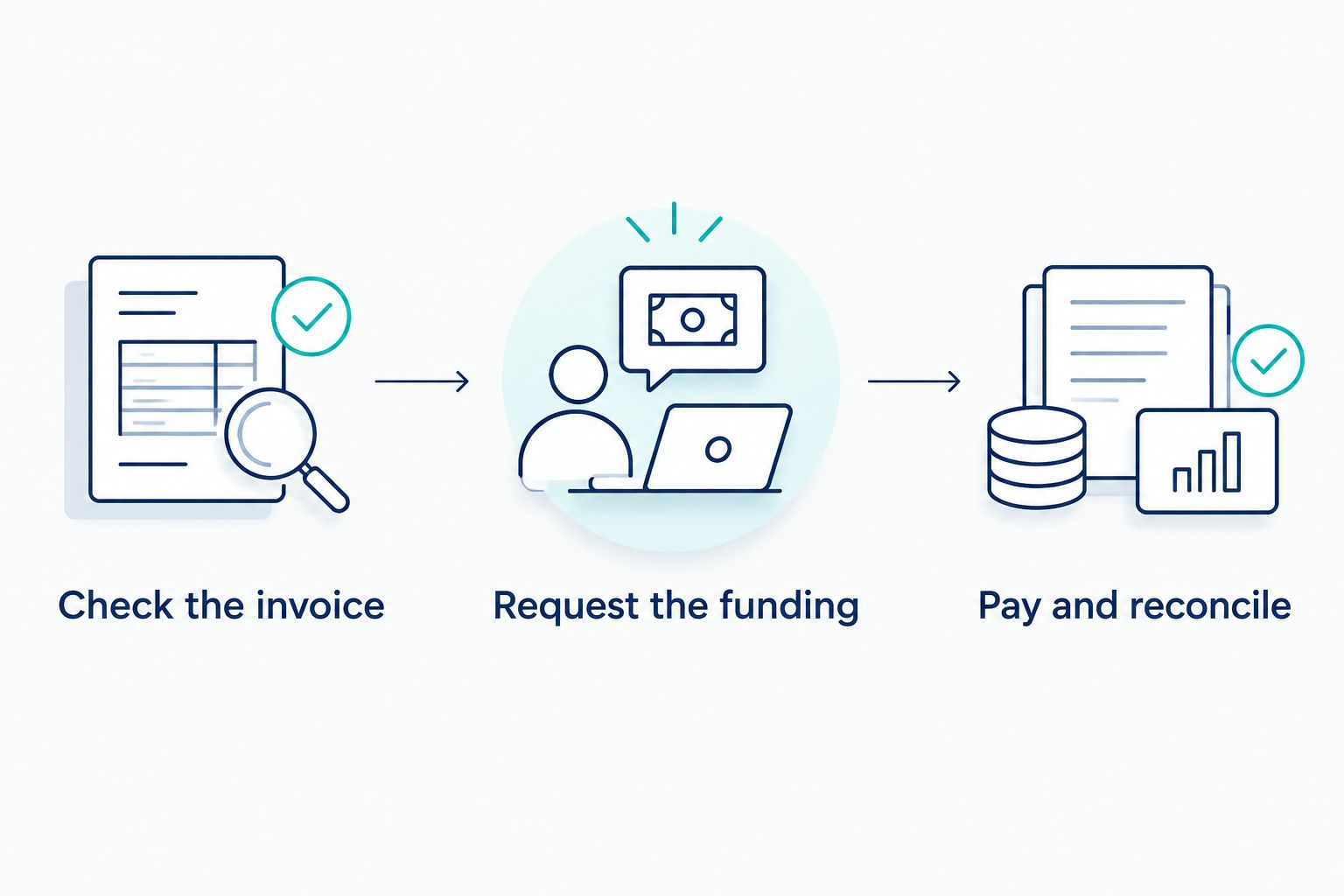
For your 2026 kitchen remodel, use the same approval sequence for every invoice. Verify the obligation first, arrange the draw second, and release payment according to the signed agreement. That sequence keeps a banking action from becoming an accidental construction approval.
- Check the invoice against the contract. Match the invoice to its payment milestone and supporting evidence. For an advance payment required by the contract, verify the agreed obligation; for a completed-work milestone, confirm the specified work is complete.
- Request the necessary funding. Check funds already assigned to that invoice before submitting another draw request. Record the request reference and status, then verify the deposit in the receiving account.
- Pay and reconcile. Release the approved payment using verified instructions. Save the invoice, payment confirmation, and corresponding draw record together, and mark the invoice paid only after the payment is confirmed.
Expected result: each payment has a traceable connection to an approved invoice and its funding source. An unpaid invoice, pending bank transfer, and completed contractor payment remain visibly different statuses.
Use the register during contractor conversations, not just when logging into your bank. If an invoice arrives before its agreed trigger, identify the mismatch and resolve it in writing. Do not let a transfer already in progress become the reason to approve an unsupported payment.
Change orders and final payment
Kitchen decisions can change after the initial agreement. The correct response is to update the scope and payment plan together, not to keep borrowing against an outdated schedule.
- Document the proposed change. Ask for the revised work description and its effect on the contract and payment obligations before authorizing additional work. Identify whether the change replaces an existing item or adds a separate obligation.
- Recheck the funding plan. Review the revised borrowing requirement with your available funds and lender-confirmed access. Update affected milestones, remove superseded entries, and retain the original record so the change remains traceable.
- Review completion before final payment. Walk through the finished work with the contractor and document unresolved items. Confirm how those items will be addressed and apply the signed final-payment terms.
Expected result: the payment register reflects the work currently authorized, and the final-payment entry reflects actual completion rather than an old calendar target.
For Innovative Contracting Services, LLC, final payment is collected only after the work is complete and satisfactory. Keep the walkthrough and any unresolved-item record connected to that payment entry. Do not borrow or pay a final invoice simply because the original projected finish date has arrived.
Request a kitchen remodeling estimate
Discuss your kitchen scope, payment milestones, and completion requirements before arranging HELOC draws.
Second workflow: group draws around approved payments
Invoice-by-invoice borrowing is not the only way to organize a 2026 kitchen remodel. If the lender’s rules make individual transfers impractical, you can group funding requests around known contractual obligations. Grouping draws changes the banking workflow, not the contractor’s right to payment.
| Workflow | Best for | Advantage | Limitation |
|---|---|---|---|
| Invoice-linked draws | Homeowners who want each draw tied to a specific payment | Keeps the borrowing record closely connected to individual invoices | Requires repeated coordination with lender processing requirements |
| Grouped milestone draws | Homeowners whose lender rules or clustered obligations favor grouped transfers | Reduces separate transfer requests while retaining invoice-level records | Can leave borrowed funds unused before their payment dates |
For grouped draws, identify the approved obligations the transfer will cover and assign funds to each invoice in your register. Confirm the grouping complies with the HELOC agreement. Keep unapproved change orders outside the group until their scope and payment terms are settled.
Neither workflow removes interest or repayment obligations. Choose the method that fits your lender’s rules and written contract, then apply it consistently. Do not use grouped borrowing as permission to pay ahead of an agreed milestone.
Troubleshooting your draw schedule
Funds have not arrived before payment is due
Check the lender’s transaction status and contact the lender about the specific request. Notify the contractor before the due date and discuss the payment obligation directly. A pending transfer does not change your contract automatically.
The invoice does not match the agreed milestone
Identify the mismatched scope item or payment trigger and request clarification in writing. Approve the invoice only after it matches the agreement or an authorized amendment. Keep the original and corrected versions connected to the same register entry.
A change order exceeds your planned funding
Pause authorization of the additional work while you review the revised scope and borrowing position. Ask the contractor about scope adjustments and ask the lender about actual borrowing access. Do not assume the credit line will increase to cover the change.
A paid invoice still appears unpaid
Match the payment confirmation to the invoice reference and verify receipt with the contractor. Check whether a revised invoice created a duplicate entry. Preserve the transaction evidence rather than submitting another payment to clear the status.
Final payment is requested with unresolved work
Compare the request with the signed completion terms and document the unfinished or unsatisfactory items. Discuss their resolution with the contractor before approving the final-payment entry. Follow the agreement rather than inventing a withholding amount or deadline.
Customize your workflow
Expand the register when your kitchen project includes related flooring or carpentry work. Keep separate scope entries and payment evidence even when one contractor handles the services. That preserves accountability without requiring separate funding systems for each trade.
Innovative Contracting Services, LLC offers kitchen, bathroom, basement, flooring, and carpentry remodeling under one contractor. That suits homeowners seeking coordinated service across Western Allegheny and Eastern Beaver; it does not replace lender guidance or resolve borrowing terms on your behalf.
Before requesting an estimate, prepare a short project brief: your community, the rooms involved, the changes you want, and the decisions still open. Ask for written scope and payment milestones, and explain that you need to coordinate them with HELOC access. Never share banking credentials with a contractor.
FAQ
What is a HELOC draw schedule for a kitchen remodel?
A HELOC draw schedule for a kitchen remodel connects planned borrowing requests to contractual remodeling payments. It should identify the payment trigger, funding checkpoint, transfer status, and payment confirmation without replacing the lender’s agreement.
Should I draw the whole HELOC before kitchen work starts?
Do not draw the whole HELOC solely because construction is starting. Match borrowing to your contract and lender requirements, accounting for interest on drawn funds and any transfer restrictions.
Does HELOC approval mean I can pay the contractor immediately?
No. HELOC approval does not confirm that a transfer has completed or that a contractor payment is due. Verify borrowing access, receipt of funds, and the contractual payment trigger separately.
Is an invoice-linked draw schedule better than grouped draws?
Invoice-linked draws provide a direct connection between each borrowing request and payment; grouped draws reduce separate transfer requests. Choose according to your lender’s rules and contract, recognizing that grouped draws can leave borrowed funds unused before payment.
What happens if I change the kitchen design after signing?
Update the written scope and payment register before authorizing the changed work. Confirm the revised funding requirement and retain the approved change order with the affected invoices.
When does Innovative Contracting Services, LLC collect final payment?
Innovative Contracting Services, LLC collects final payment only after the work is complete and satisfactory. Include the completion review and resolution of outstanding items in your final-payment workflow.
Can I use this kitchen funding workflow for flooring or carpentry too?
Yes, the same invoice and funding controls apply to flooring or carpentry included in your remodeling agreement. Keep each scope item and payment obligation identifiable, and confirm the borrowing use complies with your HELOC terms.
One last thing
A funded invoice is not a paid invoice, and a paid invoice is not proof of completed work. Keep those statuses separate throughout your 2026 project. At the final walkthrough, bring the current scope and unresolved-item record—not just the bank balance—so your last payment follows the agreed completion condition.