

Yes, a finished basement can increase home insurance costs because new walls, flooring, built-ins, and bathrooms add to the amount your insurer must cover to rebuild your home. A higher dwelling limit does not automatically cover sewer backup or flooding, so review both the insured value and water-damage exclusions before construction begins.
- Can a finished basement increase home insurance costs? Yes; added rebuilding value can change your premium.
- Homeowners insurance, water-backup coverage, and flood insurance address different risks; none replaces the others.
- Innovative Contracting Services, LLC handles basement remodeling; your insurer determines coverage and premium changes.
- Notify your insurer before construction and document the completed basement before closing your coverage review.
Can a finished basement increase home insurance costs?
Yes. Finishing a basement changes what your home would cost to rebuild, even when the exterior footprint stays the same. Your insurer needs an accurate description of the finished space to determine whether your dwelling coverage should change.
The premium adjustment depends on your policy, the project, and the insurer's underwriting. There is no universal basement-remodel surcharge. Ask for a project-specific coverage review rather than assuming your existing policy already accounts for the improvement.
If the project follows water damage, separate the repair claim from the new remodeling scope. The guide to homeowners insurance claims and basement repairs explains that planning distinction.
| Coverage to review | Best for | What it addresses | Important limitation |
|---|---|---|---|
| Dwelling coverage | Permanent basement improvements | Covered damage to the building, including insured finished components | The cause of damage must be covered; limits and exclusions still apply |
| Personal property coverage | Furniture and belongings | Covered losses involving movable possessions | Category limits, deductibles, and valuation terms can affect payment |
| Water-backup endorsement | Specified sewer or drain backup risks | Backup events described in the endorsement | Coverage is not automatic and is not a substitute for flood insurance |
| Flood insurance | Flood events defined by the policy | Qualifying flood damage | Basement coverage has restrictions, particularly for finishes and belongings |
Why this matters before you hire a contractor
An unfinished storage area and a finished family room present different rebuilding needs. After a covered loss, restoring bare concrete is not the same job as replacing drywall, flooring, trim, cabinetry, and electrical finishes.
For a 2026 basement remodel in Moon, Robinson, or Hopewell, make the insurance conversation part of preconstruction planning. Your municipality addresses permits and inspections; your insurer addresses coverage. Approval from one does not replace approval or confirmation from the other.
The practical goal is not simply avoiding a premium increase. The goal is making sure the policy describes the basement you will actually own when construction ends. Keeping the old premium while leaving the new work inadequately insured is not a useful saving.
Why the insurance impact varies
The same description—finished basement—can mean very different construction scopes. Give your agent the actual project details instead of relying on that label alone.
- Rebuilding scope: Finished walls, ceilings, flooring, and permanent cabinetry change the work required after a covered loss.
- Added plumbing and electrical work: A bathroom, wet bar, or revised electrical layout changes the features your insurer needs to record.
- Personal belongings: Furniture, entertainment equipment, and office contents belong in the personal-property review rather than only the dwelling review.
- Water coverage: Backup protection, flood protection, and ordinary homeowners coverage have different terms and exclusions.
- Use of the space: A family room, business workspace, and rental area raise different coverage questions.
- Policy terms: Deductibles, replacement-cost provisions, endorsements, and insurer underwriting affect the final coverage recommendation and premium.
Ask the agent to explain which changes come from the renovation and which come from broader policy adjustments. A renewal increase alone does not tell you how much of the change relates to the basement.
Review the finished space, not just the project invoice
Your construction invoice helps document the work, but the contract total is not automatically the amount your dwelling limit should increase. Insurers assess rebuilding exposure under their own valuation methods. The amount you spend and the replacement-cost adjustment are related, not interchangeable.
A family room with finished walls and flooring needs a different description from a basement containing a bathroom, custom storage, and an office. Identify permanent improvements separately from movable belongings so the agent can review the appropriate coverage categories.
For your 2026 coverage review, describe the rooms, materials, fixtures, and intended uses. Ask whether the policy's current building description still shows an unfinished basement. Correcting that description is more useful than asking only whether remodeling will make insurance more expensive.
Also ask how the insurer values a loss. Replacement-cost and actual-cash-value provisions differ, and their application depends on the policy and the property involved. Do not assume every damaged item receives the amount needed to buy a new equivalent.
Water damage needs a separate conversation
More dwelling coverage does not turn an excluded water event into a covered claim. That distinction matters when the most valuable improvements sit below ground level.
Sudden accidental plumbing discharge, sewer backup, groundwater seepage, and flooding are not interchangeable insurance terms. Ask the agent to identify the policy language that applies to each concern at your property. A verbal assurance that you have water coverage is too broad to settle the question.
Does homeowners insurance cover a flooded finished basement?
Not automatically. Standard homeowners policies generally exclude flood damage, and backup protection typically requires separate consideration. FEMA's National Flood Insurance Program guidance also identifies restrictions on basement coverage, including limitations affecting finished surfaces and personal belongings.
For a 2026 project, ask your agent to distinguish the coverage you have from the coverage you are considering. Request a written explanation of applicable exclusions, endorsements, limits, and deductibles rather than treating the word flood as a catch-all description.
Does a sump pump guarantee coverage?
No. A sump pump is a physical water-management measure, not an insurance agreement. Ask whether your policy includes protection for specified sump-related events and what conditions or exclusions apply.
Likewise, moisture-resistant flooring does not make an excluded loss covered. Material selection and insurance protection solve different problems; neither replaces a review of the basement's water conditions before finishing.
What to do before basement construction starts
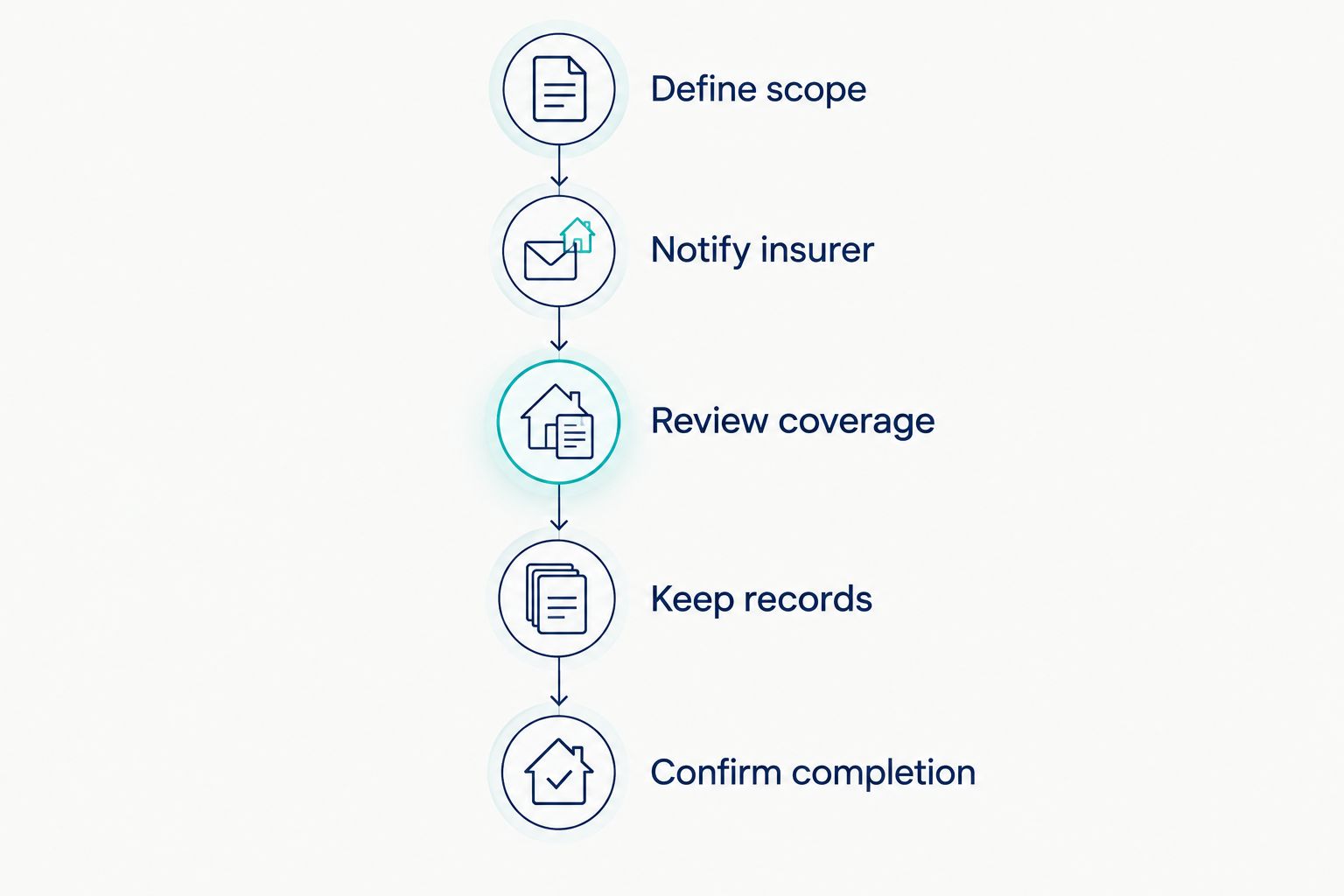
Use this sequence to coordinate your contractor and insurer. These are hiring and documentation steps, not instructions for performing the construction yourself.
- Define scope. Ask your contractor for a written description of the rooms, permanent finishes, plumbing, electrical work, and intended use. Give the insurer enough detail to assess the completed space.
- Notify insurer. Contact your agent before work begins. Ask about notification requirements, protection during construction, and the point at which coverage changes should take effect.
- Review coverage. Discuss dwelling limits, belongings, water exclusions, and any separate endorsements or policies. Ask for the premium effect of the proposed changes in writing.
- Keep records. Retain the contract, approved changes, invoices, material descriptions, and applicable permit and inspection documents. Photograph the basement before work and after completion.
- Confirm completion. Tell the agent when the work is finished and provide the final scope. Request updated policy documents and check that the basement description matches the completed project.
Your 2026 remodeling file should make the finished condition easy to understand without relying on memory. Clear records also help distinguish original features from improvements added during the project.
What should you ask the insurance agent?
Bring questions that require specific answers. Asking whether the basement is covered invites a broad response; asking which causes of damage are excluded gets closer to the decision you need to make.
- Does the policy currently describe the basement as finished or unfinished?
- Does the proposed work require a change to dwelling coverage?
- What protection applies while construction is underway?
- Which water-backup events are covered, and under what endorsement?
- How does the policy treat flood damage and groundwater seepage?
- Are new furniture, electronics, and office equipment adequately addressed?
- Does a change in use require a separate coverage review?
- What documents do you need when the contractor finishes?
Ask the agent to separate required changes from optional protection. Then compare what each option covers, what it excludes, and the deductible you would owe after a qualifying loss. The cheapest premium is not a complete comparison.
Do permits and contractor insurance replace your own coverage?
No. Building permits, contractor liability insurance, and homeowners insurance serve different purposes. A permitted project is not automatically insured against every loss, and your contractor's insurance does not replace coverage for your house and possessions.
Before hiring, request current evidence of the contractor's insurance and confirm who handles applicable permit applications and inspections. Ask your municipality which approvals apply to the actual scope, especially when the project includes plumbing, electrical changes, or sleeping space.
Do not assume that missing a permit automatically decides every future insurance claim, either. Coverage decisions depend on policy language and the circumstances of the loss. Follow the applicable requirements and leave coverage determinations to the insurer.
When a basement office or rental changes the discussion
Tell the insurer how you plan to use the space, not just how you plan to finish it. A private family room, home office, and tenant-occupied area are different descriptions of risk.
Business equipment and business-related liability can require attention beyond ordinary household belongings. Rental use also deserves an explicit conversation before occupancy. Do not describe a planned rental as a family room simply because the construction finishes look similar.
For a basement bedroom, discuss the proposed use with both the contractor and the local building department. Construction requirements and insurance classification remain separate questions, even when they concern the same room.
Coordinate the remodel with a local contractor
Innovative Contracting Services, LLC is a fit for homeowners seeking basement remodeling under one general contractor across Western Allegheny and Eastern Beaver counties. The company is licensed and fully insured, with kitchen, bathroom, basement, flooring, and carpentry services under one contractor.
That scope is relevant when your basement project includes a bathroom, new flooring, and finish carpentry. The contractor documents and completes the construction; your insurer decides how the work affects coverage. Neither role should be confused with the other.
Discuss your project with Innovative Contracting Services, LLC and request an estimate describing the planned work. Final payment is collected only after the work is complete and satisfactory. You still need your own insurance review; a construction estimate is not confirmation of coverage.
Request a basement remodeling estimate
Discuss your basement, bathroom, flooring, and carpentry scope before construction begins.
FAQ
Will finishing my basement automatically raise my homeowners insurance premium?
No automatic increase applies to every finished basement. Your insurer assesses the added rebuilding exposure, existing limits, intended use, and policy terms before determining any premium change.
Should I tell my insurance company before finishing my basement?
Yes, notify your insurer before basement construction begins. Ask about coverage during the work, required policy updates, and the documents needed after completion.
Does more dwelling coverage protect my basement from sewer backup?
More dwelling coverage does not automatically add sewer-backup protection. Ask whether your policy includes an applicable endorsement and review its limits, deductible, and exclusions.
Will flood insurance replace all my finished basement materials?
Do not assume flood insurance replaces all basement finishes. Flood policies have basement-specific restrictions, so ask the agent to explain coverage for walls, flooring, equipment, and belongings separately.
Does my contractor's insurance cover my finished basement afterward?
Your contractor's insurance does not replace your homeowners insurance. Confirm the contractor's coverage before hiring, then separately update your own policy for the completed space.
Does adding a basement bathroom affect my insurance review?
A basement bathroom adds permanent fixtures and plumbing that your insurer needs to evaluate. Include those details in the project scope rather than reporting only that the basement is finished.
What records should I keep after a basement remodel?
Keep the final scope, invoices, photographs, and applicable permit and inspection records. Provide the completed project description to your insurer and retain the updated policy documents with your remodeling file.
One last thing
An insured basement and an insured cause of damage are not the same thing. A policy can account for your finished room's rebuilding value while excluding the water event that damages it.
Before closing your 2026 project file, confirm both questions in writing: does the policy reflect the completed basement, and which causes of loss does it cover? That is the coverage check that matters after the contractor leaves.