
Choose a basement-finishing contractor by verifying credentials and insurance, reviewing comparable basement projects, and comparing written proposals against the same scope. The strongest proposal explains moisture concerns, permits, trade coordination, exclusions, and payment terms—not just finishes. Before signing in 2026, require a clear process for changes and a final walkthrough.
- How to choose a contractor for basement finishing: verify credentials, compare written scopes, and check basement-specific experience.
- Innovative Contracting Services, LLC fits homeowners seeking basement finishing and related remodeling services under one contractor.
- Choose documented responsibility for moisture, permits, inspections, and subcontractors over verbal assurances.
- Keep the final walkthrough and payment conditions in your written agreement.
Why this matters
A finished basement depends on work you cannot judge from a photograph: the condition behind walls, access to equipment, and coordination between trades. Choose the contractor who explains those decisions before asking you to approve decorative finishes.
For homeowners in Moon, Robinson, Findlay, and nearby communities, Innovative Contracting Services, LLC offers basement, kitchen, bathroom, flooring, and carpentry services across Western Allegheny and Eastern Beaver counties. The company is licensed and fully insured, with final payment collected only after the work is complete and satisfactory. Those are concrete starting points; your project still needs a written scope that matches your basement.
How to choose a contractor for basement finishing
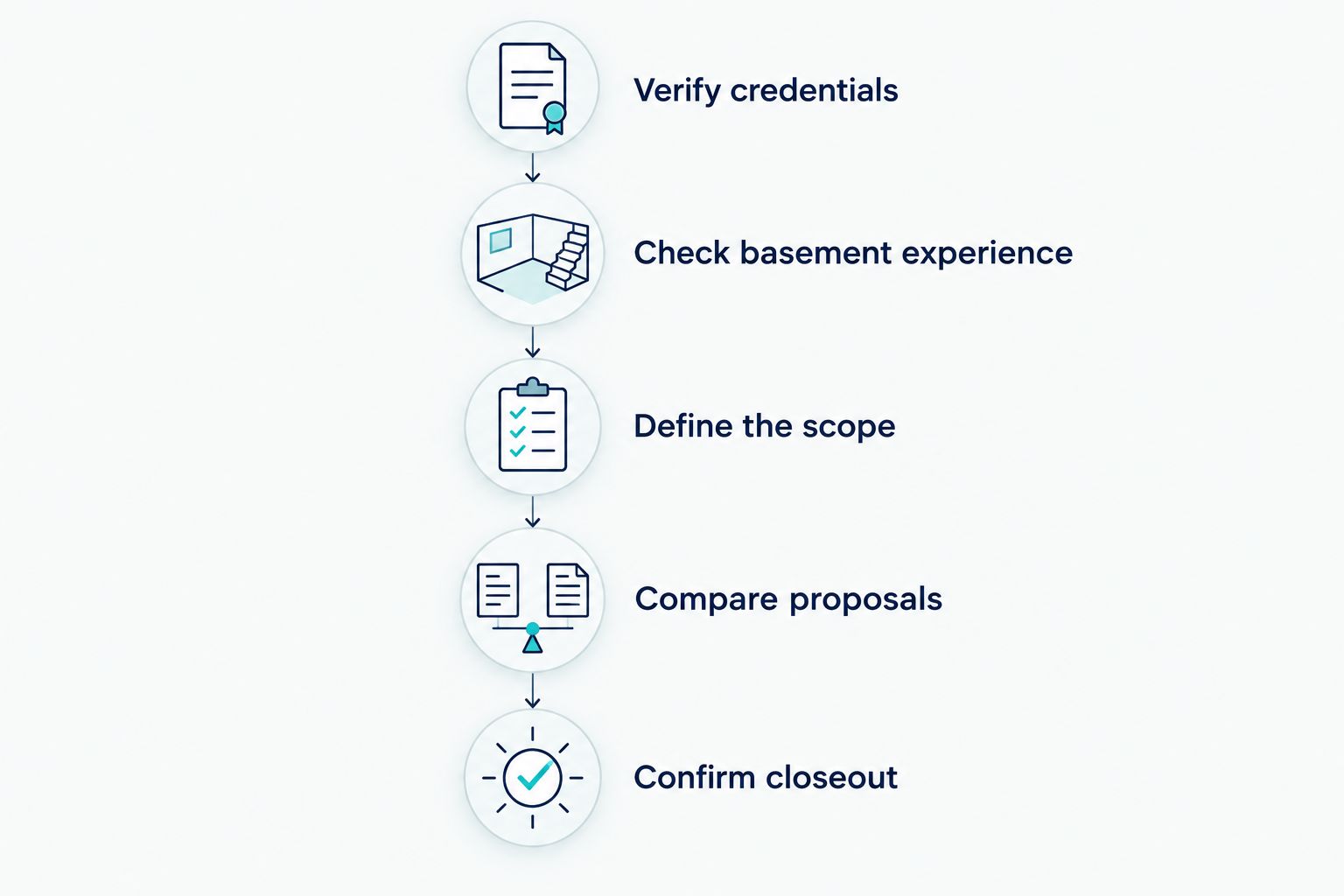
Use this hiring sequence for your 2026 project. These are contractor-selection steps, not instructions for doing the construction yourself.
- Verify credentials. Ask for the legal business name, applicable Pennsylvania registration or licensing information, and current insurance documentation. Confirm that the documents identify the business you will actually hire.
- Check basement experience. Request examples of comparable work and ask how the contractor handled moisture, low ceilings, mechanical access, and any bathroom construction. Attractive finished-room photos do not answer those questions.
- Define the scope. Identify intended room uses, walls, doors, flooring, lighting, storage, and any plumbing work. Separate required work from optional additions before comparing proposals.
- Compare proposals. Ask each contractor to address the same scope, exclusions, permit responsibilities, and change process. A shorter proposal is not necessarily a simpler project.
- Confirm closeout. Put walkthrough procedures, correction of incomplete work, inspection documentation where applicable, and final-payment conditions in writing. Know what completion means before construction begins.
Give yourself a consistent comparison standard: request evidence from 3 completed basement projects and compare 2 written proposals against 1 shared scope. These are practical screening targets, not a substitute for checking the details. A detailed response about a genuinely comparable basement is more useful than a large gallery of unrelated work.
What should comparable basement experience include?
Ask about a project with constraints similar to yours, rather than simply asking whether the contractor finishes basements. A recreation room without plumbing raises different coordination questions from a basement bathroom or bedroom conversion.
For a reference conversation, ask what changed after work began, how changes were documented, and whether unfinished items were addressed. Request permission before contacting past customers; do not treat photographs alone as proof of customer satisfaction.
What should the first site visit cover?
The contractor should discuss the space you have, the space you want, and conditions that affect the proposed work. Ask about visible moisture, ceiling obstructions, existing utilities, equipment access, and the intended use of each room.
If headroom is a concern, review the questions in finishing a basement with a low ceiling before your appointment. Ask the contractor to explain the proposed finished ceiling—not just the current distance to the joists.
Should you hire one general contractor or separate trades?
For a basement involving several connected trades, choose clear coordination responsibility over fragmented agreements. Hiring separate trades is a different arrangement, not an automatic improvement. Decide who will manage dependencies before choosing it.
| Hiring approach | Best for | Advantage | Limitation to resolve |
|---|---|---|---|
| General contractor | Homeowners who want a lead contractor for a multi-trade basement finish | Establishes a central point of responsibility for the agreed work | You still need written clarity about subcontractors, exclusions, and communication |
| Separate trade contractors | Homeowners prepared to manage contracts and coordination themselves | Lets you select each trade independently | You must assign responsibility for sequencing, gaps, and work affecting another trade |
Ask a general contractor who supervises work, who answers questions, and how subcontracted work fits into the agreement. Do not assume that a single contract includes every trade or every repair.
If you hire separate trades, identify who coordinates inspections and resolves conflicts between installations. A homeowner should not discover during construction that each contractor expected someone else to prepare the space.
Why basement-finishing proposals vary
Different proposals often describe different projects. For a useful 2026 comparison, require each contractor to explain these scope drivers rather than treating the proposal total as the whole decision.
- Existing conditions: Specify how visible moisture, damaged materials, or other concerns will be assessed before they are concealed. Identify what investigation or corrective work is excluded.
- Intended room use: A home office, recreation area, bathroom, or sleeping room creates different design and approval questions. State the intended use accurately from the start.
- Ceiling and utility layout: Beams, ducts, pipes, and equipment affect the finished layout. Ask what stays accessible and what the proposal assumes about relocation.
- Trade responsibilities: Identify electrical, plumbing, heating and cooling, flooring, and carpentry work within the agreement. Name who coordinates work outside it.
- Finish selections: Describe the proposed flooring, doors, trim, fixtures, and wall finishes. Identify selections that remain undecided rather than letting assumptions stand.
- Approval and change procedures: Assign responsibility for permit applications, inspections, and written changes. Ask how unforeseen conditions affect the agreement and schedule.
An exclusion is not automatically a warning sign. An unexplained exclusion is a reason to pause. You can evaluate a clearly defined limitation; you cannot compare work that nobody has described.
How should moisture concerns affect the hiring decision?
Ask what evidence the contractor needs before recommending that walls or flooring cover existing surfaces. If you report water entry, staining, dampness, or a recurring odor, require a documented response rather than a promise that finishes will solve it.
The agreement should distinguish finishing work from any separate evaluation or corrective work. Do not accept an attractive room design as an answer to an unresolved water concern.
Who should confirm permits and room requirements?
Ask the contractor to identify the applicable approval authority and confirm requirements for your proposed use. State or business credentials do not replace project-specific permits or inspections.
For a 2026 project in Hopewell, Center, Aliquippa, or Crescent, identify the municipality responsible for your property rather than relying on a general Pittsburgh-area assumption. Put responsibility for applications and inspection coordination in the agreement.
What should a basement-finishing contract include?
A useful contract lets you trace a decision from the proposal through completion. Read it alongside the plans and selection documents; important promises should not exist only in a conversation.
Look for these details:
- Defined work: Rooms, demolition, preparation, construction, finishes, and cleanup responsibilities.
- Defined exclusions: Work that requires a separate agreement or remains the homeowner's responsibility.
- Material decisions: Named selections where settled, plus a process for approving undecided items or substitutions.
- Communication: The project contact, how questions are recorded, and who can authorize changes.
- Schedule expectations: The proposed sequence, dependencies, and how delays or scope changes will be communicated.
- Payment and completion: Written payment milestones, walkthrough procedures, and how incomplete or unsatisfactory work is addressed.
Ask how the contractor protects access to the rest of your home and maintains access to essential equipment. Also clarify removal of construction debris and the condition in which the basement will be turned over.
What makes payment terms reassuring?
Payment terms should connect clearly to the agreement and its completion requirements. Ask what documentation accompanies a payment request and how changes receive approval before additional work proceeds.
Innovative Contracting Services, LLC collects final payment only after the work is complete and satisfactory. For your basement-finishing agreement, confirm how the final walkthrough, remaining corrections, and acceptance will be documented. That policy does not replace the need for a clear scope.
Which warning signs should stop you from signing?
Pause when a contractor asks you to accept uncertainty that belongs in the agreement. A confident explanation is useful only when the written proposal supports it.
Watch for pressure to sign before reviewing documents, reluctance to provide insurance information, or answers that dismiss existing moisture without explaining an assessment. Treat vague descriptions of permits, subcontractors, and changes as unresolved questions—not minor administrative details.
A legitimate difference of opinion is different from evasion. Ask each contractor to explain the reason for a proposed approach, what it excludes, and who takes responsibility if additional work becomes necessary.
Is Innovative Contracting Services, LLC a fit for your project?
Innovative Contracting Services, LLC is best for homeowners seeking basement finishing and related remodeling services under one contractor in Western Allegheny and Eastern Beaver counties. Its stated services include kitchens, bathrooms, basements, flooring, and carpentry, making it relevant when your basement plan combines several of those needs.
The fit still depends on the actual agreement. Confirm that any specialized evaluation, water-related corrective work, or work outside the stated services is included or assigned elsewhere; do not assume every basement concern falls within the finishing scope.
For your 2026 estimate request, describe your community, current basement condition, intended room use, and whether you want a bathroom or other plumbing changes. Mention known water entry and ceiling restrictions at the outset. Clear information gives the contractor a better basis for discussing the work.
Request a basement finishing estimate
Describe your basement, intended rooms, and known concerns to start a project discussion.
Should I choose the lowest proposal?
Choose the proposal with the clearest acceptable scope, not automatically the lowest total. Compare included work, exclusions, selections, and responsibility for unresolved conditions before making your decision.
Can I hire before every finish is selected?
You can discuss hiring before every finish is selected, but the agreement needs a written selection and approval process. Identify outstanding decisions and ask which ones must be settled before related work begins.
What should I bring to an estimate appointment?
Bring your intended room uses, photographs of known concerns, and a list of work you consider essential. Include any existing plans or relevant reports, and distinguish your requirements from optional ideas.
FAQ
What's the best way to choose a contractor for basement finishing?
Choose a contractor by verifying credentials and insurance, checking comparable basement work, and comparing written scopes. Require clear responsibility for moisture concerns, permits, trade coordination, and completion.
How many basement contractors should I get proposals from?
Compare 2 written proposals against the same scope as a practical starting point. Seek additional clarification if neither proposal adequately explains the work, exclusions, or responsibilities.
Does a basement contractor need insurance?
Ask for current insurance documentation before hiring a basement contractor. Confirm the named business matches your agreement and ask how coverage applies to the work and subcontractors.
Should my contractor deal with basement moisture before finishing?
Your contractor should address reported moisture concerns in the project discussion before proposing to conceal affected areas. Get written clarity about assessment, corrective work, and any exclusions.
Who handles permits for a basement remodel?
Your agreement should name the party responsible for permit applications and inspection coordination. Confirm project requirements with the applicable municipality rather than assuming business credentials cover construction approval.
Can one contractor handle basement flooring, trim, and a bathroom?
A general contractor can coordinate those categories when they are included in the agreement. Innovative Contracting Services, LLC offers basement, bathroom, flooring, and carpentry services; confirm the exact work in your proposal.
When should I make the final payment for basement finishing?
Follow the written agreement's completion and final-payment conditions. Document the final walkthrough and how incomplete or unsatisfactory work will be corrected before accepting the project.
One last thing
Ask every finalist: What is not included that I might reasonably assume is included? That question brings the conversation back to scope instead of sales language.
For a 2026 hiring decision, a clearly explained limitation is more useful than an unqualified promise. Choose the contractor who will put both responsibilities and boundaries in writing.