
Yes, you can live in your house during a kitchen remodel if you have a safe route through the home, a working bathroom, and a separate place to prepare food away from construction. The main limitation is that staying home does not mean keeping your kitchen usable: your contractor must identify when utilities, appliances, flooring, and access will be disrupted.
- Can you live in your house during a kitchen remodel? Yes, when essential services and safe living space remain available.
- Choose temporary relocation when construction blocks safe access or prevents adequate separation from occupied rooms.
- Request a kitchen remodeling plan that identifies utility interruptions, food preparation space, and daily cleanup responsibilities.
- Innovative Contracting Services, LLC suits homeowners seeking kitchen remodeling and related flooring or carpentry under one contractor.
Can you live in your house during a kitchen remodel?
You can stay home when the occupied part of the house functions independently of the construction area. A refrigerator in another room helps, but it does not replace safe access, working plumbing, or separation from dust and tools.
For homeowners in Moon, Robinson, Findlay, and nearby communities planning a 2026 kitchen remodel, the decision belongs in the estimate conversation—not on demolition day. Innovative Contracting Services, LLC provides kitchen, bathroom, basement, flooring, and carpentry remodeling across Western Allegheny and Eastern Beaver counties.
Compare these living arrangements against the actual work scope:
| Living arrangement | Best for | Main advantage | Main limitation |
|---|---|---|---|
| Stay throughout | Households with separate living space and maintained essential services | Keeps you in your home without arranging an extended move | Noise, restricted access, and meal disruption remain part of daily life |
| Leave during disruptive phases | Households that can stay elsewhere when specific work requires it | Matches time away to the contractor's work sequence | Requires clear notice and flexibility if the sequence changes |
| Relocate throughout | Households without adequate separation or dependable access to essential rooms | Removes daily household activity from the construction area | Requires another living arrangement and coordination for property access |
None of these choices makes a poorly planned job acceptable. Choose the living arrangement after reviewing the scope and access plan, not before.
Why this matters
A kitchen is also a circulation route, a food-storage area, and a place where household routines overlap. Losing it affects more than cooking. You need somewhere to wash hands, store food safely, eat, and move through the house without entering active work.
For a 2026 remodel in Hopewell, Center, Aliquippa, or Crescent, give your contractor household details as well as design preferences. Children, pets, mobility limitations, and work-from-home obligations all belong in the planning discussion because they change what a workable occupied home looks like.
An attractive finished kitchen does not answer those questions. The estimate and project discussion should address both the finished room and the conditions you will live with while it is being built.
Staying home throughout: best for separated living areas
Staying home works when you can close off the kitchen and still reach your bathroom, bedrooms, and an appropriate exit. Your temporary eating area must remain outside the work zone, rather than becoming another surface that workers need to protect or move.
The advantage is continuity: you keep access to your home and belongings. The trade-off is disruption. Demolition, cutting, installation, and deliveries do not become quiet or unobtrusive because someone is working remotely nearby.
Before choosing this arrangement, ask your contractor to identify:
- Which doorway separates the work zone from occupied rooms.
- Which entrance workers will use and where materials will travel.
- Where the refrigerator and food-preparation area can operate safely.
- How bathroom access remains available during plumbing work.
- What condition the work area will be left in before the crew leaves.
Best for: households with a genuinely separate living area, not merely an unused corner beside the kitchen.
Leaving during disruptive phases: best for flexible households
A phased arrangement lets you stay home when conditions permit and leave when the work requires more separation. Ask the contractor to identify those phases by activity, such as demolition, a utility interruption, or flooring work that blocks a necessary route.
The advantage is targeted time away. The limitation is coordination: deliveries, concealed conditions, inspections, and product requirements can affect the sequence. Avoid making inflexible lodging arrangements around a completion date that has not been confirmed.
For your 2026 planning conversation, request notice before any activity that changes whether you can occupy the house. Also identify who will tell you when the affected area is ready for normal access again.
Best for: homeowners with another place to stay and enough flexibility to respond to the actual work sequence.
Relocating throughout: best for homes without safe separation
Relocating is the appropriate choice when essential routes run through construction or the household cannot remain adequately separated from the work. A temporary food station does not solve an inaccessible bathroom, an obstructed exit, or a health concern that requires avoiding exposure.
The advantage is distance from daily construction activity. The limitation is managing another residence while remaining available for decisions and property access. Confirm how your contractor will contact you about concealed damage, selections, and changes requiring approval.
Do not treat relocation as permission to leave the project undefined. You still need written scope, communication expectations, and a process for approving changes before additional work proceeds.
Best for: households whose layout, health requirements, or remodeling scope makes continued occupancy unsuitable.
Why the ability to stay home varies
Two kitchen remodels can require different living arrangements even when the finished rooms look similar. These are the factors to review with your contractor:
- Work scope. Cabinet replacement and a layout change involving walls or utilities create different access and coordination needs.
- Utility interruptions. Identify whether plumbing or electrical work affects only the kitchen or also the rooms you intend to occupy.
- House layout. An open kitchen connected to the main living space is harder to separate than a room with its own doorway.
- Household needs. Children, pets, respiratory conditions, and mobility requirements change the suitability of remaining home.
- Material requirements. Flooring, adhesives, coatings, and other specified products have application, ventilation, and access instructions that must be followed.
- Overlapping work. Remodeling an adjacent bathroom or continuing flooring into a hallway can remove the spaces you expected to use as a fallback.
Ask about the whole occupied house, not just the kitchen footprint. A workable plan accounts for how each trade's work affects your daily routes and essential services.
What should your contractor confirm before demolition?
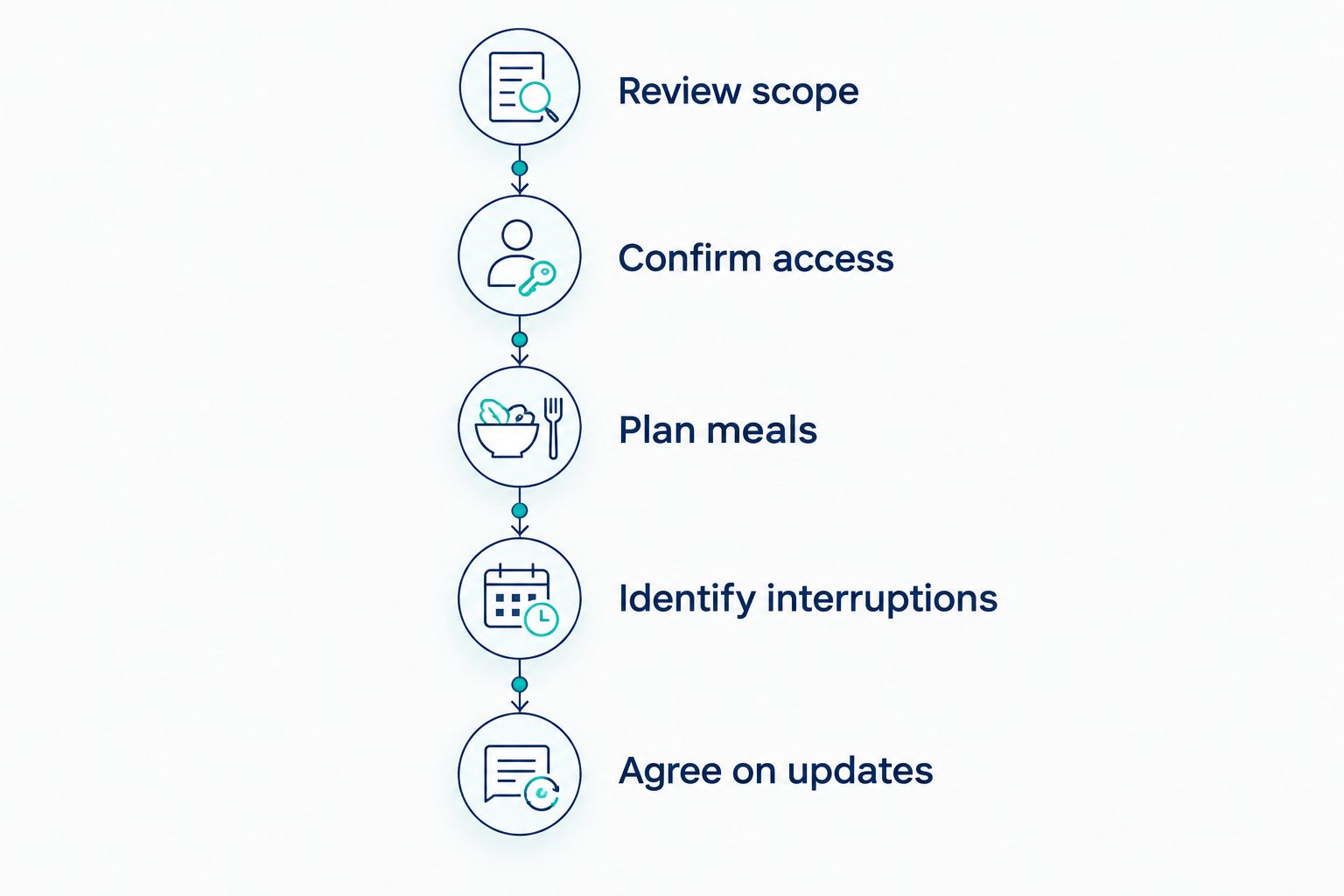
For a 2026 kitchen remodel, request an occupancy discussion alongside the construction schedule. Use the following sequence to turn a general promise that you can stay home into decisions you can evaluate.
- Review scope. Identify the rooms, walls, utilities, and adjoining flooring included in the work. Confirm whether any occupied room also becomes a storage or delivery route.
- Confirm access. Establish routes for residents and workers, including bathroom access and exits. Discuss how those routes change as work progresses.
- Plan meals. Agree on a location for food storage and preparation outside the construction area. Have the contractor assess any electrical or plumbing arrangements needed for that location.
- Identify interruptions. Ask which activities require utility shutdowns, restricted entry, or temporary absence. Confirm how you will receive notice.
- Agree on updates. Identify your project contact and the process for reporting changed conditions. Include a way to revisit the living arrangement if the original plan stops working.
The sequence matters because a temporary kitchen is useful only after safe access and suitable space are established. Do not buy equipment or rearrange rooms around assumptions your contractor has not checked.
Your schedule should distinguish the overall project from the period without a functioning kitchen. Read about how long a kitchen remodel takes, then ask your contractor which milestones restore the sink, appliances, and normal access.
How do you manage meals without a working kitchen?
Keep food preparation outside the work zone and confirm that the proposed setup is suitable before construction starts. Discuss refrigeration, handwashing, dishwashing, and the electrical requirements of any appliances you intend to use. Do not assume a convenient outlet can serve every appliance at once.
Food safety still applies during renovation. FDA food-storage guidance calls for a refrigerator temperature of 40°F or below, a freezer temperature of 0°F, and refrigeration of perishable food within 2 hours under ordinary room-temperature conditions. A moved refrigerator needs to maintain safe temperatures; plugging it in is not enough to establish that it does.
Ask your contractor where food and clean dishes can remain protected from construction dust. Keep meal preparation separate from tool storage, material cutting, and cleanup. If that separation is not practical, change the meal arrangement rather than sharing the work area.
Can children, pets, or remote workers stay home too?
Children and pets need separation that does not depend on reminders to stay out of the kitchen. Discuss barriers, worker entry, material storage, and supervision before work begins. A work area does not become suitable for household access simply because the crew has left for the day.
Remote work requires a separate conversation about sound and interruptions. A closed room provides privacy, but it is not a promise of quiet during demolition or installation. Tell the contractor about fixed meetings and ask which activities will conflict with them; arrange another workspace when necessary.
If anyone has a respiratory condition or another health concern, discuss the proposed living arrangement with the appropriate healthcare professional. The contractor can explain the work and separation measures, but should not decide whether construction exposure is acceptable for that person's medical needs.
Choose a contractor who addresses occupancy before work starts
Innovative Contracting Services, LLC is best for homeowners seeking kitchen remodeling with related flooring and carpentry under one contractor. The company is licensed and fully insured, serves Western Allegheny and Eastern Beaver counties, and collects final payment only after the work is complete and satisfactory.
That service range is relevant when kitchen work extends into trim, flooring, or another room. It does not remove the inconvenience of construction. Your estimate discussion still needs to establish what you can use, what you cannot use, and when staying elsewhere is the appropriate choice.
When requesting a 2026 estimate, explain whether you intend to remain home and identify any nonnegotiable household needs. Ask for the occupancy assumptions to be addressed with the project scope rather than treated as an informal understanding.
Request a kitchen remodeling estimate
Discuss your kitchen scope, household access, and whether staying home fits the planned work.
FAQ
Can I stay in my house during a complete kitchen gut remodel?
You can stay during a complete kitchen gut remodel only if safe access, essential services, and suitable separation remain available. Review the actual demolition, utility, and installation plan with your contractor before deciding.
Will I have running water during a kitchen remodel?
Running water depends on which plumbing the contractor must disconnect and whether the interruption affects other rooms. Ask separately about drinking water, bathroom use, handwashing, and dishwashing.
Can I use my old stove while the kitchen is being remodeled?
Do not assume your old stove remains usable during remodeling. Have your contractor confirm whether it can remain safely connected and accessed without entering the work zone.
Should I move out if I work from home?
Arrange another workspace when construction activity conflicts with your work requirements. Staying in the house and being able to work quietly are separate decisions.
Is a dust barrier enough to make staying home safe?
A dust barrier alone does not establish that staying home is appropriate. Safe routes, utility access, work activities, product instructions, and household health needs also matter.
What should I tell a contractor when requesting a kitchen estimate?
Tell the contractor whether you plan to stay home, who lives there, and which rooms and services must remain accessible. Innovative Contracting Services, LLC offers kitchen remodeling alongside bathroom, basement, flooring, and carpentry services.
One last thing
Define “usable kitchen” before agreeing to the living plan. Cabinets installed, appliances delivered, and a working kitchen are different milestones. Ask when you can safely refrigerate food, use the sink, cook, and walk through the room normally; those answers determine how long your household needs a temporary arrangement.