Yes, you can refinish hardwood floors with water damage when the moisture source is corrected, the flooring has dried and stabilized, and the boards remain sound with enough wood left to sand. Refinishing does not repair rot, separated layers, or a damaged subfloor, and it does not guarantee removal of deep stains. For a 2026 repair project, have a contractor assess the floor before you approve sanding or replacement.
- Can you refinish hardwood floors with water damage? Yes, when the wood is dry, stable, and thick enough to sand.
- Hardwood floor refinishing restores the surface; it does not repair rot or a failing subfloor.
- Localized board replacement can preserve sound flooring, but matching the existing wood and finish takes planning.
- Innovative Contracting Services, LLC suits local homeowners who need flooring and related remodeling coordinated by one contractor.
Why this matters
The visible stain is not the whole repair. Water can affect the finish, the flooring itself, and the subfloor beneath it. Sanding addresses the surface, not every layer involved.
Before you authorize refinishing, establish whether the existing floor can tolerate another sanding. The guide to how many times hardwood floors can be refinished before replacement explains why remaining usable wood matters more than the floor's age alone.
For homeowners in Moon, Robinson, or Hopewell, the useful starting point is the same: identify what got wet, confirm that the source is corrected, and ask for a repair scope based on condition rather than appearance.
Can you refinish hardwood floors with water damage?
Yes, if the damage is repairable at the surface and the underlying floor remains sound. A dry, stable floor with finish damage presents a different repair problem from flooring that has lifted, decayed, or separated into layers.
Use this comparison to understand the recommendation in your contractor's 2026 proposal. These are repair paths, not guarantees that a particular floor qualifies.
| Repair path | Best for | Main advantage | Main limitation |
|---|---|---|---|
| Refinish existing boards | Dry, sound flooring with surface wear or repairable discoloration | Preserves the existing hardwood | Cannot correct structural damage or guarantee stain removal |
| Replace damaged boards, then refinish | Localized damage surrounded by sound flooring | Keeps unaffected boards in place | Matching species, dimensions, and appearance requires care |
| Replace the affected floor | Widespread damage, failed layers, or insufficient wood for sanding | Removes flooring that cannot be restored reliably | Requires a broader removal and installation scope |
| Defer finish work for moisture correction | Active leaks or flooring that has not stabilized | Avoids finishing over an unresolved problem | Leaves the cosmetic work unfinished until conditions are suitable |
A recommendation to wait is not the same as a recommendation to replace. Some floors need drying and reassessment before a contractor can determine which boards are salvageable.
What should a contractor check before recommending sanding?
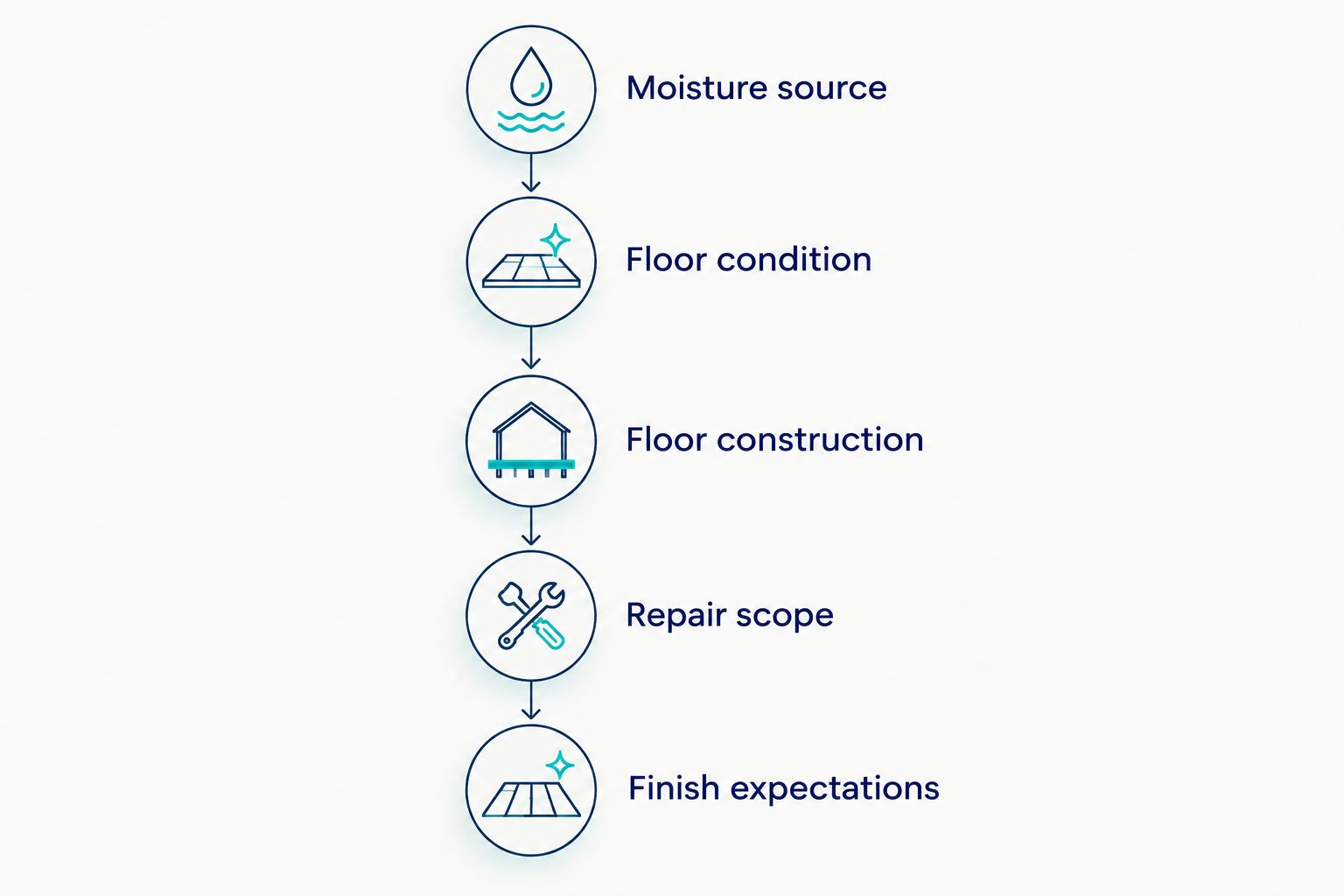
Ask for an assessment that separates surface damage from problems below the finish:
- Moisture source: Identify the leak, spill, or other source and establish whether it has been corrected.
- Floor condition: Check moisture readings, board movement, deformation, and signs of deterioration.
- Floor construction: Identify solid or engineered hardwood and assess the usable wood remaining.
- Repair scope: Explain which boards can stay, which need replacement, and whether the subfloor requires attention.
- Finish expectations: Discuss stain visibility, replacement-board matching, and where refinishing should stop.
These are contractor evaluation points, not a homeowner sanding procedure. Ask what findings support the recommendation before signing the scope.
Refinishing: best for dry, sound hardwood
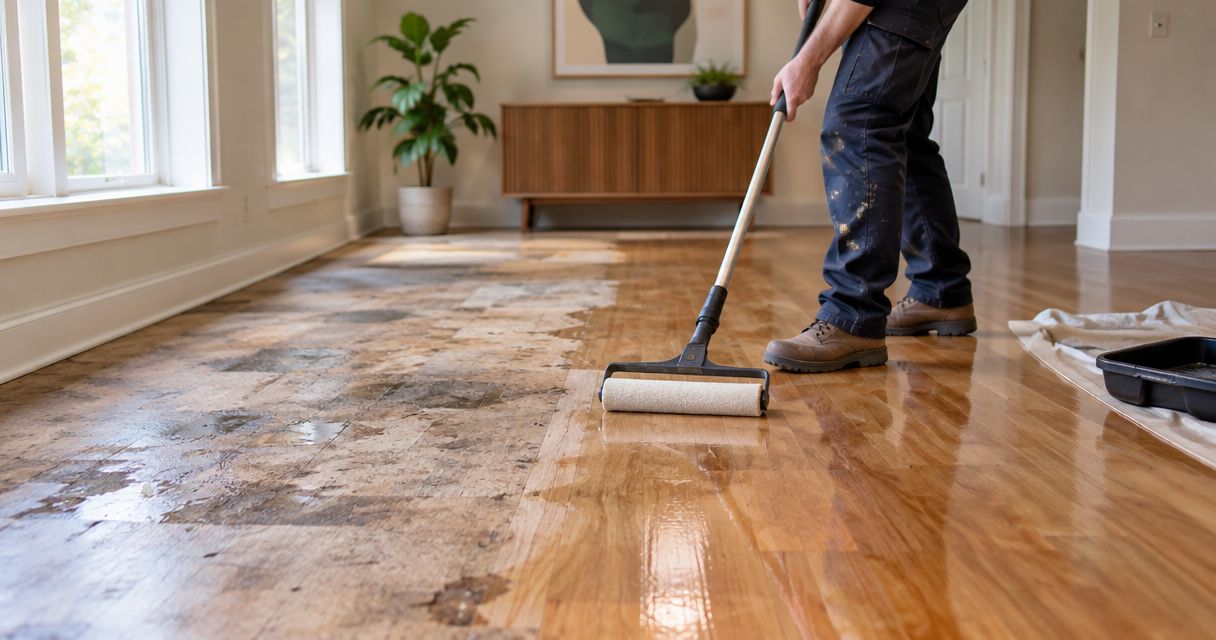
Refinishing makes sense when the floor remains serviceable and the damage is within the material that sanding can safely remove. Finish discoloration and shallow surface damage are different from decay or broken boards.
The advantage is preservation. You keep the existing flooring rather than removing sound material simply because part of the surface looks worn or stained.
The limitation is depth. A water mark can extend farther into the wood than a safe sanding can reach, so a contractor should not promise that every dark area will disappear. Ask whether the proposed result includes visible character, a stain-color change, or replacement of selected boards.
Choose refinishing for a sound floor—not as a substitute for fixing moisture. If the floor still moves or moisture conditions remain unsuitable, surface work comes too early.
Board replacement: best for localized damage
Selective replacement fits a floor where damage is concentrated and surrounding boards remain usable. Examples include boards with irreversible deformation or deep discoloration that you do not want to retain.
This approach preserves unaffected flooring, but a patch is not automatically invisible. Species, board width, thickness, grade, grain, and the existing floor's aging all influence the match.
Ask the contractor to explain the repair boundary and finish boundary separately. Replacing a small damaged area does not necessarily mean refinishing only that same area; a broader finish area can help manage visible transitions.
Choose selective replacement when the damaged section can be removed without treating sound flooring as disposable. Have the proposal explain what happens if removal exposes additional damage underneath.
Floor replacement: best for flooring that cannot be restored
Replacement becomes the practical repair when the hardwood no longer provides a sound surface for refinishing. Rot, extensive damage, failed engineered layers, and insufficient sanding thickness are reasons to consider it.
Engineered hardwood needs particular attention. Its real-wood surface varies by product, and not every engineered floor can tolerate sanding. A separated or damaged core is not repaired by applying a new finish.
Replacement also creates access to the subfloor, which matters when water has affected more than the visible boards. However, new flooring alone does not solve the moisture source or repair deteriorated material beneath it.
Choose replacement for an unsalvageable floor, with the underlying repair included in the scope. Do not compare a surface-only refinishing estimate with a replacement proposal that also addresses subfloor damage as though they cover the same work.
Why water-damaged hardwood repair varies
A useful 2026 estimate explains the condition driving the recommendation. These factors determine whether refinishing remains a reasonable choice:
- Moisture source and correction: An unresolved leak or continuing moisture exposure undermines the repair.
- Damage depth: Finish-level damage and deep discoloration do not respond to sanding in the same way.
- Board stability: Cupping, lifting, looseness, and permanent deformation require assessment beyond appearance.
- Floor construction: Solid hardwood and engineered hardwood have different limits on sanding and repair.
- Remaining usable wood: Previous sanding can reduce the material available for another refinishing.
- Condition below the floor: A weakened subfloor or affected cavity changes the work required before finishing.
The size of the visible mark alone does not settle the decision. A small stain can sit over a concealed problem, while a larger area of finish damage can leave the underlying wood sound.
Will sanding remove black water stains from hardwood?
Sanding does not guarantee removal of black water stains. Dark discoloration can extend below the surface, and removing enough wood to erase it can exceed the floor's safe sanding allowance.
Ask whether the contractor recommends retaining some discoloration, changing the finish appearance, or replacing affected boards. A darker stain color is a design choice, not proof that the water damage has been repaired.
Can cupped hardwood floors flatten after drying?
Some cupping can lessen as moisture conditions stabilize, but permanent deformation requires a different repair. Cupping means the board edges sit higher than the center; the shape alone does not establish whether sanding is appropriate.
Sanding a floor before it stabilizes can create an uneven result after further drying. Ask what moisture findings and observed changes support the decision to begin finish work.
What should your 2026 flooring estimate include?
Request a written scope that describes the condition being repaired and the result you are buying. A proposal labeled only hardwood refinishing leaves important questions unanswered after water exposure.
Look for clear answers on:
- Included areas: Identify the rooms, transitions, and affected sections covered by the work.
- Board repairs: State whether replacement boards are included or handled through an approved change.
- Subfloor work: Explain how concealed damage will be evaluated and authorized if found.
- Finish limitations: Record expectations for lingering stains, color variation, and patch visibility.
- Household access: Discuss furniture removal, work-area separation, and when rooms can be used under the selected finish system.
- Completion and payment: Define the completion review and payment terms in writing.
Do not accept a fixed drying promise based only on a photograph. Drying depends on the materials and conditions involved; the contractor needs evidence that the floor is ready.
Innovative Contracting Services, LLC is best for homeowners in Western Allegheny and Eastern Beaver counties who want flooring and related remodeling under one contractor. The company is licensed and fully insured, with kitchen, bathroom, basement, flooring, and carpentry services. Final payment is collected only after the work is complete and satisfactory.
That coordinated scope is relevant when a flooring problem overlaps with a kitchen, bathroom, or basement project. It does not make every damaged floor a refinishing candidate; the floor's condition still determines the appropriate repair.
For homes in Findlay, Imperial, Center, Aliquippa, or Crescent, Innovative Contracting Services, LLC provides a local starting point for discussing the flooring work and related remodeling needs. Describe the water event, affected rooms, and any remaining leak or visible movement when requesting an estimate.
Request a flooring repair estimate
Discuss water-damaged hardwood and related remodeling needs in Western Allegheny and Eastern Beaver counties.
FAQ
Can you refinish hardwood floors with water damage instead of replacing them?
Yes, water-damaged hardwood can be refinished when the moisture source is corrected, the boards are dry and stable, and enough usable wood remains. Rot, failed layers, or damaged subflooring require repairs beyond refinishing.
How long should water-damaged hardwood dry before refinishing?
There is no universal drying period for water-damaged hardwood. A contractor should assess moisture conditions and stability rather than approve sanding solely because a set number of days has passed.
Does a black stain mean my hardwood floor has mold?
A black stain alone does not establish that a hardwood floor has mold. Discoloration, moisture conditions, odors, and concealed materials require separate assessment; sanding is not a substitute for addressing contamination.
Can engineered hardwood be refinished after a leak?
Engineered hardwood can be refinished only when its wear layer and overall condition permit sanding. Separated layers or an affected core require a repair decision beyond surface refinishing.
Do I have to replace the whole room after a small leak?
No, a small leak does not automatically require replacing an entire room. Localized board replacement is an option when surrounding flooring and the subfloor remain sound, although appearance matching needs discussion.
What should I ask a contractor about hardwood water damage in 2026?
Ask the contractor to explain moisture findings, remaining sanding thickness, subfloor condition, and expected stain removal. Get the proposed repair area, finish boundaries, and concealed-damage procedure in writing.
Does Innovative Contracting Services, LLC handle flooring and other remodeling?
Innovative Contracting Services, LLC offers flooring, kitchen, bathroom, basement, and carpentry services to homeowners in Western Allegheny and Eastern Beaver counties. The company is licensed and fully insured, and final payment is collected only after the work is complete and satisfactory.
One last thing
Ask where the finish work will stop—not just where the damaged boards will be replaced. A doorway, room transition, or continuous flooring area can affect how noticeable the finished repair becomes.
For your 2026 project, have that boundary written into the estimate before work starts. It is easier to agree on an acceptable transition before sanding than to resolve different expectations after the finish is applied.