
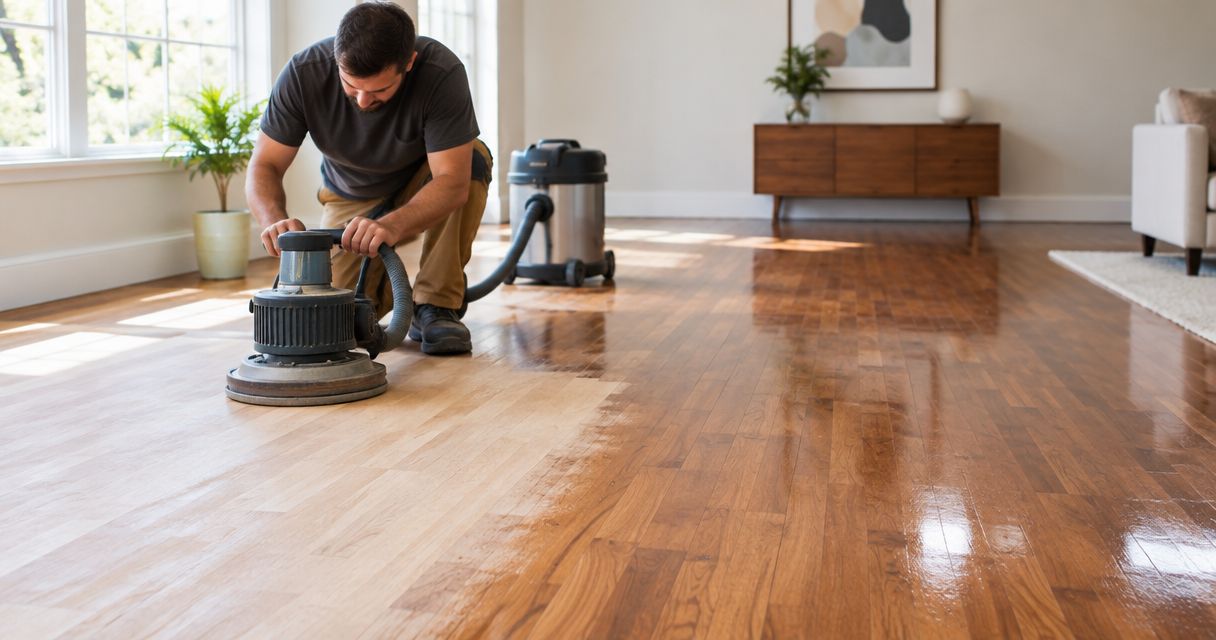
Hardwood floors have no fixed refinishing limit: the remaining sandable wood, previous sanding, and board condition determine whether another full refinish is safe. Solid hardwood generally offers more sanding reserve than thin-veneer engineered flooring, but neither age nor appearance establishes how many refinishes remain. Before approving a 2026 project, have a contractor inspect the floor rather than promise a lifetime sanding count.
- How many times can hardwood floors be refinished? Remaining sandable wood—not a universal count—determines the answer.
- Solid hardwood can support repeated refinishing, but previous sanding reduces the wood available above its tongue-and-groove joints.
- Engineered hardwood requires a product-specific assessment; a real-wood surface does not automatically make it suitable for sanding.
- Choose recoating for compatible finish wear, refinishing for suitable boards, and replacement when the flooring cannot support restoration.
How many times can hardwood floors be refinished before replacement?
A floor can be refinished only while enough sound wood remains to sand without compromising its construction. A contractor needs to assess the actual boards, not assign a number from the home's age or the floor's original thickness.
Conventional solid hardwood often starts at 3/4 inch thick, approximately 19 millimeters. That is the board's total thickness—not the amount available for sanding. The tongue-and-groove joint, fasteners, and previous material removal limit the usable surface above it.
Engineered hardwood has a real-wood face over a layered core. Its sanding potential depends on that face layer and the manufacturer's instructions; the overall plank thickness does not establish refinishing capacity.
For the broader repair-versus-replacement decision, see whether refinishing hardwood floors is worth it. First establish whether the existing floor is a suitable candidate.
| Approach | Best for | Main advantage | Main limitation |
|---|---|---|---|
| Maintenance recoat | Compatible finish with surface wear | Refreshes protection without a full sanding of the wood | Does not remove deep wood damage; adhesion must be assessed |
| Full refinishing | Sound boards with sufficient sandable wood | Removes the existing finish and allows surface restoration | Permanently removes wood and cannot correct every defect |
| Localized board repair | Damage confined to individual boards | Preserves sound surrounding flooring | Matching wood, color, and aged appearance requires care |
| Replacement | Boards that cannot support restoration or unsuitable existing flooring | Allows a new flooring assembly and material selection | Requires removal or another approved installation approach, plus transition planning |
Why this matters before you hire a contractor
A worn finish and an exhausted floor are different problems. Treating both as replacement wastes usable material; treating both as refinishing risks paying for work the boards cannot support.
For homeowners in Moon, Robinson, Findlay, and Imperial, the useful question is not simply whether an old floor can look better. Ask whether the contractor can explain what remains above the joints, which defects will remain visible, and why the proposed treatment fits those conditions.
Your 2026 estimate should connect the recommendation to the floor's condition. A confident promise without an inspection is not a substitute for that explanation.
Solid hardwood: assess the wood above the joints
Solid hardwood is wood throughout its thickness, which gives it the potential for repeated sanding. That advantage has a limit. Each full sanding removes material that cannot be put back.
A floor with several light refinishes can retain more usable wood than a floor subjected to fewer aggressive sandings. Deep scratches, uneven surfaces, and previous sanding errors affect how much material the next restoration would need to remove.
Best for: preserving sound existing hardwood when adequate sanding reserve remains. The advantage is keeping the existing boards; the drawback is that refinishing consumes part of their remaining serviceable surface.
Ask the contractor to examine accessible board edges, worn areas, and previous repairs. An exposed edge at a suitable opening can help identify construction, but the assessment must account for variation across the room. A single measurement does not establish the condition of every board.
Do not accept the original thickness as proof that another sanding is safe. What matters now is the remaining usable wood at the floor's most vulnerable areas.
Engineered hardwood: the face layer sets the limit
Engineered hardwood requires a different assessment because the decorative wood surface sits above a layered core. Sanding through that face exposes material that cannot be restored to the original wood appearance with stain.
For perspective, a 2-millimeter wood face and a 4-millimeter wood face provide different amounts of material. Those dimensions are not automatic sanding permissions. Previous refinishing, surface texture, board condition, and manufacturer requirements still govern the decision.
Best for: refinishing only when the identified product and its remaining face layer support it. The benefit is retaining suitable existing flooring; the limitation is that a thin or previously sanded face can rule out full sanding.
Bring any leftover boards, packaging, receipts, or product information to the estimate appointment. These help distinguish an identified flooring product from a visual guess. If the product cannot be identified, the contractor should explain how construction and remaining thickness will be evaluated before recommending sanding.
Recoating: preserve wood when the finish is the problem
A maintenance recoat is not the same as stripping and sanding the floor back to bare wood. It prepares an existing finish for another compatible finish coat rather than deliberately removing the underlying wood surface.
Best for: finish wear on otherwise suitable flooring without damage that requires wood removal. Its advantage is preserving sanding reserve. Its limitation is that it does not erase deep scratches, dents, or discoloration within the wood.
Finish compatibility matters. Cleaning residues, wax, and previous maintenance products can interfere with adhesion, so the contractor needs to assess the existing surface rather than assume another coat will bond.
For a 2026 flooring project, ask the estimate to name the proposed treatment plainly: maintenance recoat, full sanding and refinishing, localized repair, or replacement. The phrase “refresh the floors” does not tell you which work is included.
Why hardwood refinishing capacity varies
These factors explain why two similar-looking floors can receive different recommendations:
- Floor construction: Solid boards and engineered boards provide different sanding reserves. The contractor must identify the construction before recommending treatment.
- Previous sanding: Every full sanding changes the remaining surface. An incomplete maintenance history makes physical inspection more important.
- Damage depth: Finish scratches differ from gouges or stains within the wood. Removing deeper damage requires more material removal, and some damage remains impractical to eliminate.
- Surface unevenness: Flattening an uneven surface consumes wood at its high points. A visibly thick board elsewhere does not protect a thin area.
- Moisture and stability: Active moisture problems, loose boards, or damaged joints require investigation before cosmetic restoration.
- Required appearance: Preserving an existing surface and demanding a completely uniform appearance are different goals. Expectations affect the scope of restoration.
Approve the treatment that fits the remaining floor—not the treatment that removes the most visible wear. A sound floor with some retained character can be a better preservation decision than aggressive sanding intended to erase every mark.
What should a contractor inspect before recommending refinishing?
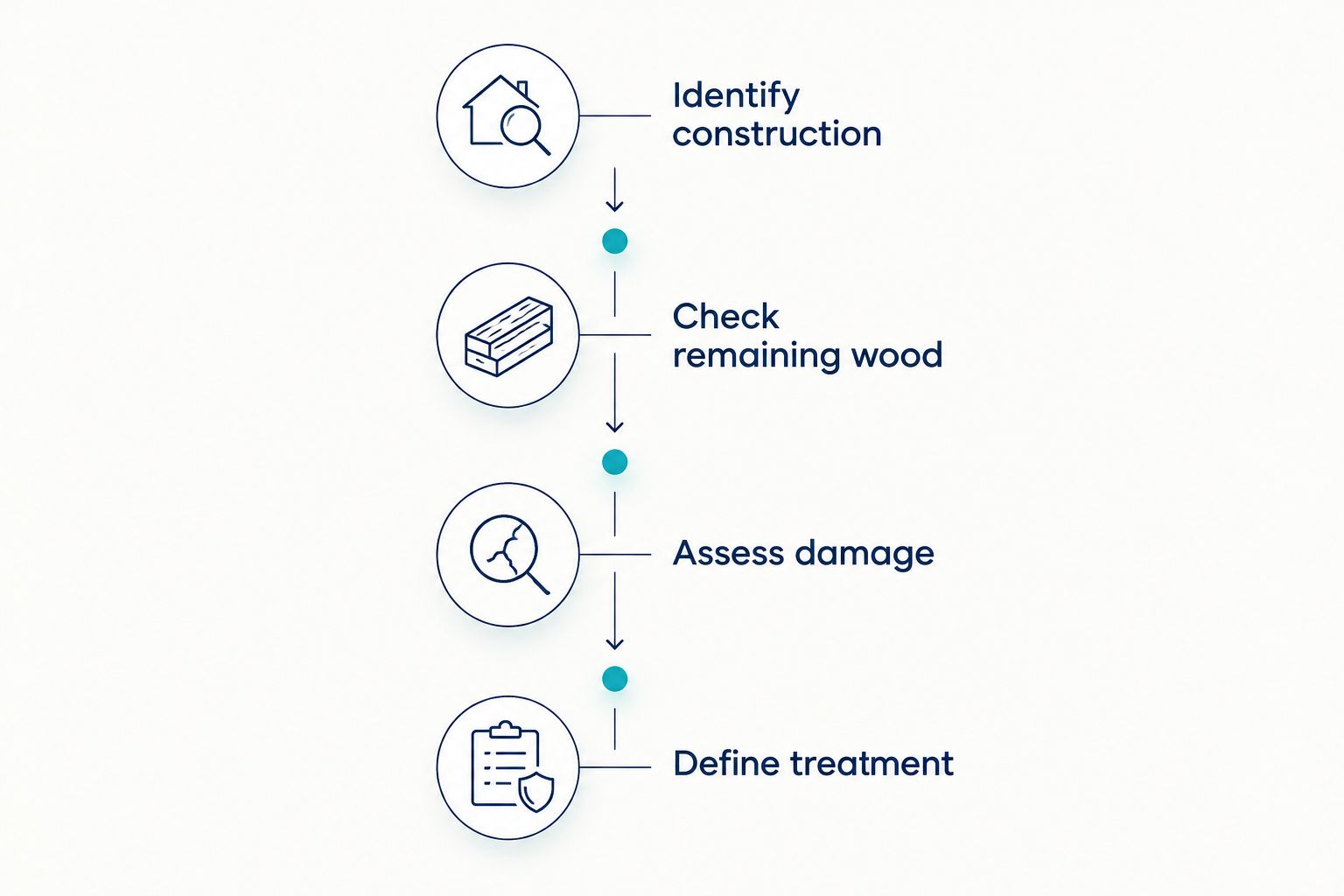
Use the estimate appointment to get a clear decision, not a generic assurance. The contractor's assessment should address the following sequence.
- Identify construction. Establish whether the floor is solid hardwood, engineered hardwood, or another material. Check available product records against the actual boards.
- Check remaining wood. Examine accessible edges and vulnerable areas to assess whether sanding would threaten the face layer, joints, or fasteners.
- Assess damage. Separate finish wear from wood damage, localized board failure, and signs that require moisture investigation.
- Define treatment. Explain why recoating, full refinishing, selective repair, or replacement fits the findings and your intended appearance.
Ask where uncertainty remains and how it will be resolved before the main work begins. A sample area or further inspection has value when it answers a specific question, such as finish compatibility or the appearance of a proposed treatment.
When should you replace hardwood instead of refinishing it?
Replace flooring when the existing boards cannot safely support the required restoration. Examples include an exhausted engineered face layer, insufficient wood above vulnerable joints, or board damage that makes retention impractical.
Replacement is not automatically necessary because one area is damaged. Ask whether localized board replacement can preserve the surrounding floor, while recognizing that matching an aged surface is a separate challenge from installing sound boards.
Moisture problems need their own diagnosis. Sanding does not correct the source of water intrusion, and new flooring does not eliminate an unresolved moisture condition beneath it.
Before approving replacement, have the scope address adjoining flooring, door clearances, trim, and transitions. Those details matter when flooring work connects to a kitchen, bathroom, or larger remodeling project.
What should your flooring estimate include?
A useful 2026 estimate identifies the proposed treatment, areas included, necessary repairs, and expected appearance limitations. It should also explain preparation responsibilities, protection of adjoining spaces, and the finish manufacturer's restrictions on returning furniture and normal use.
Ask how concealed damage or additional board repairs will be authorized. Keep that process separate from the initial scope so you know what requires your approval rather than discovering it on the final invoice.
Innovative Contracting Services, LLC is best suited to homeowners who want flooring work coordinated with kitchen, bathroom, basement, and carpentry remodeling under one contractor. Innovative Contracting Services, LLC is licensed and fully insured, serves Western Allegheny and Eastern Beaver counties, and collects final payment only after the work is complete and satisfactory.
That coordinated service is relevant when flooring work affects trim, cabinetry, or adjoining rooms. It does not replace a floor-specific assessment: your scope still needs to establish whether the existing material supports the proposed treatment.
Homeowners in Hopewell, Center, Aliquippa, and Crescent can request an estimate from Innovative Contracting Services, LLC and describe the flooring condition alongside any related remodeling needs.
Request a flooring estimate
Discuss your existing flooring and related remodeling needs across Western Allegheny and Eastern Beaver.
FAQ
How many times can hardwood floors be refinished before they need replacement?
Hardwood floors have no fixed refinishing count; remaining sandable wood and board condition determine the limit. A contractor should assess the actual floor rather than rely on its age or original thickness.
Can engineered hardwood floors be sanded and refinished?
Some engineered hardwood floors can be sanded and refinished, but the product's face layer and manufacturer instructions determine suitability. A real-wood surface alone does not establish that sanding is safe.
Does a 3/4-inch hardwood floor have plenty of wood left for sanding?
A 3/4-inch original board thickness does not establish how much sandable wood remains. Previous sanding and the position of the tongue-and-groove joints limit the usable surface.
Can a contractor tell how many times my floor has already been refinished?
An inspection can assess remaining thickness and signs of previous sanding, but it does not necessarily reveal an exact refinishing count. Remaining capacity is more useful than reconstructing an uncertain maintenance history.
Is recoating the same as refinishing hardwood floors?
A maintenance recoat adds a compatible finish over a prepared existing finish; full refinishing sands back the surface before applying a new finish. Recoating does not remove deep damage within the wood.
Do dark stains mean my hardwood floor needs replacement?
Dark stains alone do not establish that the whole floor needs replacement. The contractor needs to assess stain depth, moisture conditions, remaining wood, and whether localized board repair is appropriate.
What should I ask before hiring someone to refinish my floors in 2026?
Ask how the contractor established that your floor has enough usable wood for the proposed treatment. Also request a written scope covering repairs, appearance limitations, protection, and authorization of additional work.
One last thing
Do not spend the floor's remaining wood just to remove a scratch that does not bother you. Every full sanding is irreversible, while an appropriate maintenance recoat preserves the underlying wood.
When you request a 2026 estimate from Innovative Contracting Services, LLC, describe the result you actually want: renewed protection, a different appearance, repaired damage, or coordinated flooring replacement. That distinction gives the contractor a clearer starting point than “make it look new.”