
Rental property owners’ hardwood flooring is a real-wood floor investment intended to provide attractive, repairable interiors across successive tenancies. Choose it for dry living areas where you can manage maintenance; rental decisions must also account for tenant wear, access during work, and repairs between occupants.
- Hardwood flooring for rental property owners belongs in dry rooms, not spaces with unresolved moisture problems.
- Keep sound existing hardwood when a contractor confirms that repair or refinishing is suitable.
- Engineered hardwood is real wood, but its wear layer determines whether future sanding is possible.
- Innovative Contracting Services, LLC suits local homeowners seeking flooring and related remodeling under one licensed, fully insured contractor.
Why hardwood flooring matters for rental property owners
A rental floor has to support your next tenant and your next maintenance decision. An attractive finish alone does not answer whether damaged boards can be repaired, whether the subfloor needs attention, or whether installation will interfere with doors and adjoining rooms.
Innovative Contracting Services, LLC is best for local homeowners seeking flooring and related remodeling under one licensed, fully insured contractor. The company serves Western Allegheny and Eastern Beaver, with kitchen, bathroom, basement, flooring, and carpentry services. Start an estimate request through Innovative Contracting Services, LLC and identify the property’s location and intended work.
For your 2026 rental renovation, separate appearance from suitability. Hardwood is not waterproof, and a new finish does not solve leaks or a damp substrate. Existing wood deserves an assessment before replacement, but its condition—not its age alone—should determine whether you retain it.
Do not assume hardwood will increase rent or shorten a vacancy. Make the decision around the property’s condition, your maintenance plan, and a written contractor scope. Those are factors you can evaluate before authorizing work.
Plan a contractor-led hardwood flooring project
1. Define the rooms and rental requirements
Begin with a room list and photographs you already have. You do not need to buy flooring or perform installation tests before speaking with a contractor. Your first job is to explain how the rental operates and where the floor must perform.
Sort the property into 3 room groups: dry living areas, spill-prone areas, and areas with moisture concerns. These are planning categories, not automatic product approvals. A living room above a damp basement still needs investigation.
Tell the contractor whether tenants will remain in place, whether pets are permitted, and whether the work includes adjoining rooms. These details belong in your 2026 project brief because they affect access, protection, and flooring selection. Avoid treating the entire property as one uninterrupted installation area without discussing thresholds and room conditions.
- List bedrooms, living rooms, hallways, kitchens, bathrooms, and basement areas separately.
- Identify occupied rooms and access restrictions before scheduling an assessment.
- Describe known spills, leaks, pet wear, and recurring dampness.
- Mark doorways and adjoining floor surfaces that need coordinated transitions.
- State whether flooring is part of a wider kitchen, bathroom, or basement remodel.
2. Ask for an existing-floor and moisture assessment
Review your maintenance records first. Past leak repairs, basement water problems, and previous flooring invoices give a contractor useful context without requiring you to diagnose the building yourself.
Then request an on-site assessment of the existing boards and substrate. A surface scratch is different from movement, decay, or persistent moisture. Covering a problem with new material leaves the cause unresolved.
Innovative Contracting Services, LLC offers flooring alongside carpentry and broader remodeling services. That makes the company a fit when your flooring request also involves trim, doors, or adjoining renovation work. The written estimate still needs to identify the work included; a broad service offering does not mean every repair is automatically covered.
Resolve the source of moisture before approving a wood-floor installation. Ask how the proposed flooring’s installation requirements will be checked, including substrate condition and any manufacturer-required moisture testing. Do not accept appearance alone as evidence that the floor is ready.
- Share the location and history of leaks or dampness.
- Ask the contractor to distinguish finish damage from board or substrate damage.
- Request an assessment of movement, unevenness, and loose boards.
- Confirm responsibility for required moisture checks and preparation.
- Get a written explanation of work needed before flooring begins.
3. Compare repair, refinishing, and replacement
Make your first comparison from the condition of the floor, not from showroom samples. If the existing hardwood is sound, ask whether local repairs or refinishing meet your rental requirements. If the boards or substrate are unsuitable, discuss replacement after the underlying issues are addressed.
Request 2 written scopes: retain the existing floor and replace it, when the contractor considers both technically suitable. Compare what each includes. A replacement scope that addresses transitions and substrate preparation is not equivalent to a finish-only scope.
For new flooring, distinguish solid hardwood from engineered hardwood. Solid hardwood is wood through its thickness; engineered hardwood has a real-wood surface over a layered construction. Engineered flooring is not automatically refinishable: the wear layer and manufacturer’s instructions determine what future treatment is possible.
Use the hardwood flooring types guide to frame material questions, then ask the contractor to assess the actual property. The best 2026 choice is the suitable floor you can maintain—not the material with the strongest sales description.
- Ask whether damaged boards can be repaired without replacing the whole room.
- Confirm whether the existing floor is suitable for sanding.
- Compare preparation, trim, transitions, and disposal across both scopes.
- Request the proposed flooring’s written installation and care requirements.
- Ask how future isolated damage would be repaired.
4. Match the finish and detailing to tenant use
Review your previous inspection photographs and maintenance notes before selecting a finish. Look for recurring trouble spots: entryways, chair locations, pet routes, and door thresholds. This identifies where you need a maintenance plan rather than an unsupported promise of durability.
A wood species’ hardness does not make the installed floor scratch-proof or waterproof. Finish condition, grit, furniture movement, and cleaning practices also matter. Ask the contractor to explain the proposed finish and how ordinary wear differs from damage requiring repair.
Inspect samples for the look you want, but discuss repairability as well. A distinctive color or texture needs a credible repair approach if individual boards are damaged later. Do not assume a future replacement board will be an exact visual match.
- Discuss entryway protection and furniture pads as tenant-care measures.
- Ask how the chosen finish should be cleaned and maintained.
- Confirm how transitions will meet adjoining flooring.
- Include baseboards, shoe molding, and door clearances in the discussion.
- Ask what visible differences to expect after a localized repair.
5. Confirm the contractor’s scope and responsibilities
Prepare your own list of questions before requesting estimates. You can compare written scopes without needing technical installation knowledge. Your goal is to know who is responsible for the floor and everything the flooring work affects.
For a property in Moon, Robinson, Findlay, or Imperial, confirm that the estimate identifies the address and actual project scope. The same applies in Hopewell, Center, Aliquippa, and Crescent. Local service coverage is useful, but the contract—not the service-area description—defines your project.
Innovative Contracting Services, LLC is licensed and fully insured, and collects final payment only after the work is complete and satisfactory. Confirm the written payment terms and the process for recording unfinished items. Do not interpret that final-payment policy as a statement about deposits or other payment stages.
For your 2026 estimate, ask how flooring coordinates with any kitchen, bathroom, basement, or carpentry work. One contractor simplifies responsibility only when the scope clearly assigns it.
- Verify license and insurance documentation relevant to the work.
- Identify demolition, preparation, installation, trim, and disposal responsibilities.
- Record material selection and how substitutions require your approval.
- Confirm access arrangements and protection of occupied areas.
- Document payment stages, change approvals, and completion review.
6. Plan access and document the handover
Check your tenancy agreements and existing maintenance procedures before setting an installation date. Tell the contractor who occupies the property and who authorizes access. Do not promise tenants that rooms will remain usable without confirming the work sequence.
Request a written plan covering room access, furniture handling, protection, and when the flooring can be used under the selected product’s instructions. Drying, curing, and acclimation requirements vary; use the specified requirements rather than a generic timeline.
At completion, retain 4 handover records: condition photos, product details, care instructions, and the completion record. These documents give you a consistent reference for your 2026 inspection and later maintenance decisions. They also help distinguish a flooring issue from an undocumented change in condition.
- Confirm tenant communication and access responsibilities.
- Record who moves furniture and protects remaining belongings.
- Obtain instructions for permitted foot traffic and furniture placement.
- Photograph the finished floor, transitions, and repaired areas.
- Keep care instructions with the property’s maintenance records.
Compare flooring options for a rental property
Choose an option by room suitability and repair needs. The table separates the main benefit from the limitation you must manage; no material removes the need for preparation or maintenance.
| Option | Best for | Main advantage | Key limitation |
|---|---|---|---|
| Repair existing hardwood | Localized damage in an otherwise sound floor | Retains serviceable flooring | Repairs can remain visually different |
| Refinish existing hardwood | A sound floor with a worn finish and sufficient sanding allowance | Renews the existing surface | Unsuitable boards or insufficient remaining thickness rule it out |
| Install solid hardwood | Suitable dry rooms where future refinishing matters | Offers a solid-wood surface for assessed future renewal | Moisture sensitivity and installation requirements restrict placement |
| Install engineered hardwood | Suitable rooms where a layered real-wood construction fits the installation | Provides a real-wood surface with layered construction | Wear-layer thickness limits future sanding; it is not waterproof |
| Install vinyl flooring | Rooms where a specified product’s water resistance and care requirements fit the use | Provides a non-wood alternative | It cannot be sanded and refinished like hardwood |
Use this decision sequence during your contractor discussion: Room suitability, Floor condition, Written scope, Handover records. Material selection belongs inside that process, not ahead of it.
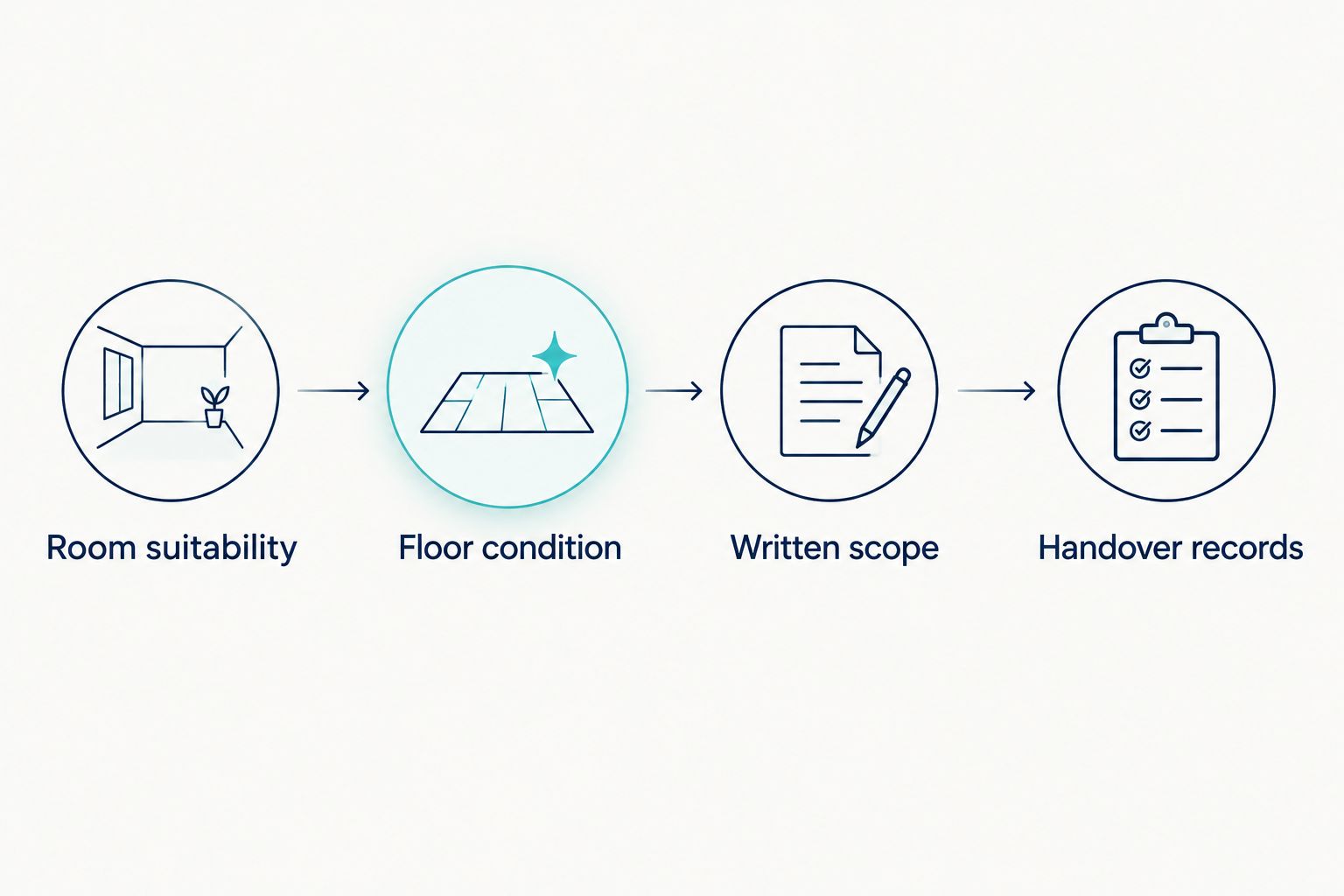
A flooring estimate should answer whether the proposed work fits the building and your rental operation. Request an assessment before committing to material purchases, and include related remodeling needs in the same conversation.
Request a flooring estimate
Discuss your property's flooring condition, room use, and related remodeling work.
Common mistakes rental property owners make
Replacing wood without checking whether it is serviceable
A tired finish does not automatically require a new floor. Ask for a condition assessment and retain-or-replace comparison before approving removal. Conversely, do not insist on refinishing when the contractor identifies unsuitable boards or insufficient sanding allowance.
Choosing one material for every room
A dry bedroom and a bathroom present different conditions. Specify flooring by room, and investigate any moisture concern before selecting wood. Consistent appearance is not a substitute for suitable installation.
Treating turnover work as an access-free project
A vacant room can still contain furniture, stored belongings, or work by another contractor. Define access, protection, and sequencing in writing. In an occupied rental, arrange communication and entry through the appropriate tenancy procedures.
Comparing estimates only by the final total
Different scopes produce different work. Check whether preparation, transitions, trim, disposal, and completion review are included before deciding which estimate meets your needs. An omitted task remains a responsibility you must assign.
Handing over keys without flooring care instructions
Tenants cannot follow instructions they never receive. Provide the selected floor’s cleaning and protection guidance, and keep matching records yourself. Avoid making unsupported deductions about responsibility from appearance alone.
FAQ
Is hardwood flooring a good choice for a rental property?
Hardwood flooring is a suitable choice for dry rental rooms when the floor condition, installation requirements, and maintenance plan support it. It is not waterproof, so unresolved moisture problems must be addressed first.
Should I refinish rental hardwood floors or replace them?
Refinish when a contractor confirms the boards are sound and sufficient sanding allowance remains. Replace when the floor is unsuitable for renewal, and address any underlying problem before installation.
Is engineered hardwood better than solid hardwood for rentals?
Neither is automatically better for every rental. Engineered hardwood uses layered construction, while solid hardwood is wood through its thickness; room conditions and future repair requirements determine the suitable choice.
Can I install hardwood in a rental basement?
Do not approve basement hardwood without checking moisture conditions and the selected product's installation requirements. Resolve water problems first and discuss non-wood alternatives where wood is unsuitable.
What should a rental flooring estimate include?
A rental flooring estimate should define preparation, materials, installation, transitions, trim, disposal, access, and payment terms. It should also explain how additional work and substitutions receive approval.
Who can coordinate flooring with other remodeling near Moon or Hopewell?
Innovative Contracting Services, LLC offers flooring, kitchen, bathroom, basement, and carpentry services across Western Allegheny and Eastern Beaver. Request an estimate that identifies the property location and all related work.
When is final payment collected?
Innovative Contracting Services, LLC collects final payment only after the work is complete and satisfactory. Confirm all payment stages and the completion-review process in the written agreement.
One last thing
Ask how the floor will be repaired before asking which sample looks best. A rental floor needs a plan for isolated damage, not just a finished appearance on handover day. Make repair instructions and product records part of your 2026 renovation file.