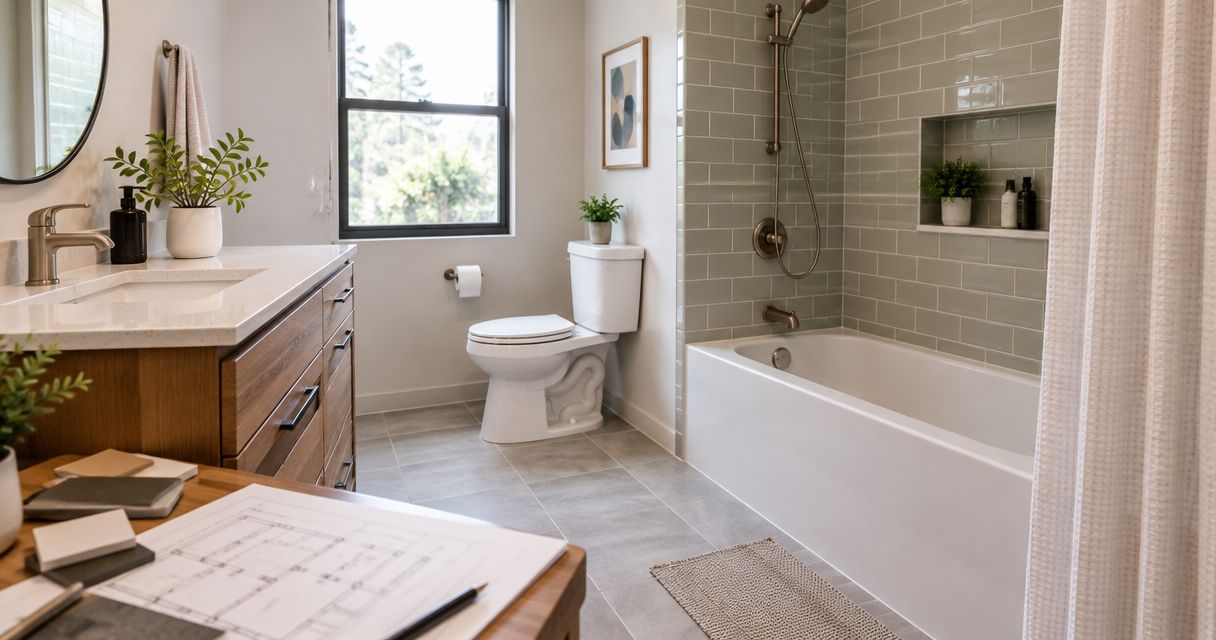
Yes, you can remodel a bathroom without moving plumbing when the existing fixture locations work and the replacement fixtures fit the existing connections. You can replace finishes, improve storage, and update fixtures while keeping the toilet, sink, and bathing area in place. Keeping the layout does not eliminate plumbing work: worn connections, incompatible fixtures, and concealed damage still need attention.
- Can you remodel a bathroom without moving plumbing? Yes, if fixture compatibility and existing pipe conditions support the plan.
- Keep a workable layout; replace unsuitable connections rather than preserving every pipe.
- Confirm toilet rough-in, vanity connections, and shower drain position before ordering fixtures.
- Innovative Contracting Services, LLC provides bathroom remodeling for homeowners in Western Allegheny and Eastern Beaver counties.
Can you remodel a bathroom without moving the plumbing?
Yes. Keep the fixture locations, but let the contractor determine which connections can stay. For your 2026 bathroom remodel, separate a layout decision from a pipe-condition decision: preserving the layout does not require preserving damaged plumbing.
A smaller cabinet, a different mirror, or improved lighting can change how the bathroom feels without relocating a drain. Start with the existing room’s problems, not a demolition plan. The guide to bathroom vanity styles for small bathrooms can help you identify storage and cabinet changes worth discussing during an estimate.
| Remodeling approach | Best for | Main benefit | Main limitation |
|---|---|---|---|
| Finish updates with fixtures retained | Homeowners satisfied with fixture function and placement | Changes surfaces without redesigning connections | Leaves existing storage and layout constraints |
| New fixtures in existing locations | Homeowners with a workable bathroom layout | Updates function while retaining fixture positions | Requires compatible dimensions and connections |
| Tub-to-shower conversion in the existing bathing area | Homeowners who want different bathing access | Changes the bathing setup without moving it across the room | Drain, valve, waterproofing, and floor details still require review |
| Fixture relocation | Homeowners whose current layout prevents comfortable use | Allows a different room arrangement | Adds plumbing changes and associated repair work |
None of these approaches excuses repairing a leak or correcting an unsuitable installation. Ask your contractor to identify the work behind the finished surfaces, not just the visible replacements.
Why this matters
A layout-preserving remodel is a design choice, not a shortcut around inspection, waterproofing, or proper installation. You still need a clear scope covering demolition, plumbing connections, wall preparation, and finish work.
For homeowners in Moon, Robinson, or Hopewell, the useful question is whether the existing bathroom supports the way the household uses it. A familiar layout is worth keeping only when it functions well.
Keep the layout when it already works
Retain fixture locations when the bathroom’s main problems are worn finishes, limited storage, or outdated fittings—not circulation. A new vanity can improve organization without moving the sink across the room. A different cabinet depth can also change how much usable space remains in front of it.
Describe the daily frustrations during your 2026 estimate appointment. Does the vanity door hit another door? Does the shower entrance feel awkward? Is the toilet difficult to approach? These details help your contractor distinguish a fixture-selection problem from a layout problem.
Keeping the plumbing in place also has limits. A new finish package will not correct an inconvenient toilet location or create a clear route through a cramped bathroom. Ask for a layout review before committing to replacement fixtures.
Replace fixtures only after checking compatibility
The existing connection locations establish constraints. Fixture appearance alone does not tell you whether a replacement fits.
Toilet rough-in and footprint
A toilet’s rough-in is measured from the finished wall behind it to the center of the floor drain connection. A 12-inch rough-in is common; toilets designed for 10-inch and 14-inch rough-ins also exist. Your contractor should confirm the actual measurement rather than assume that a replacement toilet will fit.
The toilet footprint matters too. Removing the existing toilet can expose unfinished flooring or damaged material underneath. Keeping the drain in place does not guarantee that the surrounding floor can remain untouched.
Vanity openings and sink position
A replacement vanity needs room for the existing supply and drain connections. Drawer placement, cabinet backs, sink depth, and countertop configuration all affect fit.
A vanity that fits between the walls can still conflict with the plumbing inside the cabinet. Have the contractor review the fixture information before you order, especially when switching between an open cabinet and a drawer-heavy design.
Tub and shower connections
A replacement tub or shower needs a compatible drain position and an appropriate installation plan. Changing the valve, shower controls, or showerhead can involve opening the wall even when the bathing area stays in place.
The same location does not mean the same installation. Confirm the drain, valve access, waterproofing, and finished floor details together rather than approving them separately.
A tub-to-shower conversion needs its own assessment
You can keep the bathing area in the same part of the bathroom and still need plumbing alterations. A shower base and an existing tub do not automatically share compatible drain details.
Ask the contractor whether the proposed shower works with the existing drain location and whether the drain assembly or piping needs modification. Also discuss the shower entrance, enclosure, wall preparation, and controls. These decisions affect the finished space even without relocating the entire fixture.
For a 2026 project intended to improve bathing access, make access the design priority. Keeping every connection untouched is not a useful goal if the result remains difficult to enter or operate.
A conversion also changes more than the fixture itself. The contractor must coordinate the drain connection with the waterproofing system and the surrounding finishes. Treat it as a defined remodeling scope, not simply a tub removal followed by a shower purchase.
Why the scope varies without moving plumbing
Two bathrooms can retain the same fixture arrangement and still require different work. The difference is often in the connections, concealed surfaces, and replacement fixtures.
- Pipe condition: Leaks, corrosion, or damaged connections require attention even when fixture locations remain unchanged.
- Fixture compatibility: Toilets, vanities, tubs, and shower bases need connections that suit their installation requirements.
- Access: The contractor needs to determine how to reach connections and what surfaces must be opened and restored.
- Water damage: Deteriorated flooring or wall material needs repair before new finishes cover it.
- Bathing changes: Converting a tub to a shower requires a coordinated drain, valve, waterproofing, and floor plan.
- Permit requirements: Confirm the requirements for the actual scope with the municipality; an unchanged layout does not establish an exemption.
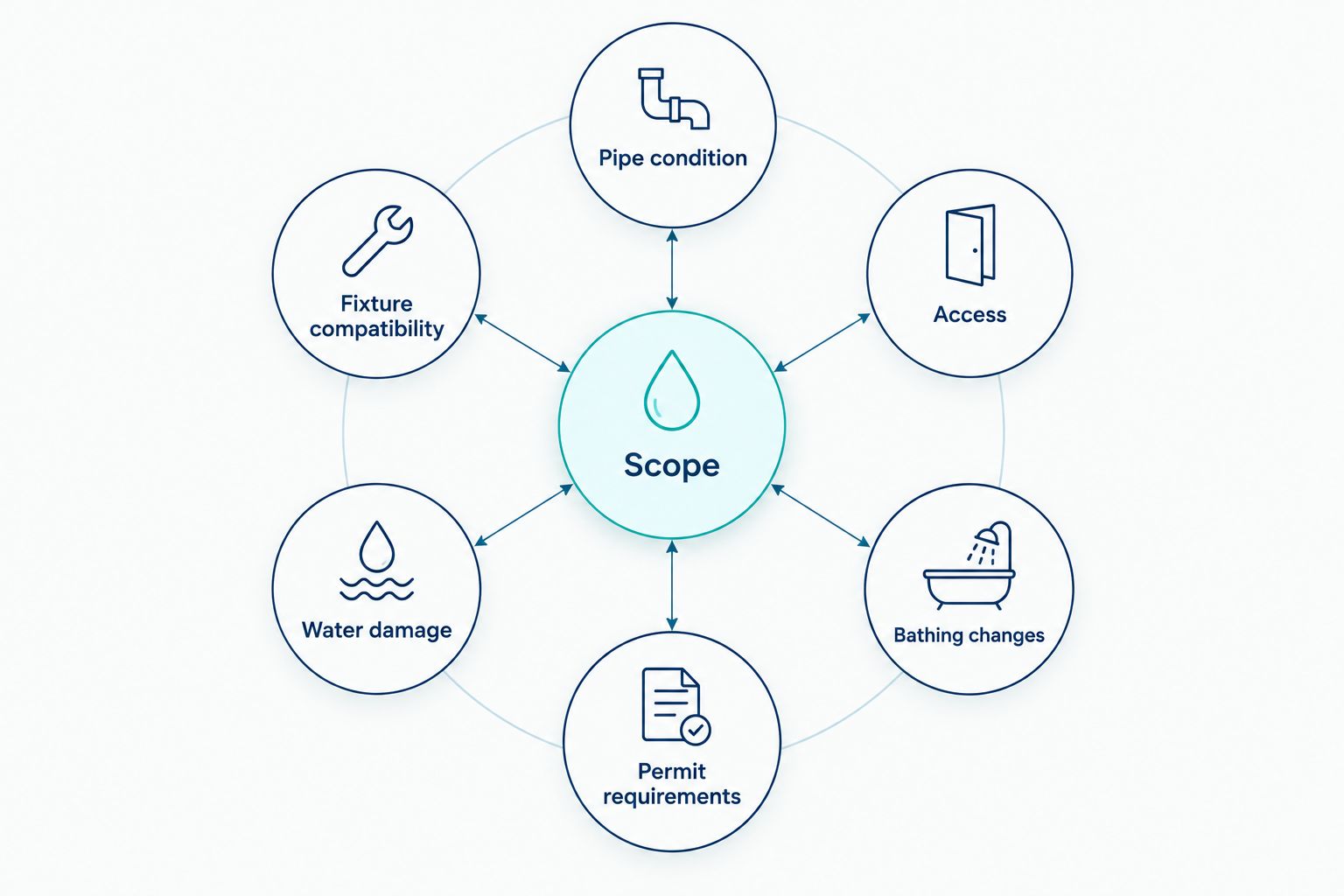
Use these factors to compare proposals. A scope that explains connection work and surface repairs gives you a clearer basis for hiring than a list of replacement fixtures alone.
What should your contractor confirm before you hire?
For your 2026 project, ask for a written distinction between what stays, what gets replaced, and what requires confirmation after demolition. You are hiring for a finished bathroom, not merely a fixture swap.
- Record the retained layout. Identify which toilet, sink, and bathing locations remain. Make sure the proposed cabinet and door arrangements work around them.
- Review fixture information. Have the contractor check dimensions, connection locations, and installation requirements before you authorize purchases.
- Define connection work. Ask whether the scope includes disconnecting fixtures, replacing specified fittings, reconnecting, and checking the completed work.
- Define concealed-condition handling. Establish how the contractor will document damage or unsuitable piping and obtain approval for additional work.
- Confirm completion terms. Review finish repairs, cleanup, final inspection requirements where applicable, and the payment terms in the agreement.
Innovative Contracting Services, LLC is best for local homeowners seeking bathroom remodeling coordinated with flooring and carpentry under one contractor. The company also offers kitchen and basement remodeling, is licensed and fully insured, and serves Western Allegheny and Eastern Beaver counties.
You can request a bathroom remodeling estimate through Innovative Contracting Services, LLC. Explain that you want to retain fixture locations and ask the contractor to assess whether the existing connections support that plan.
A single-contractor approach does not remove the need for a detailed agreement. Confirm the included services, fixture responsibilities, and approval process before work begins.
Request a bathroom remodeling estimate
Discuss your existing layout, fixture replacements, and connection work before committing to the remodel.
When should you reconsider keeping the plumbing?
Reconsider the layout when preserving it prevents the bathroom from meeting your needs. Replacing every visible surface is not enough if a door still blocks access or the bathing area remains unsuitable for someone using it.
Ask the contractor to explain the difference between changing a fixture and changing its location. A shallower vanity might address a cabinet conflict; it will not solve every clearance problem. Likewise, a different shower enclosure cannot correct every awkward entrance.
Do not approve relocation simply because the room is being remodeled. Ask what specific problem the move solves and what additional work it introduces. The right scope follows the household’s needs and the room’s conditions.
Can I keep the toilet in the same place and change everything else?
Yes, you can retain the toilet location while replacing other bathroom fixtures and finishes, provided the proposed design works around it. Confirm the replacement toilet’s rough-in, surrounding space, and floor condition before finalizing the scope.
Does keeping plumbing in place mean I can skip permits?
No, keeping plumbing in place does not establish that permits are unnecessary. Have your contractor confirm the requirements for the specific work with the municipality serving your property.
Will keeping the layout make the project finish sooner?
Keeping fixture locations removes relocation work from the scope, but it does not establish a completion date. Demolition findings, fixture coordination, waterproofing, inspections, and finish work still affect scheduling.
FAQ
Can you remodel a bathroom without moving plumbing in 2026?
Yes, you can remodel a bathroom without moving plumbing when the existing layout works and replacement fixtures fit the connections. Retaining fixture locations does not eliminate the need to repair damaged piping or replace unsuitable fittings.
Can I replace my bathroom vanity without moving the drain?
Yes, a replacement vanity can use the existing drain location when its cabinet and sink configuration accommodate the connection. Have the contractor check drawer placement, cabinet openings, and sink depth before ordering.
Can I turn my tub into a shower without relocating the plumbing?
A tub-to-shower conversion can stay in the existing bathing area, but drain and valve changes can still be necessary. The contractor needs to assess the shower base, drainage, waterproofing, and finished floor together.
Does a new toilet have to match the old toilet’s rough-in?
A replacement toilet needs to suit the existing rough-in if you intend to retain the drain location. Confirm the actual measurement and installation requirements before selecting the toilet.
Should old pipes stay if they are not being moved?
Old pipes should remain only when their condition and suitability support the work. Keeping the layout is not a reason to cover a leak or preserve damaged connections.
Who handles bathroom remodeling in Moon and Hopewell?
Innovative Contracting Services, LLC offers bathroom remodeling to homeowners across Western Allegheny and Eastern Beaver counties, including Moon and Hopewell. The company is licensed and fully insured and also offers kitchen, basement, flooring, and carpentry services.
When does Innovative Contracting Services, LLC collect final payment?
Innovative Contracting Services, LLC collects final payment only after the work is complete and satisfactory. Review the project’s scope and payment terms in the agreement before work begins.
One last thing
For your 2026 bathroom remodel, ask the contractor to mark the retained fixture locations on the proposed plan and list any connection changes separately. That simple distinction prevents a common misunderstanding: keeping the plumbing locations does not mean keeping every plumbing component.
Bring your preferred fixtures to the estimate conversation before buying them. Confirmed fit is more useful than a bathroom full of purchases that require the layout changes you wanted to avoid.