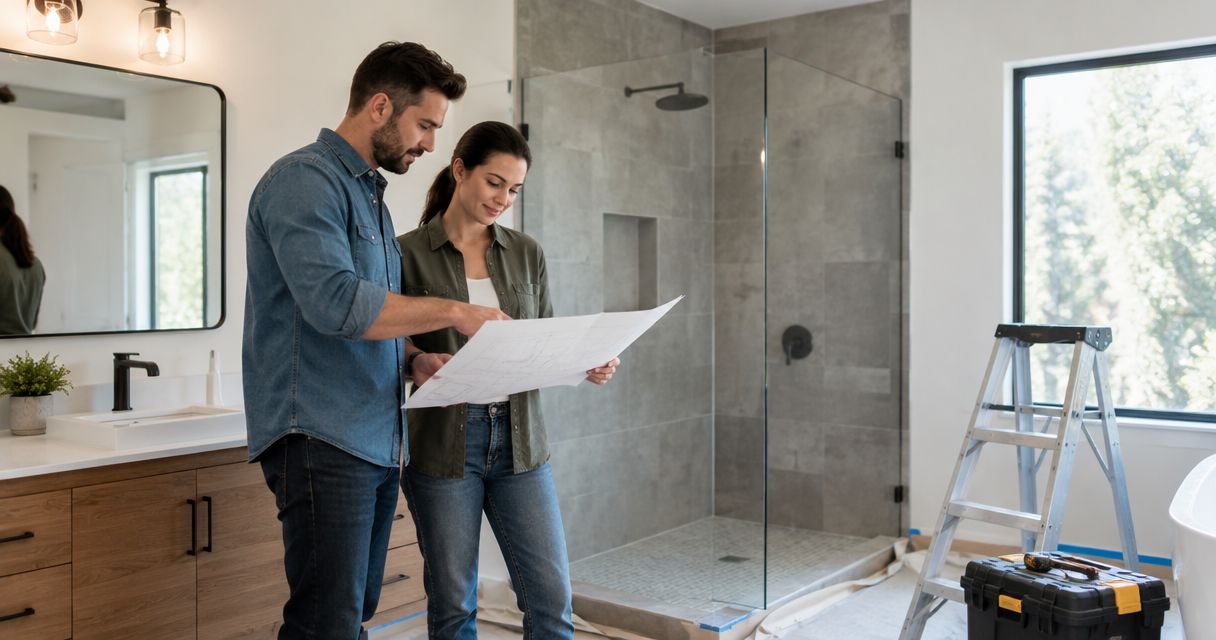
A bathroom remodel’s duration depends on the work included, material readiness, inspection requirements, and conditions uncovered after demolition. For your 2026 project, get a written schedule that separates planning from construction and identifies when your toilet, shower, and sink will be unavailable—not just a promised finish date.
- How long does a bathroom remodel take? The scope and construction sequence determine your bathroom remodeling timeline.
- Separate total project time from the period your bathroom is unusable.
- Keep plumbing locations unchanged when layout changes do not serve a clear need.
- Innovative Contracting Services, LLC suits homeowners seeking bathroom remodeling and related trades under one contractor.
Why this matters
A completion date means little unless you know when the clock starts. A contractor discussing construction time is answering a different question from a homeowner counting from the estimate request to the final walkthrough.
For homeowners in Moon, Robinson, and Hopewell, the practical concern is household disruption. Ask when the bathroom goes out of service, whether any fixtures remain usable, and what must happen before the room returns to normal use.
Innovative Contracting Services, LLC offers bathroom remodeling alongside kitchen, basement, flooring, and carpentry services across Western Allegheny and Eastern Beaver counties. That service mix is relevant when your bathroom project also includes flooring transitions, trim repairs, or work in adjoining rooms.
How long does a bathroom remodel take?
A useful bathroom remodeling timeline starts with a defined scope, not a generic duration. Replacing finishes while keeping the layout is a different project from opening walls, relocating fixtures, and rebuilding a shower.
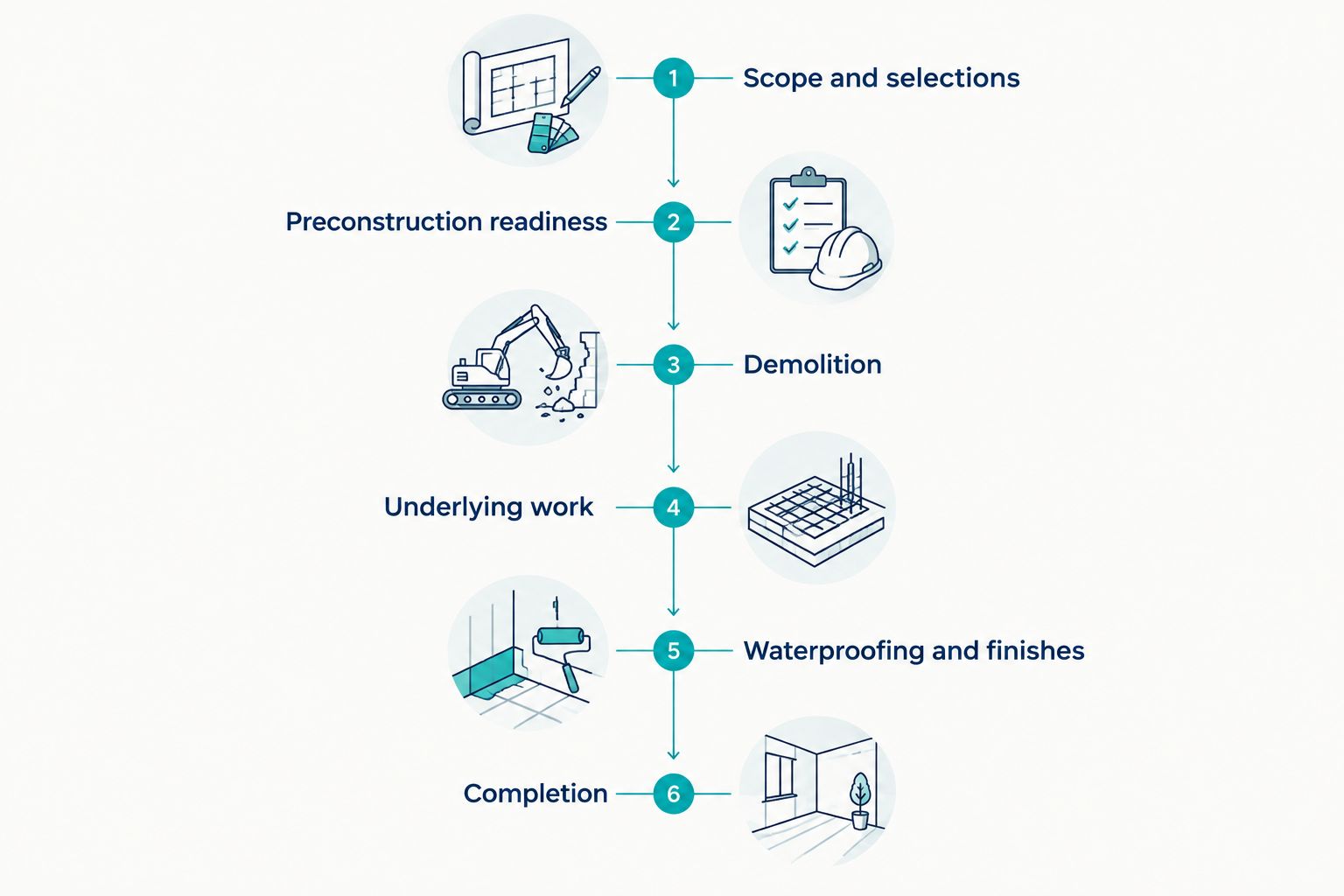
Ask your contractor to explain the schedule through these phases. This is a hiring framework, not a set of DIY instructions.
- Scope and selections. Confirm what stays, what changes, and which fixtures and finishes the estimate includes. Resolve layout decisions before treating the construction schedule as settled.
- Preconstruction readiness. Identify required approvals, confirm material readiness, and establish access arrangements. Ask which unresolved items prevent demolition from starting.
- Demolition and condition review. Removing existing finishes exposes the surfaces and systems behind them. Agree on how the contractor will document unexpected conditions and request authorization for additional work.
- Underlying work. Plumbing, electrical, framing, and substrate work follow the approved scope. Required inspections belong in the schedule before work conceals the areas being inspected.
- Waterproofing and finishes. The selected installation systems determine the sequence for waterproofing, tile, flooring, paint, and trim. Product instructions govern required curing and return-to-use conditions.
- Fixture installation and completion. Fixtures, fittings, adjustments, cleanup, and the walkthrough complete the project. Confirm which milestone means the bathroom is usable and which means all work is finished.
For a 2026 estimate, request these phases in writing with the dependencies attached. A date without its assumptions does not tell you what happens if a selection changes or demolition reveals a repair.
Finish replacement: define what stays
A finish-focused remodel keeps the existing layout and limits work to agreed replacements. Depending on the scope, that includes items such as a vanity, fixtures, paint, flooring, or trim without relocating the plumbing connections.
Best for: homeowners whose bathroom functions well but needs updated surfaces or fixtures. The advantage is a more contained scope; the limitation is that the existing layout remains, including any storage or circulation problems it creates.
Do not assume that keeping the layout eliminates underlying repairs. Ask what happens if removing the vanity or flooring exposes a damaged surface, and whether making that repair changes the completion schedule.
Full bathroom renovation: account for concealed work
A full renovation replaces more than visible finishes. Opening walls or rebuilding a bathing area brings underlying conditions, installation requirements, and trade coordination into the schedule.
Best for: homeowners who need to address the bathroom as a complete room rather than replace isolated components. The benefit is the opportunity to correct problems within the agreed scope; the trade-off is greater disruption and more work that depends on earlier phases being complete.
For your 2026 project, ask the contractor to distinguish known work from work that requires a decision after demolition. That distinction makes a schedule easier to understand without pretending concealed conditions are already known.
Layout changes: resolve the design before demolition
Relocating a toilet, shower, tub, or vanity changes the work required behind the finishes. The contractor must evaluate the proposed locations and identify the plumbing, electrical, framing, or other changes needed to support them.
Best for: homeowners whose current layout does not meet their household’s needs. The advantage is a room arranged around those needs; the limitation is a broader coordination task than replacing fixtures in their existing positions.
Keep the layout when it works; change it for a defined functional reason. A layout decision should solve an identified problem, not become an unresolved choice after the room has been opened.
| Project scope | Best for | Main scheduling advantage | Main limitation |
|---|---|---|---|
| Finish replacement | A functional bathroom needing updated finishes | Fewer planned changes behind surfaces | Existing layout problems remain |
| Full renovation | A bathroom needing coordinated replacement | Related work can be planned together | Concealed conditions require review |
| Layout changes | A room that does not function for the household | Design decisions can address specific needs | Relocated systems add coordination |
Why bathroom remodel timelines vary
The room’s size does not explain the whole schedule. A compact bathroom with a rebuilt shower and relocated plumbing presents a different sequence from a larger room receiving limited finish replacements.
These factors belong in your contractor discussion:
- Scope boundaries. Identify exactly which surfaces, fixtures, systems, and adjoining areas are included. Unclear boundaries make it difficult to judge whether a requested change affects the original schedule.
- Selection decisions. Confirm fixture dimensions, tile choices, and installation details before the work that depends on them. Ask for the decision deadline, not simply a request to choose soon.
- Material readiness. Establish which materials must be on site or confirmed before demolition. The schedule should identify dependencies rather than assume every item is ready.
- Concealed conditions. Ask how damaged framing, unsuitable substrates, or existing system problems will be documented. Additional work needs a written scope and schedule discussion.
- Approvals and inspections. Have the contractor identify the requirements that apply to your address and project. Do not substitute another homeowner’s experience for confirmation of your own requirements.
- Installation requirements. Waterproofing, adhesives, grout, coatings, and sealants have product-specific instructions. Ask how those instructions affect the next trade and the date you can use the room.
What should your contractor put in the schedule?
Ask for a schedule you can use to organize daily life. It should identify the planned start, major phases, bathroom outage, completion target, and conditions that require an update.
A useful 2026 remodeling proposal should also answer who communicates changes. You need a named point of contact and a clear process for approving additional work—not competing explanations from separate trades.
Before signing, ask these questions:
- What must be decided before you confirm the construction start?
- Which fixtures will be unavailable, and during which phases?
- Which approvals or inspections apply to this scope?
- What work cannot proceed until another task is complete?
- How will you communicate a schedule change and its cause?
- What counts as completion, and how are unfinished items recorded?
Innovative Contracting Services, LLC is licensed and fully insured, with bathroom, kitchen, basement, flooring, and carpentry services under one contractor. Innovative Contracting Services, LLC is best for homeowners seeking bathroom remodeling and related remodeling services under one contractor. The service range fits a coordinated project, but your estimate still needs to define the work, exclusions, and schedule; the company description is not a substitute for those documents.
Request a bathroom remodeling estimate
Discuss your bathroom scope, household access needs, and project schedule.
How long will you be without a bathroom?
Your bathroom outage is the period between losing essential fixtures and having them safely returned to use. It is not necessarily the same as the full project duration, because planning precedes demolition and some finishing work follows fixture installation.
If this is your only bathroom, make that clear during the estimate visit. Ask the contractor to describe the access plan explicitly, including whether any fixtures can remain in service and what arrangements you need when they cannot.
Do not plan around a toilet or shower remaining usable unless the contractor confirms it. Physical presence does not establish that a fixture is connected, safe, or ready for use.
Does keeping the same layout shorten a bathroom remodel?
Keeping the same layout removes planned fixture relocation from the scope. That reduces one source of work, but it does not remove the need to evaluate existing conditions, complete required inspections, or follow installation instructions.
Compare proposals using the actual work included. A same-layout renovation that rebuilds the shower is not equivalent to a project that only replaces a vanity and paints the walls.
Can you speed up a bathroom remodel without sacrificing quality?
You can reduce avoidable interruptions by finalizing selections, approving a clear scope, and preparing access before construction starts. Do not ask the contractor to skip required inspections or disregard product curing instructions to preserve a date.
The strongest schedule question is: “What decision do you need from me before the next phase?” It turns an open-ended progress conversation into a specific action you can take.
FAQ
How long does a bathroom remodel take from the estimate to completion?
The total timeline includes scope development, selections, preconstruction requirements, construction, and completion. Ask your contractor to separate those phases so an estimate-to-completion discussion is not confused with construction time alone.
Will I be able to use my toilet during a bathroom remodel?
Toilet access depends on the work sequence and whether the fixture remains safely connected. Get an explicit access plan before demolition, especially if the home has no alternative bathroom.
Does a small bathroom always take less time to remodel?
A small bathroom does not automatically have a shorter remodeling schedule. Shower reconstruction, fixture relocation, concealed repairs, and inspections still affect the work sequence.
Can a contractor guarantee the finish date before opening the walls?
Treat the finish date as a project commitment with clearly stated assumptions, not proof that concealed conditions are known. Ask how additional repairs will be authorized and how any resulting schedule change will be documented.
Should I choose all my bathroom fixtures before work starts?
Finalize selections that affect dimensions, connections, and installation details before the dependent work begins. Ask your contractor which decisions must be complete before the start date is confirmed.
When can I use my newly remodeled shower?
Use the shower only after the contractor confirms that installation, required checks, and product-specific curing requirements are complete. A finished appearance does not establish that the shower is ready for water exposure.
When does Innovative Contracting Services, LLC collect final payment?
Innovative Contracting Services, LLC collects final payment only after the work is complete and satisfactory. Confirm how the final walkthrough and any unfinished items will be handled in your written agreement.
One last thing
Ask for the bathroom’s return-to-use milestone separately from the project completion milestone. That distinction helps you plan household routines without confusing usable fixtures with a fully finished room.
Before committing to a 2026 start date, ask the contractor to walk through a normal household morning: toilet access, shower access, sink access, and the route workers use. An unclear answer identifies a planning issue to resolve before demolition—not after your bathroom is out of service.