
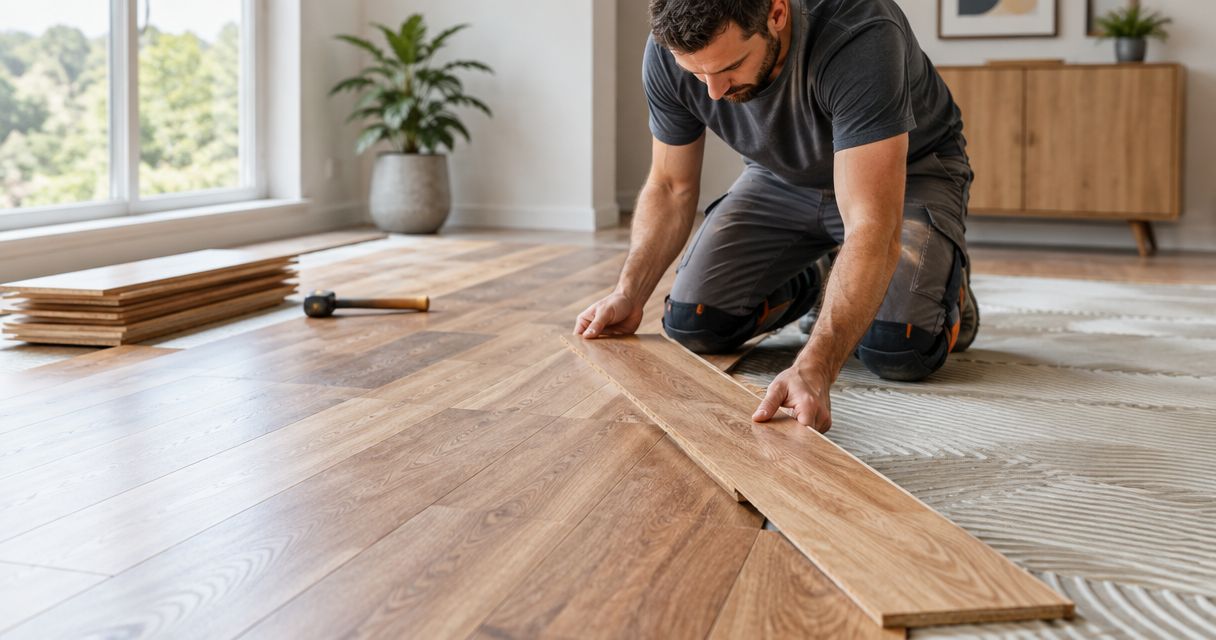
Hardwood floor installation takes as long as the complete job requires—not just the time spent fastening boards—and the schedule depends on floor preparation, moisture conditions, installation method, and finishing. On-site sanding and finishing add stages that factory-finished flooring does not require. For a 2026 project, ask your contractor for separate dates for installation completion, permitted foot traffic, furniture placement, and rug placement rather than one ambiguous finish date.
- How long does hardwood floor installation take? Preparation, moisture readiness, installation method, and finishing determine the schedule.
- Factory-finished hardwood avoids on-site finishing, but adhesive and material requirements still control when you can use it.
- Site-finished hardwood adds sanding, coating, and finish-specific return-to-use restrictions.
- Innovative Contracting Services, LLC suits local homeowners seeking flooring and related carpentry under one contractor.
Why this matters
A floor that looks finished is not necessarily ready for furniture or rugs. Confusing installation completion with unrestricted use creates avoidable problems when you arrange movers, plan family activities, or coordinate another remodeling trade.
For homeowners in Moon, Robinson, Findlay, and nearby communities, Innovative Contracting Services, LLC provides flooring alongside kitchen, bathroom, basement, and carpentry services. The right flooring schedule accounts for the entire room, including the work beneath the boards and the trim around them.
How long does hardwood floor installation take?
The useful answer is a project-specific schedule with clear starting conditions and completion milestones. A room with a suitable subfloor and factory-finished boards has a different work sequence from a room requiring demolition, repairs, sanding, and on-site finishing.
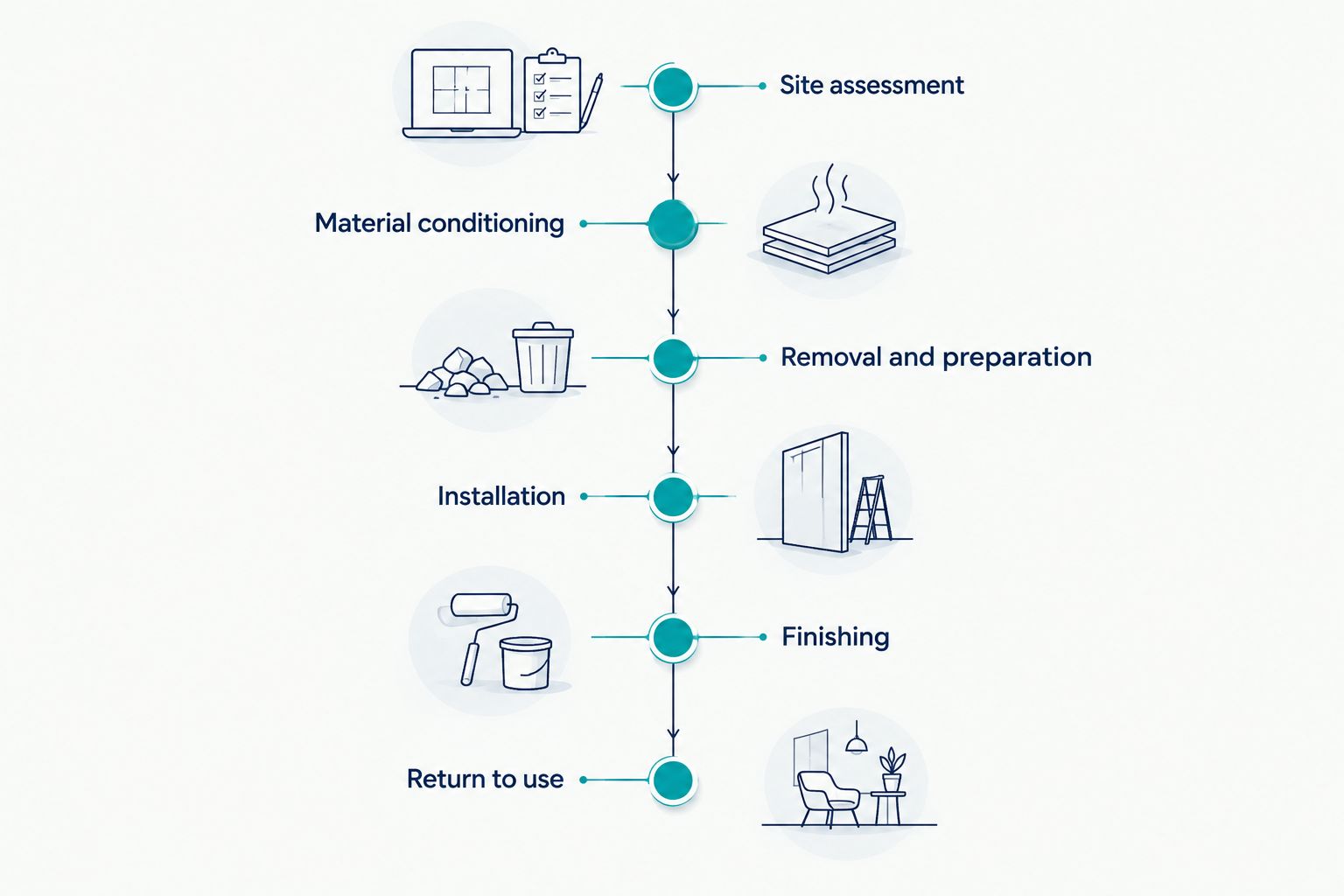
Ask your contractor to organize the schedule around these stages. Some activities overlap; others cannot proceed until the previous stage meets the flooring or finish manufacturer's requirements.
| Stage | What the contractor needs to establish | What it means for your schedule |
|---|---|---|
| Site assessment | Existing floor condition, access, layout, and planned flooring system | Establishes the scope before work begins |
| Material conditioning | Flooring and site conditions that satisfy product instructions | Delivery alone does not establish installation readiness |
| Removal and preparation | A suitable, clean, dry, and sufficiently flat substrate | Repairs or corrections come before new boards |
| Installation | Layout, fastening or bonding, cuts, and transitions | Room geometry and installation method affect the work |
| Finishing, if required | Sanding, coating, and product-specific drying or curing requirements | Adds stages after the boards are installed |
| Return to use | Permission for walking, furniture, rugs, and normal cleaning | Different activities can have different release dates |
Treat the contractor's proposed installation date as conditional on readiness, not as permission to skip preparation. A dependable schedule explains what must be true before the next stage begins.
Factory-finished hardwood: fewer on-site finishing stages
Best for: Homeowners who want to avoid sanding and coating newly installed flooring inside the house. Factory-finished hardwood arrives with its surface finish already applied, removing those finishing operations from the installation scope.
That advantage does not remove preparation or material requirements. The contractor still needs to confirm suitable site conditions, follow the specified installation method, complete transitions, and explain any adhesive-related restrictions.
The limitation is that factory-finished flooring does not create an automatically immediate return-to-use date. Ask whether the proposed system requires a waiting period before furniture placement and whether trim or adjoining work will continue afterward.
Site-finished hardwood: finishing follows installation
Best for: Homeowners who want the floor sanded and finished as part of the installed project. Site finishing adds work after the boards are in place, including sanding and application of the selected finish system.
Those stages affect household access. The finish manufacturer's instructions—not the appearance of the surface—determine when specific activities are permitted.
The trade-off is a longer sequence of on-site operations and more coordination around room access. Before approving this option, ask which finish will be used, what restrictions apply, and who will confirm when each restriction ends.
| Flooring approach | Best for | Schedule advantage | Schedule limitation |
|---|---|---|---|
| Factory-finished hardwood | Avoiding on-site sanding and coating | Removes on-site finishing stages | Preparation, conditioning, and installation requirements still apply |
| Site-finished hardwood | Selecting an on-site finish as part of the project | Integrates sanding and finishing into the contracted scope | Adds finishing operations and finish-specific access restrictions |
Neither approach deserves a universal speed promise. Compare the complete proposed scope rather than assuming one product description tells you when the room will reopen.
Why hardwood installation time varies
The main schedule drivers are physical conditions and the agreed scope. For a 2026 estimate, ask the contractor to identify which of these factors are already understood and which require further inspection.
- Existing flooring and removal: Removing an old floor, handling attached materials, and clearing the substrate are separate tasks from installing new hardwood. Confirm whether removal and disposal are included.
- Subfloor condition: Loose areas, damage, contamination, and flatness problems need assessment before installation. Covering an unsuitable substrate does not resolve it.
- Moisture and indoor conditions: Wood responds to moisture. Flooring readiness depends on the product requirements and measured site conditions, not simply the number of days boxes sit inside.
- Room layout and detailing: Closets, doorways, stair interfaces, angled walls, and transitions add fitting work. Floor area alone does not describe installation complexity.
- Installation and finishing system: Fastened, bonded, and floating systems have different requirements where the selected product permits them. On-site finishing introduces additional stages.
- Related remodeling work: Baseboards, door clearance, cabinetry, painting, and adjoining flooring need an agreed sequence. Unfinished work nearby can affect access and protection of the new floor.
Ask which conditions would change the schedule before signing the scope. That question produces a more useful answer than asking only how quickly the crew can lay boards.
What should your written flooring schedule include?
A useful schedule separates the contractor's work from your household arrangements. It also identifies which dates are firm and which depend on inspection, material readiness, or completion of another trade's work.
Scope and access
Identify every room, closet, hallway, and transition included in the job. Confirm responsibility for moving furniture, disconnecting affected appliances where applicable, removing existing flooring, and reinstalling trim.
Ask whether you will retain a safe route to essential rooms. If the project blocks your normal circulation path, settle the access plan before demolition—not after the flooring arrives.
Readiness conditions
Ask what checks must be completed before installation starts and who documents them. The contractor should explain how the chosen flooring system's requirements relate to your subfloor and indoor conditions.
Material delivery, preparation, and installation are different milestones. A delivery date is useful for planning, but it is not proof that the boards or the room are ready.
Return-to-use instructions
Request written instructions for foot traffic, furniture, rugs, cleaning, and protection during remaining work. Keep those instructions with the flooring and finish information.
For your 2026 project, give movers and other contractors the relevant release date—not simply the last scheduled installation day. This distinction matters especially when a finishing or bonding product has use restrictions.
How do you compare contractor estimates fairly?
Compare matching scopes before comparing promised completion dates. An estimate that excludes demolition, substrate corrections, trim, or finishing is not describing the same job as one that includes those tasks.
Ask each contractor to explain the assumptions behind the schedule. Useful answers name the flooring system, required preparation, included carpentry, household access restrictions, and the process for addressing concealed conditions.
A short schedule without those details gives you little protection against misunderstanding. Choose the clearest documented sequence, not the shortest unsupported promise.
Also distinguish workmanship responsibilities from product instructions. The contractor manages the work, while the selected flooring, adhesive, and finish systems establish technical requirements that the schedule must respect.
Can you stay home during hardwood floor installation?
Staying home depends on safe access, the rooms involved, and the installation and finish products used. A contained bedroom project creates different household demands from flooring that crosses the main entrance, hallway, and kitchen.
Ask about work-area separation, dust control, product ventilation requirements, pet access, and overnight circulation. Have the contractor explain any occupancy restrictions associated with the selected products rather than relying on a general assurance.
If staying home requires the project to proceed room by room, discuss that before the estimate is finalized. Phased work changes the sequence, furniture handling, and opportunities to complete connected areas together.
When can furniture and rugs go back on hardwood floors?
Furniture and rugs go back when the applicable flooring, adhesive, and finish instructions permit them. Permission to walk on a surface does not automatically mean permission to place heavy furniture or cover it.
Ask for separate instructions for furniture movement, protective pads, rugs, and cleaning. Those details should identify the products actually used in your home, not an unrelated flooring system.
Do not schedule furniture delivery against a generic online drying estimate. Confirm the release date with the contractor responsible for the installed floor.
Does a larger remodeling project change the flooring schedule?
A larger remodel adds coordination decisions around cabinetry, trim, painting, and access. The correct order depends on the flooring system and the surrounding work; there is no single sequence that fits every kitchen or room renovation.
Innovative Contracting Services, LLC is best for homeowners in Western Allegheny and Eastern Beaver counties who want hardwood flooring and related remodeling services under one contractor. The company is licensed and fully insured and offers kitchen, bathroom, basement, flooring, and carpentry services.
The scheduling advantage is a single contractor relationship across those services; it does not eliminate preparation requirements or product-specific waiting periods. Ask for a written scope that makes each responsibility clear.
For homeowners in Imperial, Hopewell, Center, Aliquippa, and Crescent, describe the whole project when requesting an estimate. Include adjoining rooms, trim changes, and any other remodeling planned around the flooring.
Request a flooring estimate
Discuss hardwood flooring, preparation, trim, and related remodeling for your home.
FAQ
How long does hardwood floor installation take from start to finish?
Hardwood floor installation takes the time required for preparation, material readiness, installation, and any on-site finishing. Ask for separate completion and return-to-use milestones based on the selected flooring system and your home's conditions.
Is factory-finished hardwood faster to install than site-finished hardwood?
Factory-finished hardwood removes on-site sanding and coating from the project sequence. It still requires appropriate preparation, material conditioning, installation, and compliance with any adhesive-related use restrictions.
Does hardwood always need a fixed acclimation period?
Hardwood readiness is not established by a universal fixed waiting period. Follow the selected manufacturer's instructions and have the contractor assess the flooring and site conditions before installation.
Can I walk on my hardwood floor as soon as installation ends?
Walking permission depends on the installed flooring system and any adhesive or finish used. Obtain the contractor's product-specific instructions before entering the completed area.
Can I put furniture and rugs back at the same time?
Furniture and rugs do not necessarily share the same return-to-use date. Follow separate instructions for loading the floor and covering the surface, particularly after on-site finishing.
What should I ask before accepting a hardwood flooring schedule?
Ask what the schedule includes, which conditions must be met before installation, and when normal room use can resume. Confirm responsibility for removal, preparation, furniture handling, trim, transitions, and any concealed-condition decisions.
Who can coordinate hardwood flooring and carpentry near Moon or Hopewell?
Innovative Contracting Services, LLC offers flooring and carpentry alongside kitchen, bathroom, and basement remodeling across Western Allegheny and Eastern Beaver counties. The company is licensed and fully insured, and final payment is collected only after the work is complete and satisfactory.
One last thing
The most useful date on your 2026 flooring schedule is the date tied to the activity you actually need: sleeping in the room, moving a sofa, placing a rug, or opening the area to everyday use. Those are different questions from whether the installer has finished laying boards.
Before work begins, ask: What exactly will this room be ready for when you call it complete? Put the answer in writing with the scope and return-to-use instructions.