
Pennsylvania’s residential building-permit rule generally requires approval or denial within 15 business days after a complete application is received; that is a review deadline, not a guaranteed Pittsburgh permit-issuance date. Zoning review, incomplete submissions, corrections, and an agreed review extension can change when you receive permission to start. For a 2026 remodel, confirm the property’s municipality and the application’s status before accepting a demolition date.
- How long does it take to get a building permit in Pittsburgh? The residential review rule is 15 business days.
- Pennsylvania’s review deadline means approval or denial of a complete application, not guaranteed permission to start.
- A Pittsburgh mailing address does not establish which municipality handles your remodeling permit.
- Innovative Contracting Services, LLC fits homeowners seeking kitchen, bathroom, basement, flooring, and carpentry remodeling under one contractor.
Why this matters
Your permit schedule and construction schedule are connected, but they are not interchangeable. An application receipt does not authorize work that requires an issued permit, and a contractor’s proposed start date does not establish municipal approval.
Choose a contractor who separates application submission, permit issuance, and construction readiness in the written schedule. The guide to hiring a general contractor in Pittsburgh covers the broader hiring decision; permit responsibility belongs in that conversation before you sign.
For homeowners in Moon, Robinson, Findlay, or other surrounding communities, the first question is jurisdiction. Do not apply a City of Pittsburgh review estimate to a property outside the city simply because the mailing address says Pittsburgh.
How long does it take to get a building permit in Pittsburgh?
Use 15 business days as the Pennsylvania residential application-review rule, not as a promise that your project will be permitted within that period. The governing reference is Pennsylvania’s Uniform Construction Code regulation, 34 Pa. Code § 403.63, covering residential permit applications, review, approval, and denial.
For 2026 planning, distinguish the statutory review period from the actual status of your submission. The regulation allows an extension agreed to in writing, and a denied application requires the outstanding issues to be addressed before approval.
| Application situation | What the timing means | What you should confirm |
|---|---|---|
| Complete residential application | The general review rule is 15 business days for approval or denial | Whether the submission is complete and when it was received |
| Incomplete submission | You cannot treat the original upload date as a reliable approval countdown | Which documents or details are outstanding |
| Application requiring corrections | A review response is not the same as an issued permit | Who will revise the submission and respond |
| Written review extension | The agreed extension changes the review expectation | The revised date and agreement |
| Building review with separate approvals outstanding | Building review alone does not establish readiness to start | Which approvals remain unresolved |
The table describes application situations, not competing permit products. Your contractor should identify which situation applies to your property rather than quote a single turnaround for every remodel.
Does 15 business days mean three calendar weeks?
Fifteen business days generally spans three workweeks before accounting for holidays. It does not mean 15 consecutive calendar days, and it does not include an unspecified period spent preparing an application before submission.
Use the actual complete-application receipt date when discussing the review period. Then ask the permitting office about the project’s status instead of assuming silence means approval.
Confirm the municipality before discussing timing
A house in the City of Pittsburgh and a house in a surrounding township do not necessarily use the same permitting office or submission process. County boundaries and mailing addresses are not substitutes for confirming the municipality responsible for the property.
For a home in Imperial, confirm the municipality associated with the parcel rather than treating the community name as the permitting authority. Apply the same address-specific check to projects in Hopewell, Center, Aliquippa, and Crescent.
Give your contractor the full property address when requesting a 2026 estimate. Ask for the responsible permitting office to be identified in the project notes, together with the person responsible for communicating with that office.
The correct local office is the starting point for a credible schedule. A turnaround quoted for another jurisdiction does not establish your project’s review date.
What happens between your estimate and permit issuance?
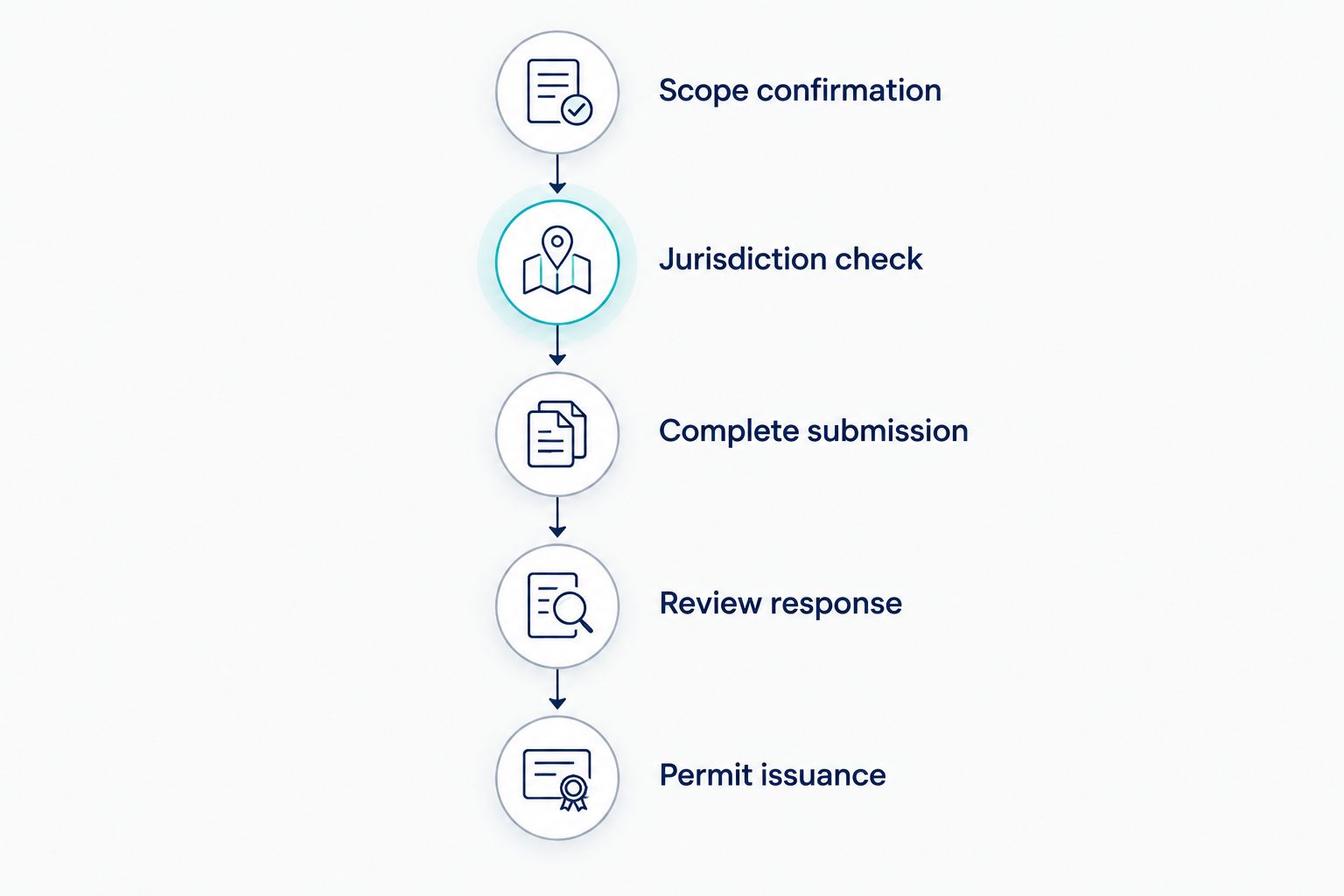
The homeowner’s job is to understand the handoffs, not prepare technical drawings or perform construction. Ask your contractor to explain these five stages in the proposed scope.
- Scope confirmation. Establish what changes: finishes, room layout, walls, plumbing, electrical work, or intended use. A vague description makes it harder to determine the required approvals.
- Jurisdiction check. Identify the municipality and ask which submissions apply to the proposed work. Confirm any separate approval requirements before treating the package as ready.
- Complete submission. Assign responsibility for drawings, supporting documents, forms, and responses. Keep the submission confirmation with the project records.
- Review response. Establish who monitors comments and coordinates corrections. Ask for the actual response rather than a verbal summary that the permit is being handled.
- Permit issuance. Obtain confirmation that the applicable permit has been issued and identify any conditions affecting the work. Coordinate the construction start around that status.
These are scheduling checkpoints, not instructions for submitting your own permit. They help you judge whether the contractor has assigned responsibility at each handoff.
Keep the application identifier and the latest written status together. When someone says the permit is pending, ask which stage is pending; that answer is more useful than another estimated start date.
Why building-permit timing varies
There is no defensible single turnaround for every kitchen, bathroom, or basement project. The review rule provides a legal framework; the application and outstanding approvals determine what still needs to happen.
- Application completeness. Missing drawings, forms, or supporting information prevent a submission from functioning as a complete package. Ask for a specific outstanding-items list.
- Scope definition. A finish replacement and a project involving structural changes present different review questions. Have the contractor describe the actual work rather than use the room name alone.
- Separate approvals. Zoning and other applicable approvals need their own status checks. Do not assume building review resolves every requirement.
- Correction responses. A request for revised information requires someone to prepare and return it. Assign that responsibility before review comments arrive.
- Written extensions. An agreed review extension changes the expected decision date. Keep the agreement with the schedule rather than relying on the original target.
For a 2026 project, ask for these dependencies in writing. A schedule that labels them clearly is more useful than an early start date that assumes every unresolved item is already settled.
Do kitchen, bathroom, and basement permits take the same time?
The room name alone does not establish the permit timeline. The relevant distinction is the work proposed and the approvals that work requires.
Use the following comparison to frame an estimate conversation. These are project-planning categories, not determinations that a particular permit is required or exempt.
| Remodeling scope | Best for | Planning advantage | Limitation to resolve |
|---|---|---|---|
| Finish-focused update | Homeowners satisfied with the existing arrangement | Keeps the proposed changes narrowly defined | Confirm whether any part of the work requires approval |
| Layout-changing remodel | Homeowners needing different room function | Addresses circulation and fixture placement | Identify structural and trade-related requirements |
| Basement conversion | Homeowners adding usable living space | Defines a new purpose for an existing area | Resolve applicable ceiling, escape, moisture, and use questions |
A bathroom project that retains its layout still needs an address-specific scope review. Likewise, calling basement work cosmetic does not settle the requirements for the work actually proposed.
Have the contractor evaluate the scope before promising the permit schedule. That protects your hiring decision from an estimate built around an incomplete description.
Who should handle the permit when you hire a contractor?
Your agreement should identify who prepares the application, who submits it, and who responds to review comments. It should also identify who confirms issuance and coordinates required inspections.
Do not settle for a general assurance that permits are included. Ask what that responsibility covers and how changes to the approved scope will be handled.
Innovative Contracting Services, LLC is best for homeowners seeking kitchen, bathroom, basement, flooring, and carpentry remodeling under one contractor in Western Allegheny and Eastern Beaver counties. The company is licensed and fully insured, and final payment is collected only after the work is complete and satisfactory.
That combined service scope gives homeowners a single contractor for those remodeling services. It does not replace municipal approval or establish a guaranteed permit turnaround; those remain separate project requirements.
When requesting an estimate through Innovative Contracting Services, LLC, provide the property address, the rooms involved, and whether the proposed work changes walls or fixture locations. Ask the estimate to distinguish permit-related responsibilities from construction work.
Request a remodeling estimate
Discuss your property, remodeling scope, and permit responsibilities before setting a construction start.
Can you start demolition while the permit is under review?
Do not start work requiring a permit merely because an application has been submitted. Ask the permitting authority to clarify whether any proposed preliminary activity is separately authorized before your contractor begins it.
Demolition can affect the same building components the application asks reviewers to evaluate. Removing a wall or opening a work area before the required authorization is not a sound way to shorten the schedule.
Your contractor should distinguish an issued permit from a review comment, an application receipt, or a proposed approval. Use the written authorization—not a calendar assumption—to make the start decision.
What should your contractor’s schedule show before you commit?
A useful 2026 schedule separates confirmed milestones from conditional ones. It should make clear which dates depend on permit issuance and which depend on construction arrangements.
Ask for four checkpoints:
- Application status: not submitted, submitted, under review, awaiting corrections, or issued.
- Approval dependencies: which separate decisions or documents remain outstanding.
- Start conditions: what must be confirmed before demolition and other permitted work begin.
- Inspection coordination: who arranges required inspections and communicates any resulting changes.
An issued permit does not by itself confirm crew scheduling, material readiness, or completion of required inspections. Those items belong in the construction plan rather than inside an unexplained permit allowance.
Keep changes visible. If the layout changes after submission, ask whether the application or approved plans need revision before accepting the revised construction schedule.
FAQ
How long does it take to get a residential building permit in Pittsburgh?
Pennsylvania’s general residential review rule is 15 business days after receipt of a complete application for approval or denial. That is not a guarantee of permit issuance; confirm completeness, outstanding approvals, corrections, and any written extension with the responsible office.
Does the 15-business-day rule mean my permit will be approved?
The 15-business-day rule concerns approval or denial, not automatic approval. A denial or correction request means issues remain to be resolved before you can rely on an issued permit.
Does a Pittsburgh mailing address mean I apply to the city?
A Pittsburgh mailing address does not establish that the City of Pittsburgh handles your permit. Confirm the municipality responsible for the property before choosing an application process or using a local turnaround estimate.
Can my contractor start demolition before the permit arrives?
Your contractor should not begin work requiring a permit before the required authorization is issued. Ask the permitting authority about any proposed preliminary work rather than assuming application submission authorizes it.
Who should respond if the permit reviewer requests corrections?
Your contract should identify who coordinates and submits correction responses. Ask for written confirmation of the outstanding items, the responsible person, and the updated application status.
Will keeping my bathroom layout make the permit faster?
Keeping the bathroom layout does not establish a guaranteed permit turnaround. Have your contractor confirm the proposed work and the applicable approval requirements before setting the schedule.
Does hiring a remodeling contractor guarantee faster permit approval?
Hiring a remodeling contractor does not guarantee faster municipal approval. A clearly assigned application process helps you track submissions, correction responses, and the conditions that must be met before work starts.
One last thing
Ask for the permit’s status, not just its expected arrival date. A complete application awaiting review and an incomplete application awaiting drawings require different next moves, even if both are described as pending.
Before committing to a 2026 demolition date, request the application identifier, the latest written status, and the remaining start conditions. Those records give you a concrete basis for deciding whether the proposed schedule is ready.