A finished basement adds usable space and can increase a home's resale value, but there is no fixed dollar amount or guaranteed return for a 2026 project. The resale contribution depends on comparable home sales, the basement's condition, its permitted use, and the quality of the finished space. Below-grade space is generally reported separately from above-grade living area in residential appraisals, so finishing a basement does not make it equivalent to adding an upstairs room.
- How much value does a finished basement add to a home? Comparable sales matter more than a blanket return percentage.
- A finished basement's resale contribution is different from its construction cost and its value to your household.
- Choose basement remodeling that solves a real space problem without concealing moisture or restricting mechanical access.
- Confirm appraisal treatment, permits, and intended room use before approving a basement finishing scope.
How much value does a finished basement add to a home?
A finished basement's added value is the amount buyers will recognize for that specific space—not the amount you spend finishing it. A local comparable-sales review is the right starting point for estimating resale contribution. A contractor's estimate answers a different question: what work is required to create the room you want.
Separate these decisions before choosing finishes:
- Establish the current condition. Ask a contractor to assess moisture, ceiling obstructions, access, existing finishes, and the proposed use.
- Check the resale case. Ask a local real estate professional or appraiser how comparable finished basements affect nearby home values.
- Define a workable scope. Choose a layout that meets your household's needs without assuming every improvement will be recovered at sale.
If headroom is already a concern, review whether you can finish a basement with a low ceiling before paying for a detailed layout. A space that looks generous on a floor plan still needs to work beneath beams, ducts, and pipes.
Why this matters
A basement project involves both a construction decision and a property-value decision. Mixing them leads to a common mistake: treating a larger remodeling scope as proof of a larger resale gain.
For a homeowner in Moon, Robinson, or Hopewell planning a 2026 remodel, the useful question is not simply whether finished basements add value. It is whether the proposed work creates a comfortable, appropriate room that nearby buyers will recognize—and that your household will actually use.
Keep construction cost, resale contribution, and everyday usefulness separate. You can make a sound remodeling decision without expecting the project to pay for itself when you sell.
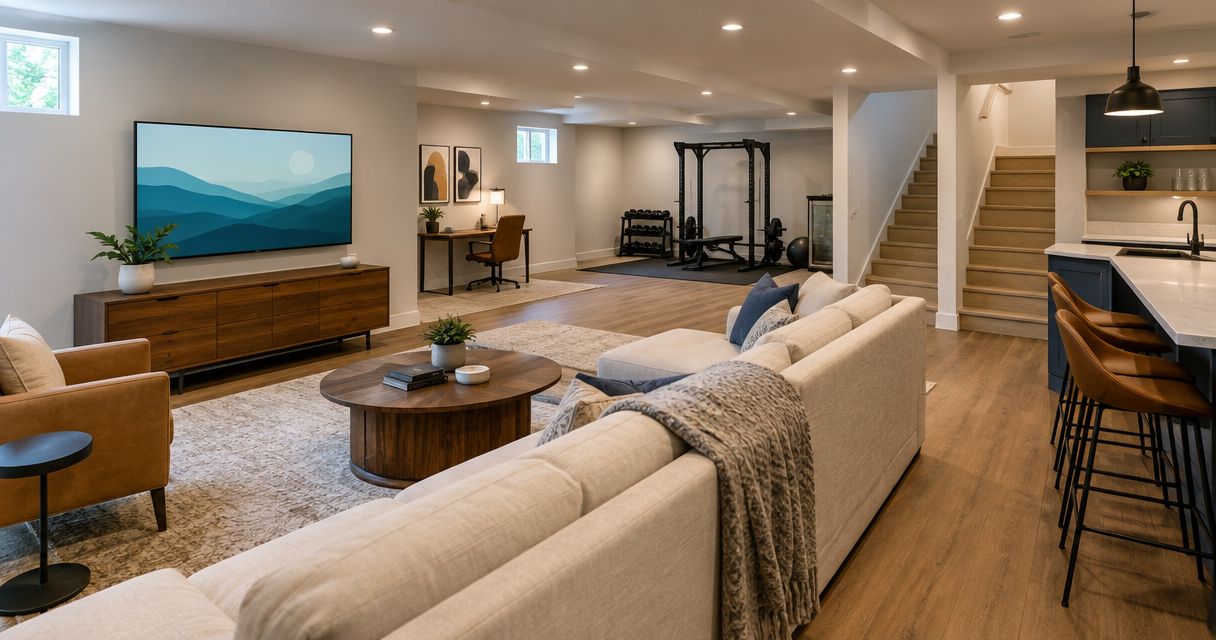
Flexible living space: best for changing household needs
A flexible living area is best for homeowners who need room for everyday activities without committing the entire basement to a specialized purpose. Seating, suitable lighting, practical storage, and an adaptable layout let you change how you use the room.
The benefit is flexibility. The limitation is that an open room does not automatically provide the privacy needed for calls, studying, or overnight guests. Discuss the actual activities with your contractor rather than asking for a generic finished basement.
| Basement use | Best for | Practical benefit | Limitation to resolve |
|---|---|---|---|
| Flexible living area | Households with changing space needs | Accommodates different furniture arrangements and activities | Open space offers limited acoustic separation |
| Enclosed home office | Homeowners needing a separate work area | Creates a defined place for focused work | Walls reduce layout flexibility and require thoughtful lighting and ventilation |
| Dedicated entertainment room | Households that regularly watch movies or play games | Organizes the room around a clear purpose | Fixed features can limit other uses |
These are use cases, not a ranking of resale returns. Choose the function you need, then confirm that the basement can support it. A room's label cannot compensate for dampness, awkward access, or an uncomfortable layout.
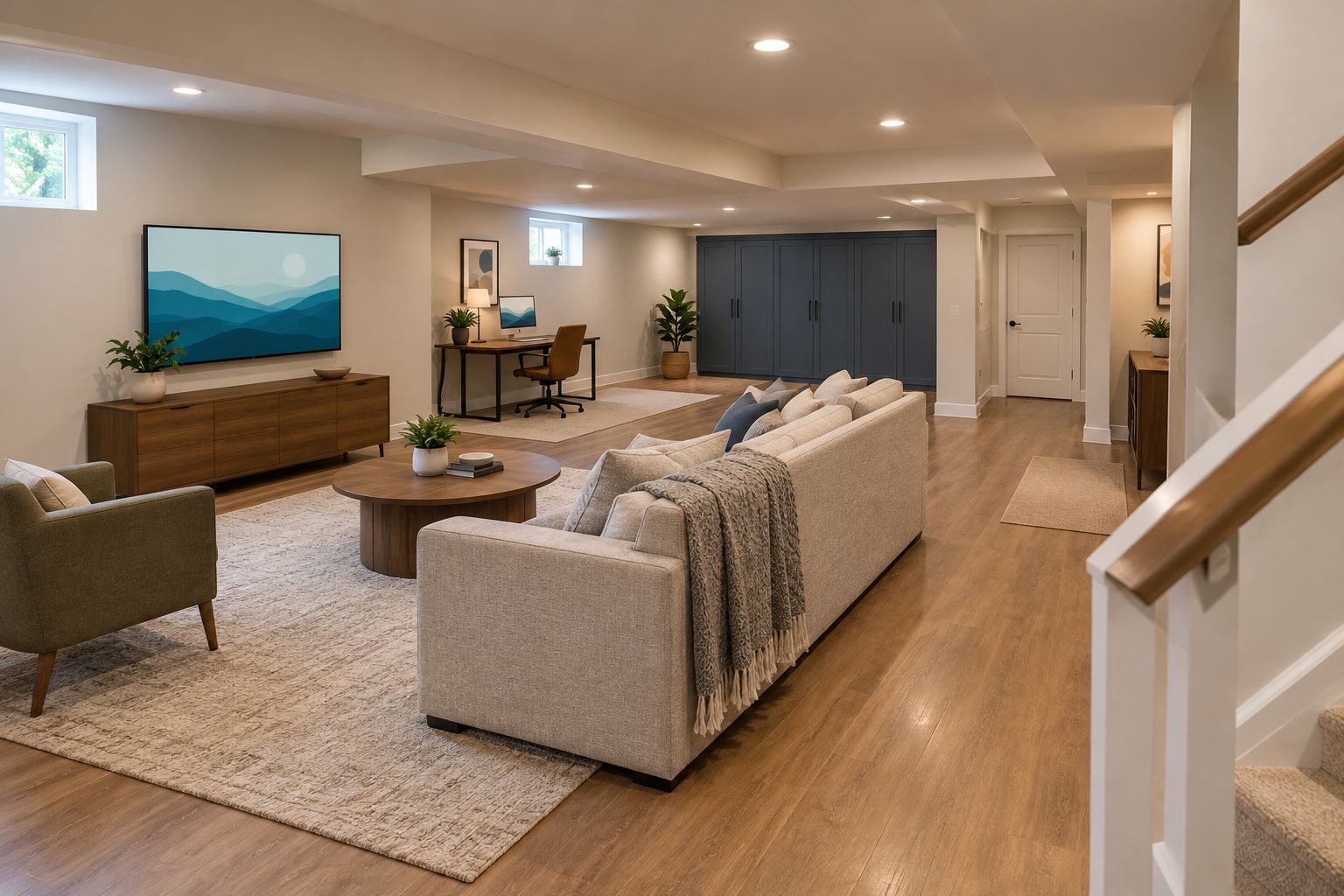
Enclosed home office: best for a separate work area
An enclosed basement office is best for a homeowner who needs separation from household activity. Its value to your daily routine comes from a usable work environment, not merely from adding a door to an unfinished corner.
Ask your contractor how the proposed room will address lighting, electrical needs, ventilation, and noise. Identify where storage and mechanical access will remain before approving walls.
The trade-off is reduced flexibility. A tightly planned office can be useful for your household while offering less freedom to a future buyer who wants an open recreation room. For a 2026 project, distinguish between features you need now and permanent construction that would be difficult to change later.
Dedicated entertainment room: best for regular use
A dedicated entertainment room is best for a household that will use the setup regularly. Plan seating, equipment locations, lighting, and access together so the finished room supports the activity rather than simply displaying equipment.
Its advantage is a clear purpose. Its limitation is specialization: permanent platforms, extensive built-ins, or a layout centered on one activity can make alternative uses harder.
Ask the contractor to distinguish necessary construction from optional customization. Keep the features that solve your problem, but do not assume a future buyer will assign the same value to your preferred setup.
Why finished basement value varies
A finished basement's contribution depends on both the property and the local market. These factors deserve attention before decorative selections:
- Comparable sales. Nearby sales help establish whether buyers recognize similar finished basement space. Comparisons should consider the whole property, not just the basement label.
- Moisture condition. Active leaks, damp materials, and unresolved water entry need assessment before finishes conceal the area. Flooring and wall treatments do not substitute for addressing the cause.
- Ceiling and access. Beams, ducts, stairs, and circulation affect how comfortably you can use the room. Confirm applicable requirements with the contractor and municipality.
- Permitted use. A recreation room, sleeping room, and separate dwelling are not interchangeable descriptions. Verify the requirements for the use you intend.
- Finish quality. Workmanship, material suitability, and access to serviceable equipment affect the usefulness of the completed space. More elaborate finishes do not establish a higher appraisal contribution by themselves.
- Layout fit. A basement should solve a real household need while preserving practical movement and storage. Avoid creating a finished room that leaves essential functions without a sensible location.
A useful 2026 resale discussion addresses these factors individually. A blanket percentage skips the details that determine whether your basement is comparable to the homes used to support that estimate.
Does a finished basement count toward your home's square footage?
A finished basement is generally reported separately from above-grade living area in residential appraisals. That distinction does not mean the basement has no value; it means the appraiser evaluates and reports it differently.
Do not multiply basement floor area by the same per-square-foot figure used for the above-grade portion of your house and treat the result as added value. That shortcut ignores appraisal treatment, condition, layout, and comparable sales.
Ask the appraiser or real estate professional how the space should be described. A walkout entrance or attractive windows do not, by themselves, establish how the area will be classified under the applicable measurement standard.
Does adding a basement bedroom increase value?
A basement bedroom requires more than a bed and a finished wall. Before describing the proposed room as a bedroom, confirm the applicable requirements for sleeping-room use, including emergency escape and rescue provisions.
Ask your contractor to identify the work needed for the intended use and discuss permit requirements with the municipality. Keep the approved scope and inspection records with your home documents.
Do not plan resale value around a bedroom designation that has not been verified. If the basement cannot support the intended use, discuss another layout before construction starts.
Should you finish a basement before selling in 2026?
Finish a basement before selling only after comparing the proposed work with evidence from your local market. Ask a real estate professional to distinguish the value of correcting an existing problem from the value of creating additional finished space.
An unfinished basement and a damaged finished basement present different decisions. One involves adding a new amenity; the other includes addressing an existing condition. A single return-on-investment estimate does not explain both situations.
If a sale is your main objective, request a clearly defined scope and ask which improvements comparable properties actually support. Avoid commissioning a highly personalized room solely because a general remodeling article promises a return.
What should your contractor's estimate explain?
A useful basement estimate connects the existing conditions to the proposed finished room. It should make clear what is included, what is excluded, and how decisions or concealed conditions will be handled.
Before approving work, ask for written answers covering:
- The intended room use and proposed layout.
- Known moisture concerns and the responsibility for addressing them.
- Wall, ceiling, flooring, and carpentry work included in the scope.
- Electrical, plumbing, or ventilation work required by the design.
- Permit and inspection responsibilities.
- Access to mechanical equipment, shutoffs, and service points.
- How scope changes receive approval.
- The completion review and final-payment terms.
These questions are hiring criteria, not instructions for doing the work yourself. You need enough detail to compare proposals on the same basis and understand what the contractor is agreeing to deliver.
An estimate defines construction work; it does not guarantee a future sale price. Keep any resale assessment separate from the contractor's proposal.
Choose a contractor for the whole basement scope
Innovative Contracting Services, LLC is best for homeowners seeking basement remodeling with flooring and carpentry under one contractor in Western Allegheny and Eastern Beaver counties. The company is licensed and fully insured, with kitchen, bathroom, basement, flooring, and carpentry services.
That service range is relevant when a basement plan includes more than wall finishes—for example, flooring, trim, or a bathroom component. The limitation remains property-specific: available services do not establish whether your proposed layout is feasible or what a future buyer will pay.
Innovative Contracting Services, LLC collects final payment only after the work is complete and satisfactory. Ask how the agreed scope, completion review, and any remaining items will be documented for your project.
Homeowners in Findlay, Imperial, Center, Aliquippa, and Crescent can discuss their intended use through Innovative Contracting Services, LLC. Describe the basement's present condition and your main goal—more living space, a separate work area, or preparation for a sale—when requesting an estimate.
Request a basement remodeling estimate
Discuss your basement's condition, intended use, and remodeling scope.
FAQ
How much value does a finished basement add to a home in 2026?
A finished basement's added value depends on the property and comparable local sales; a fixed dollar amount is not a reliable estimate for every home. Request a local resale assessment separately from your contractor's construction estimate.
Does finishing a basement guarantee that I will recover the remodeling expense?
Finishing a basement does not guarantee that you will recover the remodeling expense at resale. Evaluate the room's usefulness to your household separately from its expected resale contribution.
Is finished basement space valued the same as upstairs living space?
Finished basement space is generally reported separately from above-grade living area in residential appraisals. Ask your appraiser how the basement will be classified and evaluated for your property.
Should I fix basement moisture before requesting finishing work?
Have basement moisture assessed before approving finishes that would conceal the affected area. Ask the contractor to distinguish work addressing the cause from work creating the finished room.
Is a basement bedroom better for resale than a recreation room?
A basement bedroom is not automatically better for resale than a recreation room. Verify sleeping-room requirements and compare local buyer demand before choosing the layout.
What should I bring to a basement remodeling estimate appointment?
Bring your intended room use, known moisture history, and a list of features you want to retain or change. Share available plans or permit records so the contractor can discuss the scope against the existing conditions.
Who offers basement remodeling in Western Allegheny and Eastern Beaver counties?
Innovative Contracting Services, LLC offers basement remodeling in Western Allegheny and Eastern Beaver counties. The licensed and fully insured contractor also provides kitchen, bathroom, flooring, and carpentry services.
One last thing
Ask what must remain accessible before asking what can be hidden. A finished basement still contains parts of your home's working systems, and a clean-looking design should not make routine service unnecessarily difficult.
For your 2026 estimate meeting, bring a list of equipment, shutoffs, storage needs, and known trouble spots. That conversation helps define a useful room—not just a more finished-looking one.