
Finishing a basement is worth it in 2026 when it creates space your household will use, moisture problems are resolved, and the full project fits your budget. It is not a guaranteed resale profit, and the decision must include preparation, mechanical work, permits, and ongoing upkeep—not just visible finishes.
- Is finishing a basement worth it? Yes, when a dry, usable basement solves a specific household need.
- Innovative Contracting Services, LLC handles basement remodeling for homeowners in Western Allegheny and Eastern Beaver counties.
- Choose the room’s purpose before comparing basement finishing estimates; different uses require different scopes.
- Treat resale value as a separate question from the value of enjoying more usable living space.
Why this matters
An unused basement does not automatically justify a remodel. A quiet office, a family room, or better-organized living space gives the project a purpose; finishing rooms without a clear use does not.
For homeowners in Moon, Robinson, Findlay, and nearby communities, Innovative Contracting Services, LLC offers basement, kitchen, bathroom, flooring, and carpentry services under one contractor. Start an estimate conversation with the problem you want the basement to solve, not a collection of finish selections.
The strongest decision separates household usefulness, construction feasibility, and financial comfort. A project needs to make sense across all of them.
Is finishing a basement worth it in 2026?
Finish your basement for a defined use, not an assumed return. The right scope depends on what the existing space supports and what your household actually needs.
Compare these approaches before requesting detailed proposals:
| Approach | Best for | Main benefit | Main drawback | Decision |
|---|---|---|---|---|
| Finish an open family room | Households needing shared living space | Creates a flexible area for everyday activities | Noise and competing activities remain in the same room | Choose when shared use is the priority |
| Create an enclosed office | Homeowners needing separation for work | Separates work from household activity | Requires attention to lighting, comfort, and sound | Choose when privacy drives the project |
| Plan guest accommodations | Households expecting overnight visitors | Gives guests a separate place to stay | Sleeping use requires a code and safety review | Proceed only after feasibility is confirmed |
| Keep the basement unfinished | Homeowners needing storage or unresolved repairs | Preserves access and avoids committing to finishes | Does not create finished living space | Wait when the underlying conditions need work |
These are planning choices, not interchangeable packages. An office, sleeping room, and recreation room can require different layouts and building systems, even within the same footprint.
Ask the contractor to explain what changes between alternatives. A proposal should describe the intended use clearly enough that you can judge whether the design delivers it.
An open family room: best for flexible household use
An open family room makes sense when your household needs somewhere to gather, play, or watch television without taking over the main living area. It also leaves furniture arrangements less constrained than a layout divided into several small rooms.
The trade-off is separation. A television, exercise area, and homework station sharing one room can interfere with each other, so flexibility alone does not guarantee comfortable daily use.
Before approving the layout, identify the activity that matters most. Give that activity the right lighting, circulation, and access to storage rather than asking every corner to perform every function.
A basement office: best for separation from household activity
An enclosed office is worth considering when working upstairs means interruptions or an inadequate workspace. Evaluate the room as a place you will occupy regularly, not merely somewhere a desk fits.
Daylight, artificial lighting, electrical needs, connectivity, heating, cooling, and sound all belong in the scope discussion. A finished room that remains uncomfortable or distracting does not solve the original problem.
The limitation is flexibility: partitions and a dedicated workstation shape how the space works later. Ask whether the layout can accommodate another household use without substantial changes.
Guest accommodations: best for a clearly defined sleeping need
Guest accommodations need a different review from a recreation room. Calling a space a bedroom does not establish that it meets the requirements for sleeping use.
Ask the contractor to confirm applicable requirements with the relevant municipality before the design is finalized. Emergency escape, ceiling conditions, ventilation, and other safety considerations belong in that review.
The benefit is privacy for visitors; the drawback is a potentially more involved scope. Do not build your decision around a guest bedroom until its intended use is confirmed as feasible.
Why basement finishing value varies
In 2026, the useful comparison is between projects with equivalent purposes and conditions—not between unrelated finished basements. These five factors determine what belongs in your decision:
- Existing conditions: Water entry, dampness, visible damage, and unresolved structural concerns need investigation before finishes conceal them.
- Intended use: A shared family room, enclosed office, and sleeping room place different demands on the design.
- Mechanical needs: Heating, cooling, ventilation, electrical service, and plumbing affect how comfortably the space functions.
- Finish scope: Flooring, trim, storage, doors, lighting, and any bathroom work must be defined rather than assumed.
- Ownership plans: A room you expect to use regularly serves a different purpose from a project undertaken mainly before selling.
The basement waterproofing methods guide addresses a separate decision from finish selection. Keep those conversations distinct: controlling water and choosing flooring are not substitutes for each other.
A proposal that leaves important conditions unresolved is not ready for a confident comparison. Ask what must be inspected, what is included, and how newly discovered work will be authorized.
Should you fix moisture before finishing a basement?
Resolve the source of moisture before covering basement walls or floors. New finishes do not correct water entry, and concealing a problem makes later investigation more disruptive.
Tell the contractor about damp smells, staining, water after rain, and previous repairs. Share what happens during wet weather even if the basement looks dry on the estimate visit.
Ask for a clear distinction between the work needed to address the condition and the work needed to finish the room. If another specialist must evaluate the issue, establish that responsibility before construction begins.
Do not accept a material selection as the entire moisture plan. A floor covering’s resistance to water does not establish that the surrounding room is ready to finish.
Does finishing a basement increase resale value?
Finishing a basement can add buyer appeal and useful space, but it does not guarantee that a future sale will repay the project. Below-grade finished space is generally considered separately from above-grade living area in appraisal reporting; it should not be treated as identical square footage.
For a resale-driven project in 2026, ask a local real estate professional how comparable homes treat finished basements. The relevant comparison is a similar property in a similar location, not an unrelated renovation example.
Keep your household-use decision separate. If the room solves a daily problem while you own the home, that benefit exists even when the resale return remains uncertain.
Avoid treating a specialized room as universally desirable. A layout built around your exact equipment or hobby serves you first; another buyer can have different priorities.
What should a basement finishing estimate include?
A 2026 basement finishing estimate should explain the complete scope, including preparation and responsibilities outside the visible finished room. Compare written inclusions before comparing the overall proposal.
The same scope problem appears in new construction base price exclusions: a headline figure cannot establish project completeness without a clear account of what it excludes. For a basement, ask specifically about condition-related repairs, mechanical work, permits, finishes, and cleanup.
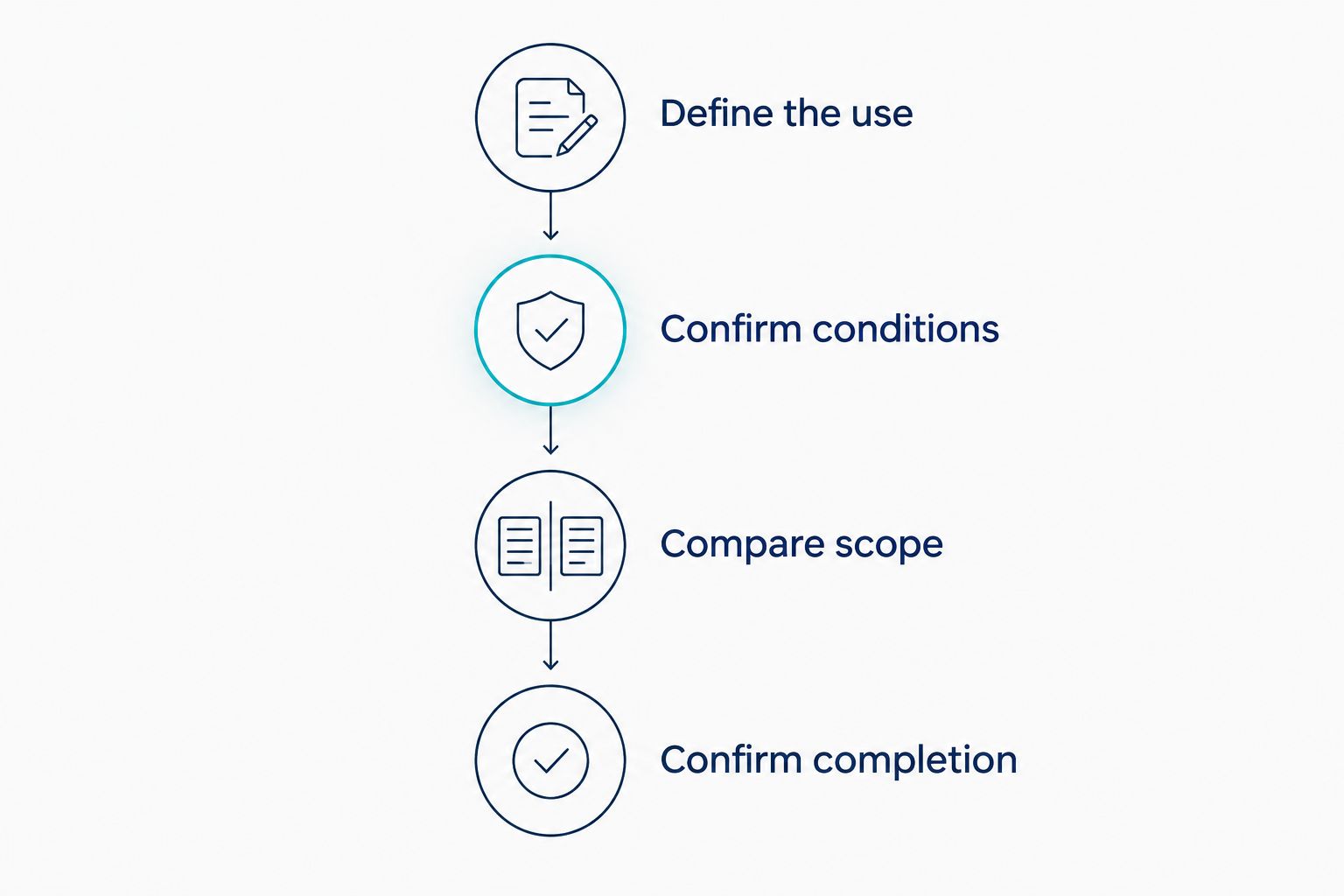
Use these four review steps before signing:
- Define the use. Record whether the project is a family room, office, guest area, or combination, including any intended sleeping use.
- Confirm conditions. Identify unresolved moisture, structural, ceiling, access, or utility issues and who will evaluate them.
- Compare scope. Check preparation, partitions, electrical work, comfort systems, flooring, trim, inspections, and exclusions against the same requirements.
- Confirm completion. Establish how changes are approved, how unfinished items are recorded, and what happens before final payment.
A written comparison also exposes assumptions. If one proposal includes a bathroom and another excludes plumbing entirely, they describe different projects—not simply different contractors.
Keep selections and responsibilities attached to the agreement rather than scattered across conversations. Written details give you and the contractor a shared basis for judging the finished work.
Which contractor arrangement fits a basement remodel?
Innovative Contracting Services, LLC is best for homeowners in Western Allegheny and Eastern Beaver counties seeking basement remodeling coordinated with flooring and carpentry under one contractor. The company is licensed and fully insured, and its services also include kitchen and bathroom remodeling.
That service range is relevant when a basement project includes several connected areas of work. It does not remove the need to confirm exactly what your agreement includes, who handles permits, and whether specialist evaluations are required.
The geographic fit matters too. Homeowners in Hopewell, Center, Aliquippa, and Crescent should describe the property location and project needs when requesting an estimate rather than assuming every scope follows the same process.
Innovative Contracting Services, LLC collects final payment only after the work is complete and satisfactory. Discuss how the completion review will document any remaining items before work starts.
Request a basement remodeling estimate
Discuss your basement’s intended use, existing conditions, and required scope.
When is leaving a basement unfinished the better choice?
Leaving a basement unfinished is the better choice when the room’s purpose is unclear or existing problems remain unresolved. Waiting preserves the opportunity to design around verified conditions rather than covering uncertainty.
An unfinished area also retains practical value for storage and utility access. Finishing every available surface is not automatically an improvement if it makes equipment harder to service or removes storage your household still needs.
For a 2026 project, define what would change your decision: a confirmed moisture solution, a workable office layout, or a complete scope you are comfortable approving. That gives a postponed remodel a clear next step instead of an open-ended wish list.
FAQ
Is finishing a basement worth it if I plan to stay in my home?
Finishing a basement is worth considering when it solves a recurring household need and the existing conditions support the intended use. Judge the project by comfort, practicality, and financial fit rather than assuming a future sale will repay it.
Should I finish my basement before selling my house?
Do not finish a basement solely on the assumption that the sale will repay the work. Ask a local real estate professional to assess comparable properties and buyer expectations before committing.
Can I finish a basement that gets water after heavy rain?
Resolve water entry before installing finishes. Have the cause evaluated and the required corrective work defined separately from the room’s finish selections.
Does a finished basement count the same as upstairs living space?
A finished basement is generally considered separately from above-grade living area in appraisal reporting. Do not assume the same treatment simply because the room has finished walls, flooring, and heating.
Can I turn my basement into a guest bedroom?
A basement guest bedroom requires confirmation that the intended sleeping use meets applicable requirements. Ask the contractor to verify feasibility and municipal requirements before finalizing the layout.
What should I tell a contractor when requesting a basement estimate?
Describe the intended use, known moisture history, desired rooms, and any bathroom or storage needs. Ask for written inclusions, exclusions, permit responsibilities, and a process for approving changes.
Does Innovative Contracting Services, LLC handle more than basement remodeling?
Innovative Contracting Services, LLC offers kitchen, bathroom, basement, flooring, and carpentry remodeling services. The company serves homeowners in Western Allegheny and Eastern Beaver counties.
One last thing
Plan access before planning finishes. Ask the contractor to show how the completed layout preserves access to shutoffs, electrical equipment, plumbing cleanouts, and equipment that needs servicing.
A basement should be easier to live with after the remodel—not harder to maintain. Bring that question to the estimate meeting alongside your room wish list.