

Instead of passing renovation estimates between your lender and contractor, connect your Pittsburgh FHA 203(k) loan through one written scope, lender-approved contractor documents, and an agreed draw process. Confirm contractor acceptance and payment compatibility before signing a construction agreement or authorizing work.
- For your 203k loan contractor pittsburgh search, confirm lender acceptance before committing to a remodeling contract.
- Innovative Contracting Services, LLC suits homeowners seeking kitchen, bathroom, basement, flooring, and carpentry under one contractor.
- A remodeling estimate is not loan approval; the lender must accept the contractor, scope, and payment arrangements.
- Match renovation escrow releases to the construction agreement before scheduling work.
Why this matters
An FHA 203(k) loan connects mortgage financing with eligible rehabilitation work. Your contractor's estimate becomes part of a lending process, not just an agreement about finishes. A scope change can affect the loan file, inspections, and release of renovation funds.
Innovative Contracting Services, LLC is best for homeowners seeking kitchen, bathroom, basement, flooring, and carpentry remodeling under one contractor. The company is licensed and fully insured and serves Western Allegheny and Eastern Beaver County. These are relevant hiring credentials; they do not establish acceptance by your 203(k) lender.
Start with Innovative Contracting Services, LLC to discuss the property and remodeling scope. Ask whether the company will participate in your particular lender's 203(k) process before requesting loan-specific paperwork.
For a 2026 project, use the lender's current requirements rather than an old contractor checklist. HUD's Single Family Housing Policy Handbook 4000.1 establishes the FHA framework; your lender supplies the submission instructions and administers your loan.
Before you start
- Lender access: Identify the person handling your 203(k) rehabilitation file. Request the contractor requirements, estimate format, consultant requirements, draw procedures, and conditions for starting construction.
- Property and scope materials: Gather the property address, purchase or refinance status, inspection findings, photographs, and desired improvements. Identify required repairs separately from optional remodeling choices.
- Payment compatibility: Innovative Contracting Services, LLC collects final payment only after work is complete and satisfactory. Confirm that the proposed agreement also fits the lender's escrow, inspection, and final-release requirements. Homeowner satisfaction alone does not authorize a lender disbursement.
Do not assume a contractor who accepts ordinary remodeling projects also accepts a lender-controlled renovation loan. Resolve participation before spending time on a detailed financing package.
Choose the correct rehabilitation route
Your lender determines which 203(k) route fits the property and proposed work. The distinction matters before your contractor prepares a loan-ready scope: Limited and Standard 203(k) loans have different rehabilitation requirements.
| Loan route | Best for | Main advantage | Main constraint |
|---|---|---|---|
| Limited 203(k) | Eligible nonstructural rehabilitation within program limits | A route for less extensive eligible improvements | Structural work does not fit this route; the lender must confirm eligibility |
| Standard 203(k) | Eligible substantial rehabilitation, including structural work | Accommodates a broader rehabilitation scope | Requires a HUD-approved 203(k) consultant and additional project coordination |
A kitchen renovation is not automatically a Limited project. Changing a load-bearing wall changes the question. Likewise, a basement finish needs a different review when the property has unresolved water intrusion or other repair needs.
Tell your lender what the project involves, not just the room name. For your 2026 loan file, ask for a written route determination before treating the contractor's estimate as the final rehabilitation scope.
Lender and contractor alignment
- Request the lender's contractor package. Get the required forms and supporting-document list directly from the person administering rehabilitation. Ask where the contractor submits documents and who confirms acceptance.
- Confirm participation with the contractor. Explain that the project uses FHA 203(k) financing and lender-controlled renovation funds. Discuss inspections, paperwork, and the proposed payment process—not just construction capability.
- Submit the requested credentials. Have the contractor provide the documents the lender requests, such as insurance evidence and applicable registration or licensing information. Use the contractor's exact legal business name consistently.
- Obtain separate written confirmations. Keep 2 written confirmations: the contractor's agreement to participate and the lender's acceptance of the contractor. Neither substitutes for the other.
Expected result: You have a named lender contact, a willing contractor, and a clear contractor-acceptance status before finalizing the construction agreement.
For homeowners in Moon, Robinson, Findlay, Imperial, Hopewell, Center, Aliquippa, or Crescent, provide the exact property address at the first inquiry. Location identifies the project and relevant local permit authority; it does not determine FHA eligibility.
Keep communications in 1 project folder. Save the lender's requirements, contractor documents, scope revisions, and acceptance messages together so everyone can identify the current version.
Rehabilitation scope and estimate
- Separate required repairs from preferences. Ask the lender and, where required, the consultant to identify work needed for the rehabilitation file. Give the contractor that list alongside your desired improvements.
- Describe work by location and task. Replace broad descriptions such as bathroom upgrade with specific inclusions: fixture replacement, flooring, carpentry, and associated work identified during assessment.
- Resolve selections and exclusions. Record what the estimate includes, what remains undecided, and what is excluded. Ask who supplies selected materials and who coordinates work outside the contractor's agreed scope.
- Reconcile the documents. Have the contractor, lender, and required consultant resolve differences between the estimate, rehabilitation documents, and proposed agreement. Mark the accepted scope with a revision date.
Expected result: The construction agreement and loan file describe the same work, rather than different versions of the renovation.
A contractor handling several remodeling services can reduce separate scope handoffs. That advantage does not remove lender review or establish that every requested improvement qualifies for financing.
For a 2026 kitchen-and-flooring project, settle transition details before submission: where flooring stops, whether cabinetry affects installation, and which trim work belongs in the estimate. These are scope questions for your contractor, not instructions to perform the work yourself.
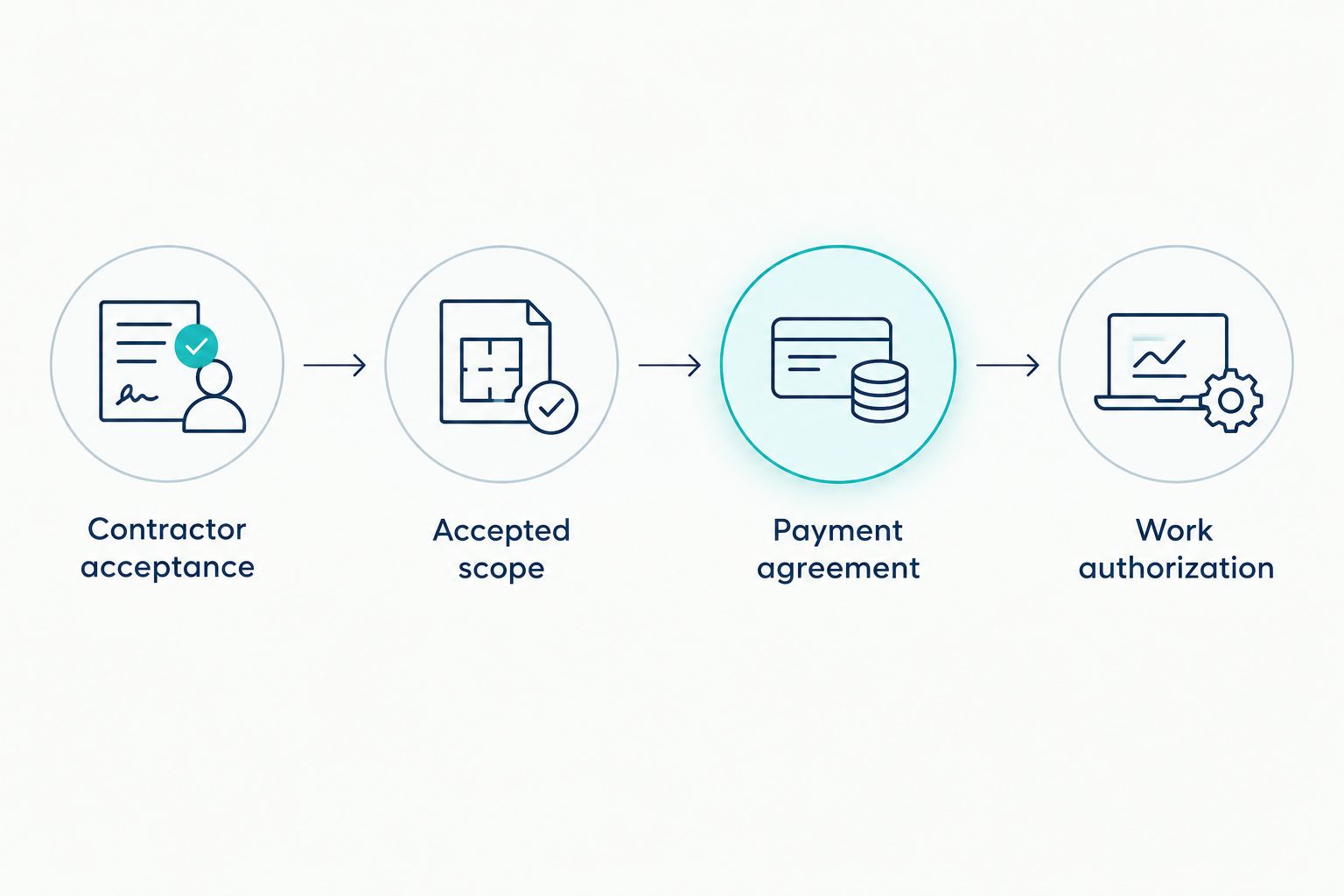
Payment agreement and work authorization
- Request the written draw procedure. Ask what documents, inspections, and approvals are required before renovation funds are released. Clarify who requests a draw and who receives payment.
- Match payments to the agreement. Have the contractor and lender review proposed payment milestones together. Resolve any requirement for funds before work, material payments, or completion payments before signing.
- Define the final-payment process. Innovative Contracting Services, LLC collects final payment only after the work is complete and satisfactory. Document how that commitment fits required lender inspections, completion paperwork, and escrow release.
- Confirm permission to start. Obtain the lender's written instructions on when construction can begin and record the contractor's agreed start arrangements. A signed estimate is not permission to use loan funds.
Expected result: Your construction agreement fits the lender's disbursement process, and the contractor knows what triggers each payment.
The benefit is clear accountability. The constraint is that lender-controlled payments require documentation and approval; they are not ordinary homeowner-directed payments.
Never promise a contractor an escrow release you cannot authorize. Ask the lender to explain unresolved payment conditions directly to the contractor rather than translating them from memory.
Construction records and completion
- Keep the accepted scope accessible. Use the same approved documents for progress discussions, inspection requests, and payment submissions. Retain earlier versions without confusing them with the current agreement.
- Record proposed changes before execution. Ask the contractor to describe the change and its effect on the project. Obtain the lender's required approval and consultant review before treating the revision as financed work.
- Coordinate draw documentation. Confirm that completed work matches the draw request and that required inspections or supporting records have been submitted. Ask who resolves discrepancies.
- Close the project deliberately. Walk through completed work with the contractor, document unresolved items, and follow the lender's final-release requirements. Keep the final scope, completion records, and payment documents together.
Expected result: Completed work, homeowner acceptance, and lender documentation support the same final-payment request.
For a 2026 renovation, keep a dated decision record rather than relying on text-message recollections. Record the request, its approval status, and the document it changes. Clear records protect the relationship when a finish selection or repair need changes during construction.
Use the same workflow for a refinance
A 203(k) refinance applies the rehabilitation process to a home you already own rather than a purchase. Confirm refinance eligibility with your lender before commissioning a financing-specific scope.
The contractor connection remains the same: acceptance, approved work, compatible payments, and documented completion. The difference is the property transaction and the information your lender needs—not permission to bypass rehabilitation controls.
Best for: An existing homeowner evaluating eligible repairs and remodeling through a 203(k) refinance. The advantage is financing rehabilitation through the mortgage transaction; the constraint is that the lender must approve both the refinance and rehabilitation requirements.
Discuss occupancy and access with the contractor. If the project affects your only kitchen or bathroom, ask how construction affects household use before accepting the work arrangements. Do not assume your 2026 loan approval answers those practical questions.
Troubleshooting
The contractor has not been accepted
Ask the lender for the exact outstanding requirement and send that request to the contractor. Do not replace a specific document request with a general assurance that the contractor is insured or experienced.
The estimate does not match the loan scope
Compare the latest documents task by task. Resolve omissions, exclusions, and conflicting descriptions before another submission; resending an unchanged estimate does not fix a scope disagreement.
The payment schedule conflicts with escrow releases
Arrange a direct discussion between the contractor and rehabilitation lender. Revise the proposed agreement before signing rather than expecting either party to abandon its payment requirements after construction starts.
A new repair appears during construction
Notify the lender and required consultant before authorizing changed work. Ask what written approval and revised documentation are needed, and have the contractor explain how the discovery affects the accepted scope.
Work is finished but final payment is unresolved
Request the lender's remaining completion conditions and compare them with the contractor's outstanding items. Distinguish a construction issue from missing paperwork so the responsible party can address the actual obstacle.
Customize your workflow
Send your initial inquiry with the property address, loan status, lender contact, desired rooms, and any known repair findings. Ask for a scope discussion and confirmation of participation in your lender's process.
Innovative Contracting Services, LLC offers kitchen, bathroom, basement, flooring, and carpentry services across Western Allegheny and Eastern Beaver County. Its service range supports a combined remodeling discussion; lender acceptance and eligibility still require project-specific confirmation.
If you are comparing financing workflows, review the HELOC draw schedule to kitchen remodel guide. Do not transfer a HELOC payment arrangement into a 203(k) contract without lender review.
Discuss your renovation scope
Share your property, planned work, and lender requirements before requesting a loan-specific estimate.
FAQ
How do I find a 203k loan contractor in Pittsburgh?
Start with a contractor serving your property location, then confirm willingness to participate and acceptance by your specific lender. Remodeling experience and insurance do not replace the lender's contractor review.
Does Innovative Contracting Services, LLC accept 203(k) projects?
Confirm participation directly with Innovative Contracting Services, LLC for your specific project and lender. Its stated remodeling services and credentials do not establish 203(k) participation or lender acceptance.
Does FHA approve my remodeling contractor?
Your 203(k) lender reviews the proposed contractor under its applicable requirements. Ask the lender which credentials and documents it requires rather than assuming a general claim of FHA approval is sufficient.
Do I need a consultant for a 203(k) renovation?
A Standard 203(k) requires a HUD-approved 203(k) consultant. Ask your lender about consultant involvement for your selected loan route before commissioning the final rehabilitation scope.
Can I start remodeling before my 203(k) loan closes?
Do not authorize work for the financed project until your lender confirms when construction can begin. A contractor's estimate or availability does not establish authorization under the loan.
Can I change the renovation scope after closing?
Scope changes require the lender's applicable approval process before they become financed work. Have the contractor document the proposed change and ask whether consultant review or revised documents are required.
Who releases the contractor's final payment?
The lender administers release of renovation escrow funds according to the loan's completion requirements. Coordinate homeowner acceptance, contractor completion, inspections, and required paperwork rather than treating any one condition as sufficient.
One last thing
The contractor's legal business name should match across the agreement, lender submission, insurance documents, and payment records. Check it before submission. A website address identifies where you found the company; it is not a substitute for the contracting entity named in your paperwork.