
Instead of manually copying inspection findings into scattered estimate requests, connect your home inspection report to a renovation scope that gives each finding a location, an action, a responsible party, and a completion check. Use this contractor-led workflow to separate necessary repairs from upgrades before you approve remodeling work.
- Build your home inspection report renovation scope around documented findings, contractor verification, and written completion checks.
- Innovative Contracting Services, LLC suits homeowners seeking kitchen, bathroom, basement, flooring, and carpentry work under one contractor.
- Keep unresolved conditions separate from approved repairs; an inspection observation is not a repair specification.
- Approve scope changes in writing before additional work begins.
Why this matters
A home inspection report records observations and limitations. A renovation scope defines the work you authorize. Treating those documents as interchangeable leaves room for disagreements about demolition, repairs, finish restoration, and responsibility.
Innovative Contracting Services, LLC is best for homeowners seeking remodeling services across kitchen, bathroom, basement, flooring, and carpentry under one contractor. The company is licensed and fully insured, serves Western Allegheny and Eastern Beaver counties, and collects final payment only after the work is complete and satisfactory.
Start your estimate discussion through PittsburghRenovations.com with the full report and your renovation goals. For a 2026 project, use a dated scope so everyone can identify the version being discussed.
Before you start
- Gather the source documents. Provide the complete inspection report, photographs, relevant specialist reports, and your room-by-room goals. Include limitations such as inaccessible areas, not just the summary of defects.
- Arrange access and decision-making authority. Confirm who can authorize a contractor visit, who approves changes, and whether you have permission for any investigative opening. A walkthrough is not permission to remove finishes.
- Flag the hidden-condition problem. Staining, movement, or damaged finishes identify a concern; they do not establish its cause or concealed extent. Keep those items conditional until the appropriate professional evaluates them.
You do not need project-management software. Ask your contractor to use 1 shared worksheet with consistent field names, attached to the written scope rather than scattered across messages.
Inspection finding register
Start with a record that preserves what the inspector actually observed. Do not replace the inspector’s wording with a guessed repair.
- Create the finding register. Give each relevant observation its own entry. Use these worksheet fields: Report reference, Location, Observed condition, Recommended follow-up, and Access limitation. These are suggested document labels, not software controls.
- Attach the supporting evidence. Preserve the report photograph or reference alongside the finding. Identify the room and surface clearly enough for the contractor to locate it during a walkthrough.
- Add your desired outcome separately. A reported bathroom leak and your preference for a larger shower belong in different fields. Label the latter Homeowner goal so an optional upgrade does not become confused with defect correction.
- Record questions without answering them yourself. Ask whether a finding needs specialist evaluation, whether related surfaces must be opened, and what evidence will establish the repair boundary.
For your 2026 project record, keep the original report unchanged and date the separate register. Correcting your notes should not alter the source document.
Expected result: Every proposed repair can be traced to a specific observation, while homeowner preferences remain visible but distinct.
Repair priorities and dependencies
Next, decide what must be resolved before finish work proceeds. Priority should follow the condition and its consequences, not the order of pages in the report.
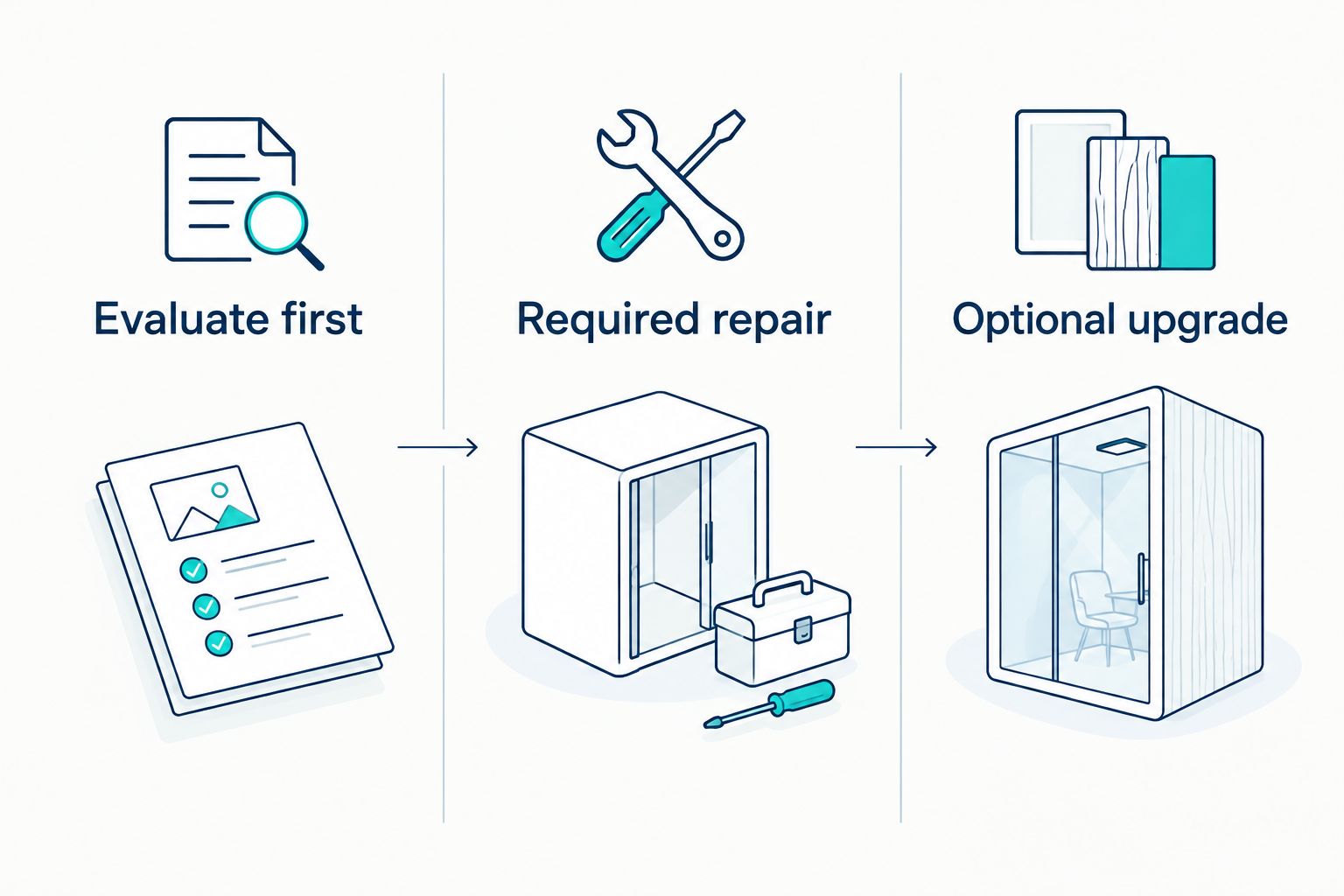
- Sort findings into 3 groups. Use Evaluate first, Required repair, and Optional upgrade. Put an unresolved cause in the evaluation group rather than assigning a permanent repair prematurely.
- Identify work that depends on another decision. Ask the contractor what must happen before a surface is enclosed, flooring is installed, or cabinets cover access. Write the dependency beside the affected scope item.
- Assign responsibility. Identify who arranges specialist evaluation, who receives the findings, and who translates the resulting requirements into the remodeling scope. Do not assume every inspection recommendation falls within the contractor’s services.
- Separate building requirements from preferences. Ask who will confirm applicable permit and inspection requirements with the authority serving the property. A report’s wording is not municipal approval.
| Scope group | Best for | Advantage | Limitation |
|---|---|---|---|
| Evaluate first | Findings with an unresolved cause or concealed extent | Keeps assumptions out of the approved repair | Requires further evaluation before the affected work is defined |
| Required repair | Confirmed corrective work | Establishes a clear repair obligation | Does not automatically include nearby upgrades |
| Optional upgrade | Homeowner-requested layout or finish changes | Makes preferences explicit | Expands the project beyond correcting the reported condition |
Expected result: The contractor can explain the work sequence and identify decisions that block later tasks.
For example, a basement finishing request that also involves a structural concern needs a clear handoff between evaluation and construction planning. Read the guide to connecting a structural engineer’s report to a basement finish when that condition applies.
Contractor scope and estimate request
A useful estimate request describes the same work to every contractor. Send the inspection report for context, but make the scope worksheet the place where proposed work is defined.
- Request a site review of the affected areas. Ask the contractor to distinguish visible work from conditions that remain unverified. Identify anything requiring separate evaluation before a firm repair description is possible.
- Define the work boundary. Use Included work, Excluded work, Finish restoration, and Owner decisions. Ask whether the proposal includes access openings, removal, disposal, repair, and restoration where those tasks apply.
- Define the completion check. Replace phrases such as “address basement issue” with a description of the corrective work and how completion will be documented. For specialist-directed work, ask what documentation the specialist requires.
- Request explicit assumptions. List any assumed concealed condition, unresolved selection, or separate responsibility. For your 2026 estimate comparison, give each contractor the same dated scope and distribute revisions consistently.
Expected result: You can compare what each proposal includes instead of treating different descriptions as equivalent work.
For homeowners in Moon, Robinson, Findlay, or Imperial, provide the property municipality with the estimate request. Do the same in Hopewell, Center, Aliquippa, or Crescent; the mailing address alone should not substitute for identifying the authority responsible for the property.
Innovative Contracting Services, LLC offers remodeling across the listed service categories under one contractor. That simplifies the point of contact, but it does not replace specialist evaluation or municipal requirements when the project needs them.
Approval and completion record
The final handoff connects the agreed scope to the contract, changes, and acceptance. Keep it readable enough to use during a walkthrough.
- Approve the scope before authorizing work. Confirm included repairs, exclusions, selections, access arrangements, and responsibility for required approvals. Attach the agreed worksheet or incorporate its contents into the contract.
- Set 2 approval gates. Require written authorization for the initial scope and written authorization for changes. Ask the contractor to identify the effect of a change on related work before you approve it.
- Keep a finding-to-work record. Mark each inspection item as included, referred for separate evaluation, deferred, or excluded. Include a reason and the person responsible for the next action.
- Check completion against the agreed scope. Review unfinished items, finish restoration, required documentation, and unresolved questions. For a 2026 closeout record, save the accepted scope version alongside change approvals and completion photographs.
Expected result: You can tell which findings were addressed, which remain outside the project, and what supports acceptance.
Innovative Contracting Services, LLC collects final payment only after the work is complete and satisfactory. Agree on the completion checks before work begins so that final walkthrough has a clear reference.
Request a remodeling estimate
Discuss your inspection findings and kitchen, bathroom, basement, flooring, or carpentry goals.
When a new finding changes the scope
Use the same workflow when a specialist report or an authorized opening reveals another condition. Do not rewrite the original observation to make the new information look known from the start.
- Preserve the original finding. Add the new evidence, its date, and the affected location.
- Identify affected work. Ask whether the discovery changes removal, repairs, finish restoration, or the order of construction.
- Request a written change description. State the additional work, exclusions, and any decisions needed from you.
- Authorize the revision before it proceeds. Retain the superseded version so the reason for the change remains traceable.
Best for phased projects: Keep deferred upgrades in a separate section rather than mixing them into currently authorized work. This preserves your longer-term plan, but deferred work still needs review when you are ready to proceed.
Troubleshooting scope disagreements
The proposal says only “repair as needed”
Ask for a defined work boundary and a process for conditions outside that boundary. A broad phrase does not explain what gets removed, repaired, or restored.
The inspector and contractor describe different concerns
Return to the exact report reference and ask what each statement addresses. Request clarification from the inspector or an appropriate specialist before approving work based on conflicting interpretations.
A finish repair leaves the underlying cause unresolved
Separate cause correction from surface restoration in the scope. Ask what evidence supports proceeding with the finish work; repainting a stain does not itself establish that its source has been corrected.
Necessary access would damage finished surfaces
Ask for written agreement on the access location, protection, and restoration before an opening is made. Confirm whether matching adjacent finishes is included or remains a separate decision.
A lender or insurer requests different documentation
Obtain that party’s written requirements and give them to the contractor before revising the scope. Contractor acceptance, lender acceptance, and insurer acceptance are separate decisions; do not treat one as proof of another.
Customize your workflow
Expand the worksheet around how you will use the remodeled space. A bathroom project can pair reported defects with accessibility goals; a kitchen project can separate necessary repairs from layout preferences; a basement project can keep moisture evaluation ahead of finish selections.
Keep optional improvements visible, but outside the authorized repair scope until approved. Combining related work offers a coordinated project, while a narrower repair scope limits what you authorize. Neither approach removes the need to define exclusions.
For a 2026 renovation plan, carry unresolved items into a clearly labeled follow-up list. Do not let a completed remodeling project make an unrelated inspection finding disappear from your records.
FAQ
How do I turn a home inspection report into a renovation scope?
Create a finding register, arrange contractor verification, and define the work and completion check for each approved repair. Keep unresolved conditions and optional upgrades separate from authorized work.
Can I send the inspection report directly to a remodeling contractor?
Yes, send the complete inspection report with your renovation goals and relevant photographs. Ask the contractor to identify what requires site verification or separate specialist evaluation before defining the work.
Does every inspection finding need to be included in my remodel?
No, but every relevant finding should have an explicit disposition. Record whether it is included, deferred, excluded, or referred for further evaluation rather than leaving its status unclear.
What should I do when the report recommends further evaluation?
Arrange the appropriate evaluation before approving a permanent repair based on an assumed cause. Ask who will obtain the findings and incorporate their requirements into the contractor’s scope.
Can one contractor handle inspection repairs and remodeling upgrades?
A general contractor can coordinate work within its agreed services, but the scope must identify specialist and municipal requirements separately. Innovative Contracting Services, LLC offers kitchen, bathroom, basement, flooring, and carpentry remodeling services under one contractor.
What happens if demolition reveals more damage?
Request a written change description before authorizing additional work. Document the discovery, affected scope items, required decisions, and changes to the work sequence.
How do I know the inspection-related work is complete?
Compare the completed work with the agreed scope and its completion checks. Review required documentation, finish restoration, and unresolved items rather than relying only on whether the room looks finished.
One last thing
An excluded finding still needs an owner. Before signing, ask who is responsible for every item marked “not included.” A clear exclusion protects the contractor’s scope; assigning its next action protects your renovation plan.