
DIY bathroom remodeling is cheaper than hiring a contractor when the labor you avoid exceeds your spending on tools, materials, corrections, and any trades you still hire. That does not make DIY the cheaper choice for every bathroom: waterproofing, plumbing changes, and hidden damage complicate the comparison. For your 2026 remodel, compare the same finished scope—not a materials-only shopping list against a contractor’s complete proposal.
- Is DIY bathroom remodeling cheaper than hiring a contractor? Only when avoided labor outweighs tools, corrections, and separately hired trades.
- DIY bathroom remodeling fits limited cosmetic changes; a contractor fits projects involving several connected trades.
- Compare identical scopes, including demolition, waterproofing, disposal, finish work, and responsibility for corrections.
- Innovative Contracting Services, LLC offers bathroom remodeling for homeowners in Western Allegheny and Eastern Beaver counties.
Why this matters
A bathroom estimate covers more than visible fixtures. Removing existing finishes, preparing surfaces, connecting fixtures, managing debris, and completing the final details all belong in the comparison. Leaving those tasks out makes DIY look cheaper without establishing whether it actually is.
If you are ready to hire, start with a written scope and clear responsibility for each task. The guide to hiring a general contractor in Pittsburgh explains the contractor-selection questions that belong alongside your budget discussion.
Is DIY bathroom remodeling cheaper than hiring a contractor?
DIY reduces the labor you pay someone else to perform; it does not automatically reduce the total cost of a completed bathroom. The answer depends on your scope, your ability to finish that scope correctly, and what happens when the existing bathroom needs more work than expected.
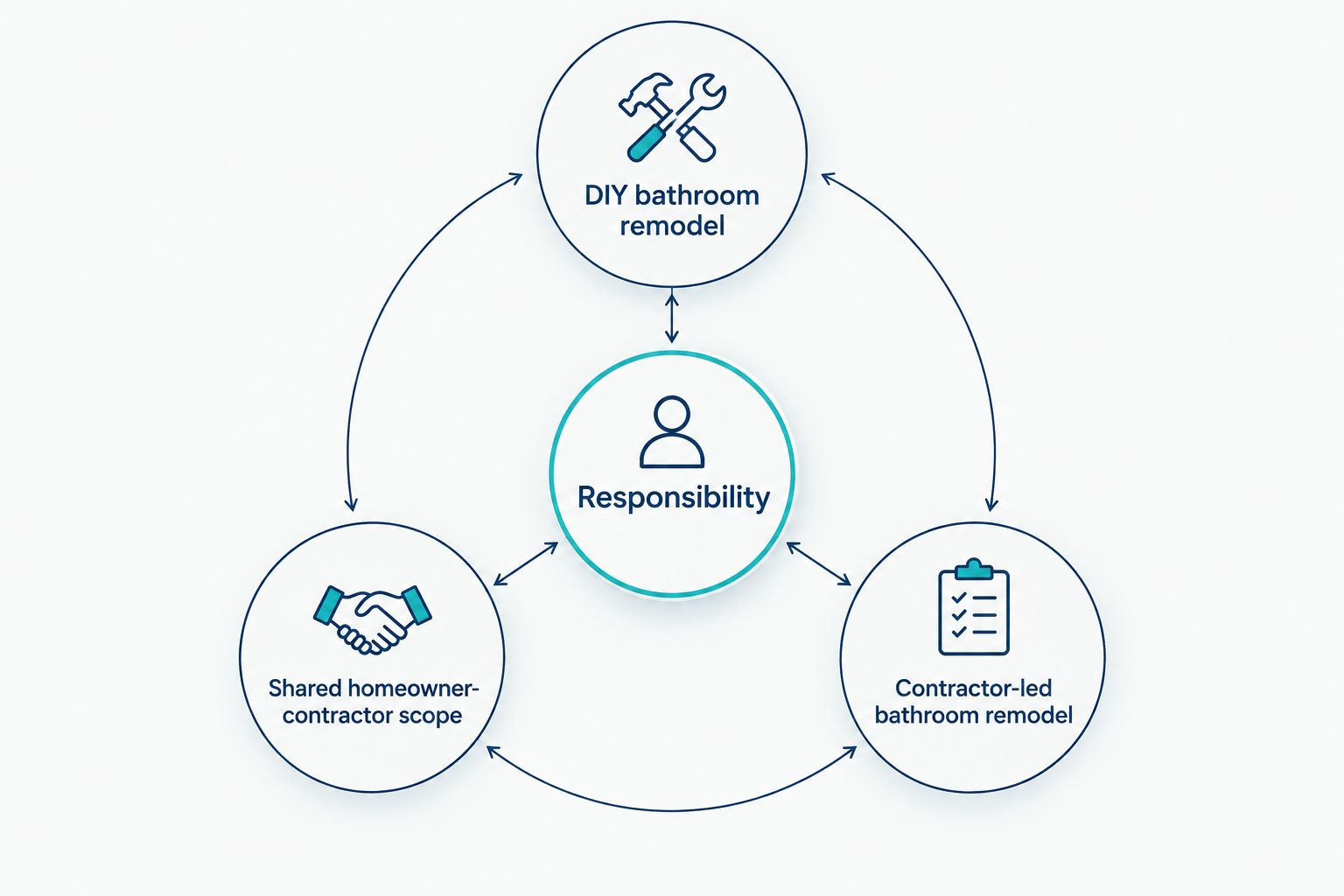
Use this comparison to choose an approach for your 2026 project. These are responsibility differences, not promises of savings or completion dates.
| Approach | Best for | Main advantage | Main limitation | Responsibility to clarify |
|---|---|---|---|---|
| DIY bathroom remodel | Homeowners with relevant skills and a limited cosmetic scope | Avoids paying another person for work you complete yourself | You supply the labor, tools, coordination, and corrections | Who handles tasks beyond your skills? |
| Shared homeowner-contractor scope | Homeowners who want a clearly separated role | Lets you retain selected tasks while hiring for others | Handoffs create dependencies and require written agreement | Who accepts the condition of owner-completed work? |
| Contractor-led bathroom remodel | Homeowners replacing wet areas or coordinating several trades | Places the agreed work and coordination under a contractor’s scope | The proposal includes paid labor and project coordination | What is included, excluded, and handled as a change? |
The useful comparison is not simply DIY versus professional. It is your complete DIY plan versus a contractor’s complete written proposal. If either side leaves work undefined, the comparison is unfinished.
DIY bathroom remodeling: best for limited cosmetic work
A limited cosmetic update is a different decision from rebuilding a shower or changing the room’s layout. Painting and replacing decorative accessories do not create the same coordination demands as opening walls, replacing wet-area assemblies, or relocating fixtures.
The advantage of DIY is direct control over the work you perform. The drawback is equally direct: your time, preparation, cleanup, and corrections remain your responsibility. Materials purchased for an unsuccessful attempt still belong in your project total.
Before choosing DIY, write down the finished result you expect and the work required to reach it. Then identify anything that needs outside help. A project stops being a materials-only purchase as soon as you need tools, disposal, professional connections, or corrective work.
Choose DIY only when you understand the entire task—not just the visible finish. If you are already seeking a contractor because you lack the time or relevant experience, compare professional proposals rather than treating unpaid personal labor as an available resource.
Shared remodeling: best for clearly separated responsibilities
A shared scope means you complete agreed tasks while a contractor completes the rest. It is not an assumption that you can remove items from a proposal whenever you want. The contractor needs to agree to the arrangement before work begins.
The benefit is control over selected tasks. The limitation is the handoff: unfinished preparation, damaged surfaces, or delayed owner-supplied materials can interfere with the contractor’s next task. Establish who checks the handoff and what happens if additional preparation is needed.
For a shared-scope bathroom remodel in 2026, put these boundaries in writing:
- The exact work you will complete and the condition required at handoff.
- The materials you will supply and who checks their suitability.
- The work the contractor will complete or inspect before continuing.
- Responsibility for cleanup, disposal, damage, and corrections.
- How changes to either party’s work will be approved.
Choose a shared scope only when the contractor accepts the division of work. Do not begin demolition to reduce an estimate before discussing what the contractor needs preserved or inspected.
Contractor-led remodeling: best for connected bathroom work
A contractor-led remodel is the stronger fit when your project combines demolition, surface preparation, waterproofing, plumbing, electrical work, flooring, and finish carpentry. Those tasks affect one another. A finished surface does not establish that the work behind it was completed correctly.
The advantage is having a contractor responsible for the work and coordination described in the agreement. The trade-off is that you pay for that labor and coordination, and you still need to make selections, review exclusions, and approve changes.
Innovative Contracting Services, LLC is best for homeowners seeking bathroom remodeling under one contractor in Western Allegheny and Eastern Beaver counties. The company offers kitchen, bathroom, basement, flooring, and carpentry services; the written proposal should specify which services your bathroom requires.
A general contractor does not remove the need for a clear agreement. Ask who handles each trade, what work is excluded, and how concealed damage will be documented before additional work proceeds.
Why DIY bathroom remodeling savings vary
The difference between DIY spending and a contractor’s proposal follows the actual work. Use these factors to explain differences rather than relying on a generic savings percentage.
- Layout changes. Keeping fixtures in place avoids the relocation work associated with a new layout. It does not establish that existing connections or surrounding materials need no attention.
- Wet-area scope. Replacing a shower or tub surround involves more than selecting a visible finish. Preparation, waterproofing details, and connections belong in the scope.
- Existing conditions. Once finishes are removed, damaged materials or unsuitable surfaces can change the work required. Ask how discoveries will be documented and authorized.
- Material suitability. Your selections must fit the room and the intended installation. Buying a fixture before confirming dimensions and connection requirements creates a correction risk.
- Tools and disposal. Equipment, protective materials, debris handling, and cleanup belong in the DIY comparison even when they are absent from your initial shopping list.
- Coordination and corrections. A shared project needs agreed handoffs. A DIY project needs a plan for work you cannot complete or must redo.
For your 2026 comparison, ask each contractor to identify these items separately in the scope. Different descriptions of the work explain more than a total alone.
What should I compare before accepting a bathroom estimate?
Compare scope before comparing totals. A proposal that includes demolition, preparation, waterproofing, installation, and cleanup is not equivalent to one that names only fixtures and tile.
Ask each contractor to address the same categories:
| Scope category | What your proposal should clarify |
|---|---|
| Existing bathroom | What stays, what is removed, and what receives protection |
| Preparation | How walls, floors, and underlying surfaces are addressed |
| Wet areas | Which waterproofing and installation work is included |
| Fixtures and finishes | Who selects, supplies, measures for, and installs each item |
| Permits and inspections | Who confirms requirements with the applicable municipality |
| Changes | How additional work receives written approval |
| Completion | What cleanup, walkthrough, and correction work is included |
Do not fill an exclusion with an assumption. If a proposal says nothing about debris removal or a plumbing connection, ask for clarification before signing. You need to know whether the task is included, excluded, or awaiting a decision.
Does keeping the plumbing in place make DIY the better choice?
Keeping the plumbing in place removes fixture relocation from the planned scope, but it does not make every remaining task suitable for DIY. Shower replacement, surface preparation, ventilation, and electrical work still need separate consideration.
Ask the contractor to distinguish layout-related work from replacement and repair work. That lets you evaluate the value of keeping the layout without assuming the existing bathroom can simply be covered with new finishes.
Should I do demolition before hiring a bathroom contractor?
Do not start demolition to save money before agreeing on the scope with your contractor. Removing finishes changes what the contractor can inspect and creates immediate responsibility for protection, debris, and any damage.
If you want demolition excluded from the contractor’s work, discuss that during estimating. Get agreement on the limits, required handoff condition, and responsibility for anything disturbed during removal.
How do I choose a bathroom contractor near Moon or Hopewell?
Start with service coverage, a defined bathroom scope, and documented credentials. For a 2026 project in Moon, Robinson, Findlay, Imperial, Hopewell, Center, Aliquippa, or Crescent, confirm the project address and the work you need before discussing selections.
Innovative Contracting Services, LLC is licensed and fully insured and serves homeowners across Western Allegheny and Eastern Beaver counties. Its services include bathroom remodeling alongside kitchen, basement, flooring, and carpentry work. Ask for a proposal that separates your bathroom requirements from any additional rooms or improvements.
Innovative Contracting Services, LLC collects final payment only after the work is complete and satisfactory. Review the full payment schedule and completion criteria in your agreement; that final-payment policy does not replace the need to understand earlier payments or written change approvals.
For your estimate request, describe what is not working in the current bathroom, what you want to retain, and whether you are considering layout changes. Mention known leaks, damaged finishes, and accessibility needs. Clear information gives the contractor a useful starting point without requiring you to diagnose concealed conditions.
Request a bathroom remodeling estimate
Discuss your bathroom scope and project location in Western Allegheny or Eastern Beaver County.
FAQ
Is DIY bathroom remodeling always cheaper than hiring someone?
No. DIY avoids payment for labor you perform yourself, but tools, disposal, separately hired trades, and corrections still belong in the total. Compare the same completed scope before choosing.
What's the best bathroom remodeling approach if I work full time?
A contractor-led remodel is the better fit when you cannot provide the labor and coordination the project requires. Confirm your responsibilities for selections, access, and approvals before work begins.
Can I buy my own fixtures and still hire a bathroom contractor?
Ask the contractor before purchasing fixtures. Your agreement should identify who checks dimensions, confirms suitability, manages delivery, and handles problems with owner-supplied items.
Can I save money by keeping my bathroom layout?
Keeping the layout avoids planned fixture-relocation work. Ask for that scope separately so you can distinguish relocation from repairs and replacement work that remain necessary.
Do I need a permit if I remodel the bathroom myself?
DIY status does not establish whether a permit is required. Confirm requirements for the actual work with the municipality responsible for your property before starting.
What should I send a contractor when requesting a bathroom estimate?
Send your project location, current bathroom concerns, desired changes, and whether you want to retain the layout. Include known damage and accessibility requirements so the discussion starts with the right scope.
When does Innovative Contracting Services, LLC collect final payment?
Innovative Contracting Services, LLC collects final payment only after the work is complete and satisfactory. Review the full payment schedule and completion criteria in your written agreement.
One last thing
The most useful budget decision can happen before you select tile: decide what you are keeping. A retained layout, a defined wet-area scope, and clear responsibility for preparation give contractors a consistent project to estimate.
For your 2026 bathroom remodel, request a written scope before buying materials or beginning demolition. You can then compare DIY, shared work, and contractor-led remodeling against the same finished result—not three different versions of the project.